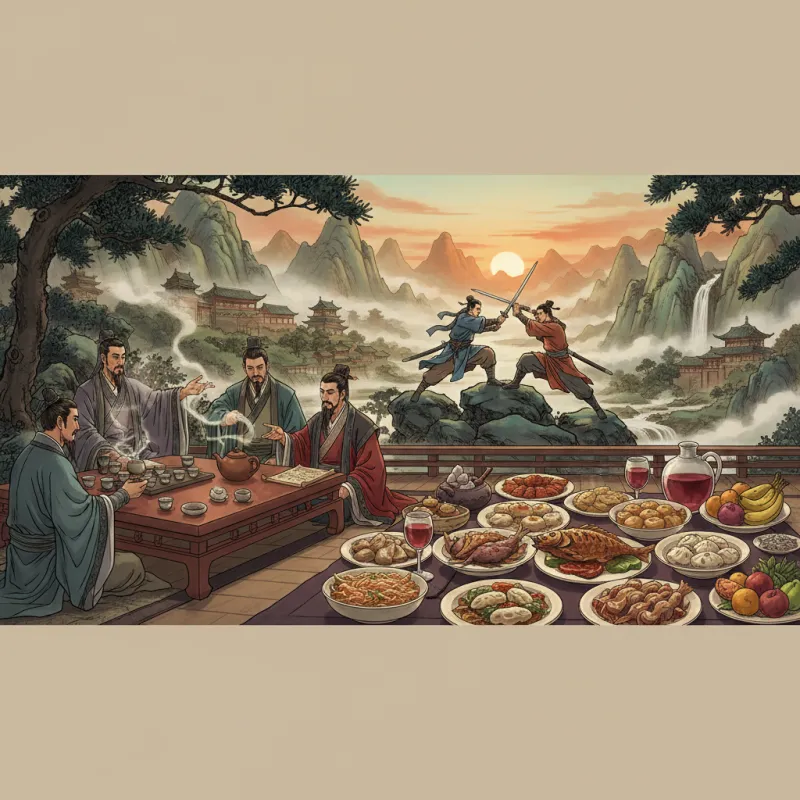
The wine jar shatters against the tavern wall, and before the last drops hit the floor, three men are dead. In Demi-Gods and Semi-Devils (《天龙八部》, Tiānlóng Bābù), Qiao Feng doesn't just fight in taverns — he lives in them, drinks in them, makes his most fateful decisions over bowls of beef and jugs of wine. This isn't background decoration. In wuxia fiction, what a hero eats, how they drink, and where they dine reveals their martial philosophy, social status, and moral character as clearly as any sword technique.
The Tavern as Jianghu Microcosm
Every wuxia reader knows the pattern: hero enters town, heads straight to the tavern, orders wine and dishes, and within minutes learns about local conflicts, hears rumors of martial arts manuals, or gets drawn into a fight. The 酒楼 (jiǔlóu, wine house) or 客栈 (kèzhàn, inn) functions as the information hub of the jianghu. It's neutral ground where beggars sit beside nobles, where Shaolin monks might share a table with demon cult members, where the social hierarchies of the martial world become visible through who orders what.
Jin Yong understood this perfectly. In The Legend of the Condor Heroes (《射雕英雄传》, Shèdiāo Yīngxióng Zhuàn), Guo Jing's naivety shows not just in his martial arts but in his complete lack of sophistication about food — he's happy with simple fare and doesn't understand why anyone would care about cuisine. Meanwhile, Huang Rong, raised on Peach Blossom Island with her eccentric genius father, uses her culinary knowledge as a weapon. She wins over Hong Qigong, the leader of the Beggar's Sect, not through martial prowess but by cooking him dishes he's never tasted. The "Twenty-Four Bridge on a Moonlit Night" (二十四桥明月夜) — tofu stuffed with minced ham — becomes as important to the plot as any kung fu manual.
This isn't just Jin Yong being whimsical. The tavern scene is ancient wuxia DNA, traceable back to Water Margin (《水浒传》, Shuǐhǔ Zhuàn) from the 14th century, where nearly every major plot development happens in or around an inn. Wu Song encounters the tiger after getting drunk at an inn. Song Jiang meets key allies over wine. The tavern is where the jianghu becomes legible, where wandering heroes decode the local power structure through overheard conversations and the quality of the wine.
Wine Culture and Martial Philosophy
The relationship between alcohol and martial arts in wuxia is complex and contradictory — which makes it perfect for exploring character depth. On one hand, excessive drinking represents a loss of control, a weakness that can be exploited. On the other hand, some of the genre's most formidable fighters are legendary drinkers, and certain martial arts styles explicitly incorporate drunkenness.
The 醉拳 (zuìquán, Drunken Fist) style embodies this paradox. Practitioners like the Drunken Immortal in various wuxia novels fight better when intoxicated, their unpredictable movements making them impossible to counter. But this isn't just about physical technique — it's philosophical. The drunken master has achieved a state where conscious control gives way to intuitive response, where the rigid forms of orthodox martial arts dissolve into fluid improvisation. It's Daoist philosophy made kinetic: the usefulness of uselessness, strength through apparent weakness.
Then there's the social dimension. In Gu Long's novels, particularly the Chu Liuxiang (《楚留香》) series, wine drinking becomes a test of character and a form of communication. Heroes bond over wine, seal alliances with toasts, and judge each other's worth by how they handle their liquor. The ability to drink heavily without losing composure signals internal strength — not just physical constitution but mental discipline. When Chu Liuxiang shares wine with an enemy, it's a temporary truce, a moment of mutual respect before they return to trying to kill each other.
The type of wine matters too. Cheap 烧酒 (shāojiǔ, burning liquor) marks you as common folk or a rough wanderer. Fine 花雕酒 (huādiāo jiǔ, carved flower wine) suggests refinement and wealth. 女儿红 (nǚ'ér hóng, daughter's red), buried when a daughter is born and opened at her wedding, carries emotional weight. In The Smiling, Proud Wanderer (《笑傲江湖》, Xiào'ào Jiānghú), Linghu Chong's friendship with the wine-loving monks and his own prodigious drinking capacity mark him as someone who refuses to be bound by orthodox sect rules — his relationship with alcohol mirrors his relationship with martial arts orthodoxy.
Food as Character Development
What characters eat reveals who they are. This is basic storytelling, but wuxia takes it to extremes that would seem absurd in other genres — and somehow makes it work.
Beggars in wuxia don't just eat scraps; they have their own sophisticated food culture. The Beggar's Sect (丐帮, Gàibāng) in Jin Yong's novels has an entire hierarchy visible through food. The number of bags a beggar carries indicates their rank, but so does their knowledge of "beggar's chicken" (叫化鸡, jiàohuā jī) — chicken wrapped in lotus leaves and clay, then baked in embers. This peasant dish becomes a symbol of the sect's philosophy: taking the lowest ingredients and transforming them through skill and knowledge into something remarkable.
Contrast this with the refined cuisine of noble sects. When characters visit the Huashan Sect or Wudang, meals are formal affairs with proper etiquette. The food itself might be vegetarian (Buddhist influence) or carefully balanced according to medicinal principles. These meals reinforce hierarchy and orthodoxy — everyone knows their place, and the meal proceeds according to established rules.
Then there are the outsiders who reject both extremes. Huang Yaoshi in The Legend of the Condor Heroes lives on an island and eats whatever he wants, combining ingredients in ways that would horrify orthodox chefs. His culinary independence mirrors his martial arts philosophy — he's created his own style, answerable to no tradition. His daughter Huang Rong inherits this creativity, but she also understands that food can be diplomatic, a way to navigate the jianghu's social complexities.
The most interesting food moments happen when characters cross social boundaries. When a noble hero shares a simple meal with peasants or beggars, it signals their virtue and lack of pretension. When a rough wanderer demonstrates unexpected knowledge of fine cuisine, it hints at a mysterious past. Food becomes a language for discussing class, education, and values without stating them directly.
The Poison in the Cup
No discussion of wuxia food culture is complete without addressing poison. In a world where anyone might be an enemy and trust is a luxury, every meal is potentially lethal. The fear of poisoning runs through wuxia fiction like a dark thread, turning the communal act of eating into a test of courage and trust.
Skilled poisoners are among the most feared figures in the jianghu. The Tang Sect (唐门, Tángmén) of Sichuan specializes in hidden weapons and poisons, their reputation built on the knowledge that they can kill you through your food, your drink, or even the air you breathe. In Gu Long's novels, poison masters are often more dangerous than the greatest swordsmen because they can kill without ever drawing a weapon.
This creates a fascinating dynamic around shared meals. When enemies sit down to eat together, the question isn't just whether they'll fight — it's whether the food itself is a weapon. Characters develop elaborate methods for testing food: forcing the host to eat first, using silver chopsticks (believed to detect certain poisons), or simply having such advanced internal energy that they can neutralize toxins. The ability to eat fearlessly in dangerous company becomes its own form of martial prowess.
But poison also serves a narrative function beyond creating tension. It's the weapon of the weak, the clever, and the patient — a counterpoint to the direct confrontation of sword fighting. When a character chooses poison over open combat, it tells you something about their personality and their relationship to martial honor. Some sects consider poison dishonorable; others see it as simply another tool. These disagreements about poisoning often reflect deeper philosophical divisions within the jianghu.
Regional Cuisines and Martial Identity
Wuxia fiction maps China's regional cuisines onto its martial geography, creating a world where your fighting style and your food preferences are intertwined. This isn't historically accurate — it's better than accurate. It's mythologically true.
Sichuan cuisine, known for its numbing spice from 花椒 (huājiāo, Sichuan pepper) and its bold flavors, aligns with Sichuan's reputation for producing fierce, unconventional martial artists. The Tang Sect's poison expertise mirrors the region's complex, layered flavors — what seems simple on the surface conceals hidden depths. Characters from Sichuan in wuxia novels often have fiery temperaments to match their food.
Northern cuisine — wheat-based, hearty, straightforward — corresponds to the northern martial arts schools' emphasis on powerful, direct techniques. When characters eat 馒头 (mántou, steamed buns) and 羊肉 (yángròu, mutton), they're usually from northern sects like Shaolin or Wudang, and their martial arts reflect that same solid, substantial quality.
Southern cuisine's emphasis on freshness, seafood, and subtle flavors maps onto southern martial arts' reputation for speed, flexibility, and technical refinement. The southern schools in wuxia often emphasize internal energy and precise technique over raw power — much like southern cooking emphasizes the quality of ingredients and careful preparation over bold seasoning.
This geographical-culinary-martial mapping does real work in the stories. When a character's food preferences don't match their supposed origin, it's a clue to their true identity or hidden past. When someone demonstrates knowledge of a region's cuisine, it suggests they've spent time there — and probably learned some of that region's martial arts. The food becomes a form of characterization that operates below the level of explicit statement.
The Meal as Ritual and Respite
Perhaps the deepest function of food in wuxia is its role in creating moments of humanity within the violence. The jianghu is a dangerous place where death comes suddenly and trust is rare. Shared meals become islands of temporary peace, moments when even enemies can acknowledge their common humanity.
This is why so many crucial conversations happen over food. When characters need to negotiate, form alliances, or simply understand each other, they do it while eating. The meal creates a ritual space where normal jianghu rules are temporarily suspended. You don't attack someone while sharing their food — it's not just dishonorable, it's a violation of something more fundamental than martial ethics.
These meal scenes also provide pacing. After an intense fight sequence, the story needs to breathe. The heroes sit down, order food, discuss what just happened, and plan their next move. The reader gets a break from the action, but the story doesn't stop — it shifts into a different register. Character development happens over meals. Relationships deepen. The world-building that would feel like exposition in other contexts becomes natural conversation between people sharing food.
And sometimes, the meal is just a meal — a reminder that these heroes, for all their superhuman abilities, still need to eat, still enjoy good food, still find comfort in familiar flavors. It grounds the fantasy in physical reality. When Guo Jing eats his simple fare or Linghu Chong gets drunk with his friends, they become more than martial arts machines. They become people living in a world that, for all its impossibilities, feels real because people in it still need to eat dinner.
The culinary culture of wuxia isn't decoration or comic relief. It's structural. Remove the meals, and you remove the humanity. Remove the taverns, and you remove the social fabric that makes the jianghu more than just a series of fight scenes. The food is what makes the world taste real.
Related Reading
- The Enigma of Jianghu: Discovering the Roots of Chinese Wuxia Literature
- Wulin Alliance: Politics of the Martial World
- The Jianghu Code: Honor Among Martial Artists
- Poison and Medicine in Wuxia: Two Sides of the Same Coin
- The Code of Jianghu: Unwritten Rules of the Martial World
- Lingzhi: The Mushroom of Immortality from Myth to Medicine
- Chinese Mythology in Hollywood: From Mulan to Shang-Chi
- Wudang vs Shaolin: Two Philosophies of Combat
Explore Chinese Culture
- Explore Jin Yong's martial arts novels
- Explore cultivation fiction and immortal heroes
- Explore the real history behind wuxia