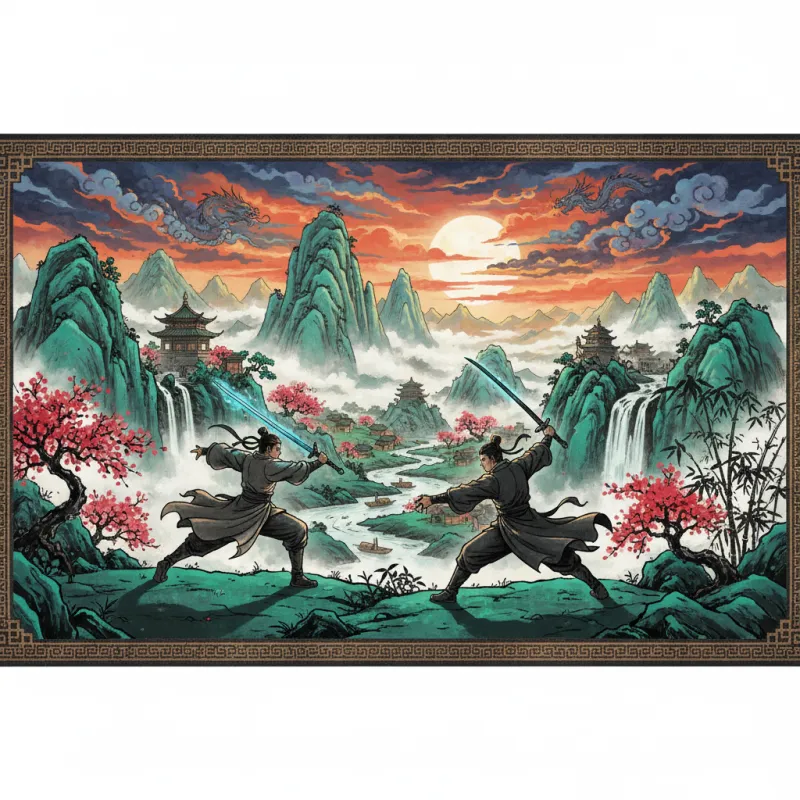
The old beggar's palm strike splits the tavern table in two. Wine spills, dice scatter, and every eye in the room locks onto his tattered robes. "You dare call yourself jianghu?" he rasps at the silk-clad merchant. This scene—repeated in countless wuxia novels—captures something essential about the martial world: status isn't worn, it's earned through deeds, skill, and adherence to a code outsiders will never fully grasp.
What Jianghu Actually Means (And Why Translation Fails)
Jianghu (江湖, jiānghú) literally translates as "rivers and lakes," but that geographical reading misses the entire point. It's the shadow society existing parallel to imperial China's official structures—a world where martial artists, wanderers, outlaws, and heroes operate by their own rules. Think of it as the Wild West meets underground fight clubs meets a honor-bound secret society, all rolled into one.
The term first appeared in Zhuangzi during the Warring States period (475-221 BCE), describing fish that "forget each other in the rivers and lakes" after rains dry up. By the Tang Dynasty (618-907 CE), jianghu had evolved to mean the realm of wandering swordsmen and martial artists who'd left conventional society behind. Jin Yong's The Legend of the Condor Heroes (1957) cemented the modern conception: jianghu as a complete alternate universe with its own geography, politics, and moral framework.
When translators render jianghu as "martial world" or "pugilistic world," they're technically correct but spiritually wrong. Jianghu isn't just where martial artists hang out—it's a state of being, a rejection of Confucian social hierarchy in favor of personal loyalty and martial merit. You can't visit jianghu like a tourist destination; you enter it by choice or circumstance, and it changes you fundamentally.
The Unwritten Laws That Govern the Martial World
Every jianghu operates on codes that make perfect sense to insiders and baffle everyone else. The concept of wulin (武林, wǔlín, "martial forest") represents the community of martial artists bound by these shared understandings. Break these rules, and you'll find yourself hunted by righteous sects and unorthodox cults alike.
First: debts must be repaid. When Guo Jing's father saves Yang Tiexin in Condor Heroes, it creates obligations that span generations and drive the entire plot. This isn't mere gratitude—it's cosmic accounting. Save someone's life, and they owe you theirs. Receive instruction, and you're bound to your master forever. Gu Long's The Sentimental Swordsman revolves entirely around Li Xunhuan repaying a debt by giving up the woman he loves.
Second: face (面子, miànzi) matters more than life itself. When Qiao Feng in Demi-Gods and Semi-Devils discovers his Khitan heritage, the entire martial world turns against him—not because he's done anything wrong, but because the righteous sects can't admit they've been following a "barbarian." He could lie, but that would violate the code. So he walks away from everything, choosing integrity over belonging.
Third: revenge isn't just permitted—it's mandatory. The twenty-year vengeance quest in The Heaven Sword and Dragon Saber isn't excessive; it's proper filial piety. Letting your master's murder go unavenged marks you as worthless. This creates the delicious moral tangles wuxia thrives on: what happens when the person you must kill is also someone you love?
Sects, Cults, and the Politics of Martial Power
The jianghu isn't anarchic—it's organized into competing power structures that make Game of Thrones look straightforward. Orthodox sects (正派, zhèngpài) like Shaolin, Wudang, and the Beggars' Sect claim moral authority and usually align with Confucian values. Unorthodox cults (邪教, xiéjiào) like the Ming Cult or the Sun Moon Holy Cult reject conventional morality and often practice forbidden techniques.
But here's where it gets interesting: Jin Yong deliberately blurs these lines. The "righteous" Huashan Sect in The Smiling, Proud Wanderer is riddled with hypocrisy and power-hungry schemers. Meanwhile, the supposedly evil Ming Cult in Heaven Sword and Dragon Saber protects common people and fights Mongol oppression. The real division isn't good versus evil—it's establishment versus outsider, conformity versus independence.
Sect hierarchy mirrors Confucian family structure but with violence. The shifu (师父, shīfu, master) holds absolute authority. Senior disciples (师兄, shīxiōng) outrank junior ones regardless of skill. Betraying your sect is worse than murder—it's spiritual patricide. When Linghu Chong in Smiling, Proud Wanderer learns techniques from outside Huashan, his master treats it as unforgivable betrayal, even though it saves lives.
The jianghu's greatest conflicts rarely pit good against evil. They're civil wars within the martial world itself: Shaolin versus Wudang over philosophical differences, the Huashan Sect's internal split between Sword and Qi techniques, the generational feuds that consume families for decades. These aren't bug—they're features, reflecting Chinese history's endless cycles of unity and fragmentation.
The Language of Jianghu: Slang, Codes, and Secret Signals
Real jianghu denizens speak their own dialect, incomprehensible to outsiders. This linguistic barrier reinforces the boundary between martial world and mundane society. When characters in wuxia novels use jianghu slang, they're not being colorful—they're identifying themselves as insiders.
"Zou jianghu" (走江湖, zǒu jiānghú, "walking the jianghu") means living as a wandering martial artist, but implies a whole lifestyle: no fixed home, survival by skill, loyalty to personal bonds over social institutions. "Liang xiangzi" (亮相子, liàng xiàngzi, "showing your stuff") means revealing your martial abilities, often as a challenge or warning. The Beggars' Sect has an entire vocabulary of hand signals and beggar's cant that lets members communicate in plain sight.
Gu Long particularly excelled at jianghu dialogue. His characters speak in clipped, cynical phrases that sound nothing like classical Chinese or modern Mandarin. "In jianghu, the only thing you can trust is your sword" isn't flowery wisdom—it's bitter experience compressed into a survival rule. His Little Li Flying Dagger never misses, but Li Xunhuan's real weapon is understanding jianghu psychology: knowing when someone's bluffing, when honor demands a fight, when walking away is the stronger move.
The most powerful jianghu phrase might be "yi yan jiu ding" (一言九鼎, yī yán jiǔ dǐng): "one word, nine tripods," meaning a promise that cannot be broken. In a world without contracts or courts, your word is your only currency. Break it once, and you're finished—not because someone will punish you, but because no one will ever trust you again.
Why Jianghu Still Matters (Even If You've Never Read Wuxia)
The jianghu concept has escaped its literary origins to become a lens for understanding Chinese culture. Modern Chinese speakers use jianghu metaphors constantly: business is "shang chang ru jiang hu" (商场如江湖, "the marketplace is like jianghu"), politics operates on jianghu rules of loyalty and face, even academic departments have their sect-like hierarchies and feuds.
This persistence reveals something the novels understood: official structures never tell the whole story. Beneath every society runs a shadow network of personal relationships, unwritten rules, and alternative value systems. The jianghu isn't fantasy—it's the acknowledgment that human communities always create these parallel worlds.
For readers outside Chinese culture, jianghu offers a framework for understanding honor-based societies generally. The codes governing samurai, knights, or Mafia families share DNA with jianghu ethics: personal loyalty over institutional authority, reputation as survival currency, violence as legitimate dispute resolution within the community. The specifics differ, but the underlying logic—how do you create order without relying on state power?—remains universal.
Reading Jianghu: Where to Start Your Journey
Jin Yong remains the essential entry point. The Legend of the Condor Heroes establishes the classic jianghu: clear moral lines, spectacular battles, heroes who embody virtue. But don't stop there. Demi-Gods and Semi-Devils deconstructs everything the earlier novel built, showing how jianghu righteousness creates its own tragedies. The Smiling, Proud Wanderer goes further, suggesting the entire orthodox/unorthodox distinction is a power game.
Gu Long offers a darker, more psychological jianghu. His martial world is noir: everyone's damaged, trust is foolish, and the greatest swordsmen are usually the loneliest. The Sentimental Swordsman, Ruthless Sword and Chu Liuxiang series trade Jin Yong's epic scope for intimate character studies. The fights are faster, the dialogue sharper, the moral ambiguity thicker.
For the truly adventurous, seek out earlier works like The Seven Heroes and Five Gallants (1879) or The Travels of Lao Can (1907). These show jianghu before it became codified, when the concept was still fluid and strange. The martial arts are less systematic, the heroes more rough-edged, the jianghu itself more dangerous and unpredictable—closer, perhaps, to what wandering swordsmen actually experienced in imperial China.
The jianghu isn't a place you visit. It's a world you enter, and if the novels do their job, you never completely leave. That beggar in the tavern, splitting tables with his palm—he's still there, waiting to test whether you understand what jianghu really means.
Related Reading
- Wuxia Slang You Need to Know: A Guide to Jianghu Terminology
- The Jianghu Code: Unwritten Rules That Govern the Martial World
- Jianghu Slang: The Secret Language of the Martial World
- Sworn Brotherhood in Wuxia: The Sacred Ritual of Jiéyì
- Jianghu Terminology Glossary: Essential Martial World Vocabulary
- Shanhai Jing in Modern Art: Contemporary Illustrations of Ancient Beasts
- Martial Arts Systems in Wuxia: Internal vs External, Orthodox vs Unorthodox
- The Art of War: Exploring Weapons in Chinese Martial Arts (Wuxia) Fiction
Explore Chinese Culture
- Explore Jin Yong's martial arts novels
- Explore cultivation fiction and immortal heroes
- Explore the real history behind wuxia