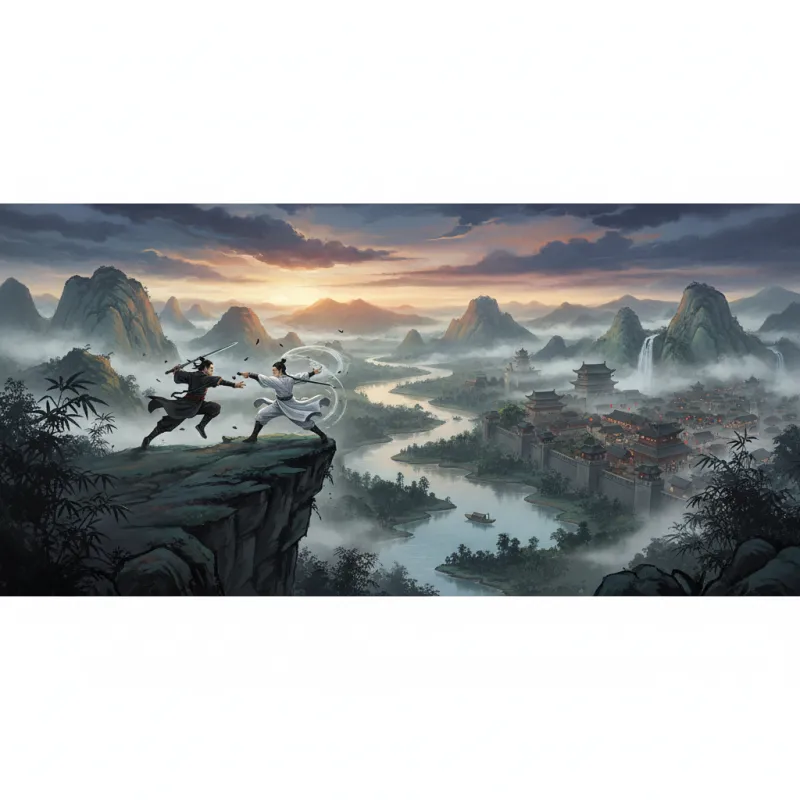
A swordsman stands at the edge of a moonlit bridge, his blade still dripping with the blood of twelve assassins. He doesn't know their names, their masters, or why they wanted him dead—but in the jianghu (江湖, literally "rivers and lakes"), the lawless martial world of Chinese fiction, such questions often matter less than the code you live by. This is the essence of wuxia (武侠, "martial heroes"), a genre that has captivated Chinese readers for over a millennium and continues to shape how millions understand honor, loyalty, and the price of righteousness.
The Jianghu: A World Beyond Imperial Law
The jianghu isn't just a setting—it's a parallel society that exists in the shadows of legitimate authority. While emperors ruled from their palaces and magistrates enforced Confucian order, the jianghu operated according to its own brutal logic. Here, martial artists, bandits, merchants, beggars, and assassins formed their own hierarchies through martial arts sects and clans, each with distinct philosophies and fighting styles.
The term itself dates back to the Zhuangzi (庄子), a Daoist text from the 4th century BCE, where it described the freedom of fish swimming in rivers and lakes—a metaphor for those who rejected conventional society. By the Tang Dynasty (618-907 CE), "jianghu" had evolved to describe the wandering communities of performers, fortune-tellers, and yes, martial artists who lived outside Confucian social structures.
What makes the jianghu fascinating is its moral ambiguity. Unlike Western fantasy's clear good-versus-evil dichotomies, the jianghu recognizes that righteousness (义, yì) often conflicts with law, that loyalty to one's master might demand betraying one's conscience, and that the greatest heroes frequently carry the deepest scars—both physical and moral.
The Evolution of Wuxia Literature
Wuxia's literary roots stretch back to the Tang Dynasty's chuanqi (传奇, "tales of the strange"), short stories featuring knight-errants with supernatural abilities. But the genre truly crystallized during the Song Dynasty (960-1279 CE) with the emergence of huaben (话本), vernacular storytelling scripts that professional storytellers used in teahouses. These tales featured early versions of characters who would become archetypes: the righteous outlaw, the vengeful swordsman, the hermit master.
The Ming Dynasty (1368-1644 CE) gave us Water Margin (水浒传, Shuǐhǔ Zhuàn), one of China's Four Great Classical Novels. While not purely wuxia, it established many conventions: the band of outlaws with distinct personalities and fighting styles, the corrupt officials they oppose, and the tragic tension between personal loyalty and social justice. Its 108 heroes of Liangshan Marsh became templates that wuxia authors would remix for centuries.
The modern wuxia novel emerged in the 1920s-1930s Shanghai publishing world, where authors like Xiang Kairan (pen name: Pingjiang Buxiaosheng) serialized martial arts adventures in newspapers. But the genre's golden age arrived in the 1950s-1970s Hong Kong, when Jin Yong (金庸, Louis Cha) and Gu Long (古龙) revolutionized wuxia with psychological depth, complex plotting, and philosophical sophistication that elevated pulp fiction into literature.
Jin Yong's Jianghu: History Meets Mythology
Jin Yong didn't just write wuxia—he created a shared universe that became part of Chinese cultural DNA. His fifteen novels, written between 1955 and 1972, are set across different historical periods, from the Tang Dynasty to the Qing, each meticulously researched yet freely embellished with martial arts fantasy.
Take The Legend of the Condor Heroes (射雕英雄传, Shèdiāo Yīngxióng Zhuàn, 1957-1959), set during the Mongol conquest of China. Jin Yong weaves real historical figures like Genghis Khan and the Song Dynasty's resistance into a tale of Guo Jing, a simple-minded but righteous hero who masters the Eighteen Dragon-Subduing Palms (降龙十八掌, Jiàng Lóng Shíbā Zhǎng). The novel asks: what does patriotism mean when your nation is falling? Can personal honor survive political collapse?
Jin Yong's genius lies in his martial arts sects, each representing different philosophical traditions. The Shaolin Temple embodies Buddhist compassion and discipline. The Wudang Sect channels Daoist principles of yielding and internal energy. The Beggars' Gang (丐帮, Gàibāng) represents grassroots solidarity. These aren't just fighting schools—they're competing visions of how to live righteously in a chaotic world.
His characters grapple with impossible choices. In Demi-Gods and Semi-Devils (天龙八部, Tiānlóng Bābù, 1963), the hero Xiao Feng discovers he's ethnically Khitan, not Han Chinese, forcing him to choose between his blood heritage and his cultural identity during a time of ethnic warfare. Jin Yong refuses easy answers, showing how even the most righteous heroes can become trapped by circumstances beyond their control.
Gu Long's Noir Jianghu
If Jin Yong's jianghu is epic and historical, Gu Long's is intimate and existential. Writing in the 1960s-1980s, Gu Long stripped away the historical pageantry to focus on lonely antiheroes navigating a morally bankrupt world. His prose is terse, almost cinematic, with short chapters that read like film scenes.
The Sentimental Swordsman, Ruthless Sword (多情剑客无情剑, Duōqíng Jiànkè Wúqíng Jiàn, 1969-1970) features Li Xunhuan, a master of the flying dagger who gave up his family inheritance and the woman he loved to his sworn brother. Now he wanders the jianghu, drinking heavily, his only companion his unerring blade. Gu Long's heroes don't seek glory—they seek meaning in a meaningless world.
Gu Long pioneered the "mystery wuxia" subgenre, where martial arts action combines with detective plotting. His Lu Xiaofeng series features a witty, womanizing hero who solves impossible crimes in the jianghu underworld. These novels acknowledge what Jin Yong sometimes glossed over: the jianghu is corrupt, its heroes are flawed, and righteousness often means choosing the least terrible option.
The Martial Arts: Philosophy in Motion
Western readers often misunderstand wuxia martial arts as mere action sequences. In reality, they're physical manifestations of philosophical principles. The distinction between external (外家, wàijiā) and internal (内家, nèijiā) martial arts reflects the Buddhist-Daoist divide in Chinese thought.
External styles like Shaolin kung fu emphasize physical conditioning, powerful strikes, and visible technique. They represent the Buddhist path of disciplined practice and gradual enlightenment. Internal styles like Taiji and Wudang swordsmanship focus on qi (气, vital energy) cultivation, using an opponent's force against them. They embody Daoist principles of wu wei (无为, effortless action) and yielding to overcome.
The most powerful martial artists in wuxia achieve a state beyond technique. In Jin Yong's The Smiling, Proud Wanderer (笑傲江湖, Xiào'ào Jiānghú, 1967), the protagonist Linghu Chong masters the Dugu Nine Swords (独孤九剑, Dúgū Jiǔ Jiàn), a style with no fixed forms—only principles for exploiting any opponent's weaknesses. This represents the Daoist ideal of formlessness, adapting perfectly to circumstances.
Wuxia novels also explore the dark side of martial arts obsession. Characters who pursue ultimate power often lose their humanity, becoming demons in human form. The quest for the ultimate martial arts manual—a recurring plot device—becomes a metaphor for how ambition corrupts.
Women Warriors and Gender in the Jianghu
The jianghu offers Chinese women a rare space for agency and power in a traditionally patriarchal culture. Female martial artists in wuxia novels wield swords, lead sects, and make their own romantic choices—freedoms denied to women in Confucian society.
Jin Yong's Huang Rong, from The Legend of the Condor Heroes, is brilliant, manipulative, and utterly devoted to the simple-minded Guo Jing—but on her own terms. She's the brains of their partnership, solving problems through wit while he provides the muscle. Ren Yingying in The Smiling, Proud Wanderer leads the Sun Moon Holy Cult (日月神教, Rìyuè Shénjiào), commanding thousands of martial artists.
Yet wuxia's gender politics remain complicated. Female characters often derive power through relationships with men, and their martial prowess is frequently linked to their sexuality or beauty. Gu Long's women tend to be more independent but also more tragic, suggesting that female autonomy in the jianghu comes at a terrible price.
The most interesting female characters occupy liminal spaces. The nun martial artists of the Emei Sect (峨眉派, Éméi Pài) have rejected conventional femininity but remain bound by Buddhist vows. Courtesans who master martial arts to protect themselves navigate between respectability and survival. These characters reveal the genre's ongoing negotiation with changing gender norms.
The Code of Xia: Righteousness and Its Discontents
At the heart of wuxia lies the concept of xia (侠)—often translated as "chivalry" but more accurately meaning "righteousness through martial prowess." A true xia uses their skills to help the weak, punish the wicked, and uphold justice when official channels fail. The phrase "行侠仗义" (xíng xiá zhàng yì, "to perform righteous deeds through martial valor") captures this ideal.
But wuxia novels constantly interrogate this code. What happens when two xia have conflicting definitions of righteousness? When loyalty to one's master conflicts with justice? When the "wicked" you're supposed to punish are simply people on the wrong side of a political struggle?
Jin Yong's The Book and the Sword (书剑恩仇录, Shū Jiàn Ēnchóu Lù, 1955) explores this through Chen Jialuo, who leads the Red Flower Society in rebellion against the Qing Dynasty—only to discover the Qianlong Emperor is his sworn brother. Personal loyalty and political righteousness become irreconcilable.
The jianghu's moral code also includes concepts like enmity (仇, chóu) and gratitude (恩, ēn), which must be repaid regardless of personal cost. This creates tragic situations where characters must kill people they love or die for people they hate, simply because the code demands it. Modern readers might see this as irrational, but wuxia novels argue that a world without such codes descends into pure might-makes-right chaos.
Wuxia's Enduring Legacy
Chinese martial arts fiction has evolved far beyond its literary origins. It spawned Hong Kong cinema's golden age, from King Hu's A Touch of Zen (1971) to Tsui Hark's Zu Warriors from the Magic Mountain (1983) to Ang Lee's Crouching Tiger, Hidden Dragon (2000). Video games like Sword and Fairy and Gujian translate wuxia's moral complexity into interactive narratives. Web novels have created "xuanhuan" (玄幻, mystical fantasy) and "xianxia" (仙侠, immortal heroes) subgenres that blend wuxia with cultivation fantasy.
Yet something essential remains constant: the jianghu as a space where individuals can forge their own identities through action, where moral choices matter more than social status, and where the sword in your hand represents not just violence but the possibility of justice in an unjust world. In an era of increasing authoritarianism and social control in China, the jianghu's promise of freedom—however illusory—continues to resonate.
For readers outside China, wuxia offers a window into how Chinese culture thinks about heroism, community, and the relationship between individual conscience and social obligation. These aren't just adventure stories—they're philosophical novels disguised as pulp fiction, asking the same questions that have preoccupied Chinese thinkers for millennia: How should we live? What do we owe each other? When is violence justified? The answers, like the jianghu itself, remain beautifully, frustratingly complex.
Related Reading
- Shaolin Temple: The Birthplace of Chinese Martial Arts
- The Beggar Sect: The Largest and Most Unlikely Martial Arts Organization
- Shaolin Temple: The Sacred Mountain of Martial Arts
- The Beggars Sect: How a Gang of Homeless People Became the Largest Organization in the Martial World
- Wudang Mountain: The Daoist Heart of Internal Martial Arts
- Exploring the Cultural Depth of Wuxia: The Art of Chinese Martial Arts Fiction
- Wuxia in Modern Culture: From Novels to Netflix
- Exploring the Evolution of Wuxia: Modern Influences on Chinese Martial Arts Fiction
Explore Chinese Culture
- Explore Jin Yong's martial arts novels
- Explore cultivation fiction and immortal heroes
- Explore the real history behind wuxia