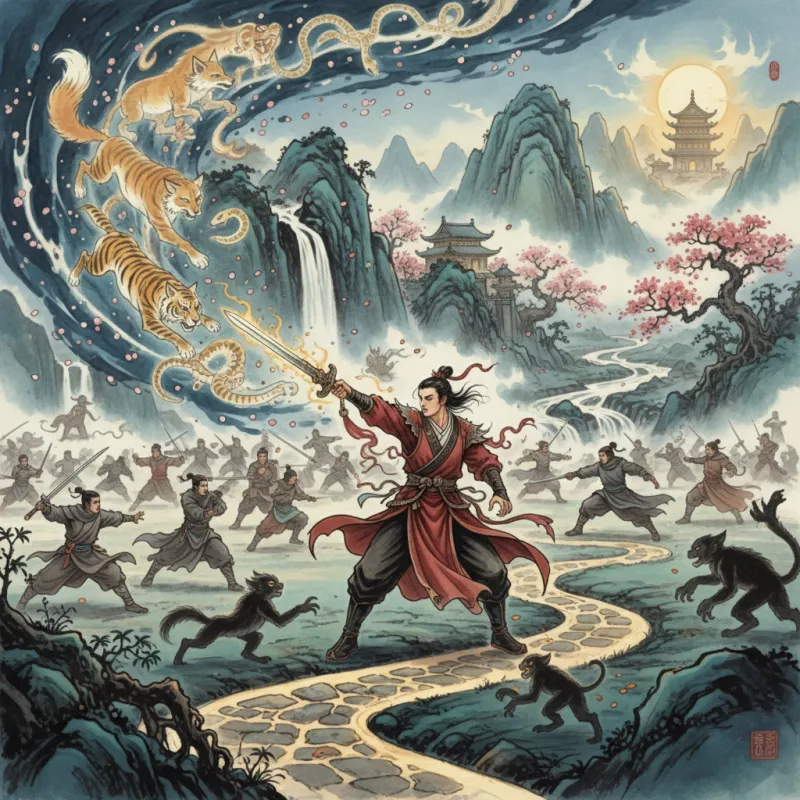
A white snake coils around a Buddhist monk's staff in the rain-soaked mountains of Hangzhou, and the monk hesitates. Is this an ordinary serpent seeking shelter, or is it Bai Suzhen — a creature that has cultivated spiritual power for over a thousand years, now capable of assuming human form, wielding magic, and experiencing love? In Chinese mythology, this question matters because the answer determines whether you're dealing with a simple animal or a being that might outlive dynasties. The path from beast to yaoguai (妖怪 yāoguài) — supernatural entity — isn't a matter of species or divine blessing. It's a matter of time, discipline, and accumulated spiritual energy.
The Cultivation Timeline: From Beast to Immortal
Western mythology gives you vampires and werewolves through curses or bites — instant transformation, no effort required. Chinese mythology makes you work for it. An animal begins its journey as an ordinary creature, but through decades or centuries of absorbing spiritual energy from the moon, sun, or earth, it gradually awakens consciousness beyond its species. The fox that lives to one hundred years develops a single tail of spiritual power. At five hundred years, it can assume human form for brief periods. At a thousand years, it becomes a fox spirit capable of maintaining human disguise indefinitely and wielding significant magical abilities.
This isn't metaphor — classical Chinese texts treat cultivation as a technical process with specific milestones. The Taiping Guangji (太平广记), compiled during the Song Dynasty, catalogs hundreds of cases with the bureaucratic precision of a government census. A turtle that cultivates for three thousand years can speak human language and predict the future. A carp that leaps the Dragon Gate becomes a dragon. A cat that lives in a household for thirteen years might develop the ability to walk upright and speak, though it will likely use this power to cause mischief rather than seek enlightenment.
The Mechanics of Spiritual Accumulation
How does a snake become Bai Suzhen? The process involves neidan (内丹 nèidān) — internal alchemy — the same techniques human Daoist practitioners use to pursue immortality. Animals cultivate by absorbing qi (气 qì) from natural sources: moonlight for foxes and snakes, mountain mists for tigers, the essence of human vitality for more predatory spirits. They practice breath control, meditation, and in some cases, study Buddhist or Daoist scriptures left unattended by careless monks.
The Journey to the West provides the most detailed fictional account of animal cultivation in Chinese literature. Sun Wukong, the Monkey King, begins as a stone monkey born from a magic rock, but his transformation into a being capable of challenging Heaven itself requires formal training. He studies under the Daoist patriarch Subhodi, learning the seventy-two transformations and cloud-somersault technique. Even his natural talent requires structured cultivation — raw spiritual potential means nothing without method and discipline.
Physical transformation follows spiritual advancement. Early-stage animal spirits might manage crude shapeshifting — a fox with a human face but still possessing a tail, or a snake that can only transform its upper body. Advanced practitioners achieve perfect human form, though they often retain one telltale feature: a shadow that shows their true shape, an inability to disguise their reflection, or a tail that appears when they're drunk or distracted. The Liaozhai Zhiyi (聊斋志异) by Pu Songling is filled with stories of scholars who discover their beautiful wives are actually fox spirits only after noticing such details.
The Moral Ambiguity of Yaoguai
Here's where Chinese mythology gets interesting: becoming a yaoguai doesn't automatically make you evil. Western demons are fallen angels, inherently corrupt. Chinese yaoguai are more like people — some virtuous, some wicked, most somewhere in between. The white snake Bai Suzhen cultivates for over a millennium and uses her powers to run a free medical clinic in Hangzhou, healing the poor. The monk Fahai, who opposes her, is technically the righteous Buddhist defender of cosmic order, but he comes across as a rigid bureaucrat destroying a loving marriage.
Fox spirits present the most morally complex cases. In northern Chinese folklore, they're often benevolent household protectors, worshipped as húxiān (狐仙) and given offerings. In southern traditions, they're seductive predators who drain men's life force through sexual encounters. The same creature, interpreted through different regional lenses. Some stories feature fox spirits who fall genuinely in love with human scholars and use their magic to help their husbands pass the imperial examinations. Others describe foxes who possess young women, drive them mad, and must be exorcised by Daoist priests.
The Fengshen Yanyi (封神演义) — Investiture of the Gods — features Daji, a nine-tailed fox spirit who possesses the concubine of the last Shang Dynasty emperor and drives him to tyranny through her seductions. She's portrayed as irredeemably evil, inventing torture devices and encouraging depravity. Yet even Daji is following orders from the goddess Nüwa, making her less an independent villain than an instrument of Heaven's will to end a corrupt dynasty. The moral calculus gets complicated.
Heavenly Tribulations and the Price of Power
Cultivation isn't a smooth upward trajectory. At certain thresholds — typically every five hundred years — Heaven sends tribulations (tianjie 天劫 tiānjiē) to test the cultivator. These take the form of lightning strikes, celestial fire, or demonic attacks. Fail the tribulation, and centuries of cultivation burn away in an instant, reducing the spirit back to an ordinary animal or destroying it entirely. Pass, and the cultivator advances to the next stage of power.
This system appears repeatedly in xianxia (仙侠) novels, the modern fantasy genre descended from classical mythology. In these stories, both human and animal cultivators face the same tribulations, emphasizing that the path to transcendence is universal — species is just a starting point. The nine-tailed fox in Douluo Dalu must survive multiple tribulations to maintain her hundred-thousand-year cultivation, and when she finally transforms into human form, she's one of the most powerful beings in that world.
The tribulation system serves a narrative function: it prevents unlimited power accumulation and creates dramatic tension. But it also reflects a deeper philosophical point. Cultivation is about transcending your original nature, and Heaven tests whether you've truly evolved or merely accumulated power while remaining fundamentally unchanged. A fox that cultivates for a thousand years but still thinks like a fox — driven by instinct and appetite — will fail its tribulation. True advancement requires wisdom, not just energy.
The Buddhist and Daoist Divide
Buddhist and Daoist texts treat animal cultivation differently, and these differences matter for understanding specific stories. Daoist tradition generally accepts that animals can cultivate and achieve immortality through the same methods humans use. The Baopuzi (抱朴子), a fourth-century Daoist text, explicitly discusses animals that achieve transcendence, treating it as a natural process within the cosmic order.
Buddhism is more skeptical. Classical Buddhist doctrine holds that being born as an animal is the result of negative karma from past lives, and animals lack the cognitive capacity for enlightenment. They must first be reborn as humans before they can pursue the Buddhist path. However, Chinese Buddhism absorbed local traditions and became more flexible. Stories like Journey to the West feature animal spirits who study Buddhist scriptures and achieve varying degrees of spiritual advancement, even if full Buddhahood remains beyond their reach.
This theological tension creates narrative conflict. In the Legend of the White Snake, the monk Fahai represents orthodox Buddhism's rejection of animal cultivation — Bai Suzhen, no matter how virtuous or how long she's cultivated, remains fundamentally a demon in his eyes and must be suppressed. The story's emotional power comes from the audience siding with the "demon" against the "righteous" monk, suggesting that rigid adherence to doctrine can be more monstrous than the monsters themselves.
Modern Interpretations and Cultural Evolution
Contemporary Chinese fantasy has taken the classical cultivation framework and expanded it into elaborate power systems. Novels like Coiling Dragon and I Shall Seal the Heavens feature detailed cultivation hierarchies with dozens of stages, each with specific requirements and abilities. Animal shapeshifters in these stories often start with advantages — a divine bloodline, natural affinity for certain elements — but face the same fundamental challenge as human cultivators: transcending their limits through discipline and insight.
The yaoguai concept has also influenced how Chinese audiences interpret supernatural creatures in Western media. When Chinese fans discuss werewolves or vampires, they often frame them through cultivation logic: How long has this vampire existed? What stage of power has it reached? Can it continue advancing, or is it stuck at its current level? This cross-cultural lens reveals how deeply the cultivation framework is embedded in Chinese supernatural thinking.
Video games like Black Myth: Wukong bring classical yaoguai into interactive media, where players experience the cultivation journey firsthand. The game's various animal spirits — each with distinct abilities based on their species and cultivation level — demonstrate how the traditional framework adapts to new formats while maintaining its core logic: power is earned through time and effort, and every creature has the potential for transcendence.
The Philosophical Foundation
At its core, animal cultivation reflects a fundamentally different view of the natural world than Western mythology. There's no unbridgeable gap between human and animal, natural and supernatural, mortal and immortal. These are points on a continuum, and movement along that continuum is possible for any being with sufficient determination and time. A human can become an immortal. An animal can become human. A demon can become a Buddha.
This fluidity makes Chinese supernatural fiction feel alive in ways Western fantasy often doesn't. When you encounter a talking animal in a Chinese story, you're not meeting a magical exception to natural law — you're meeting someone on their own cultivation journey, with their own goals, history, and moral complexity. They might help you, harm you, or simply ignore you while pursuing their own path to transcendence. The white snake wants to experience love. The fox spirit wants to pass the imperial examinations. The monkey wants to be recognized as equal to Heaven itself.
The question isn't whether animals can cultivate spiritual power and transform into yaoguai. In Chinese mythology, that's simply how the world works. The question is what they do with that power once they achieve it — and that's where the really interesting stories begin.
Related Reading
- The Enigmatic World of Shapeshifters in Wuxia Fiction: Unveiling Jianghu Adventures
- Wuxia Training Montages: How Heroes Are Made
- The Mountain Gods: Nature Deities in the Daoist Pantheon
- The Enigma of Jianghu: Discovering the Roots of Chinese Wuxia Literature
Explore Chinese Culture
- Explore Jin Yong's martial arts novels
- Explore cultivation fiction and immortal heroes
- Explore the real history behind wuxia