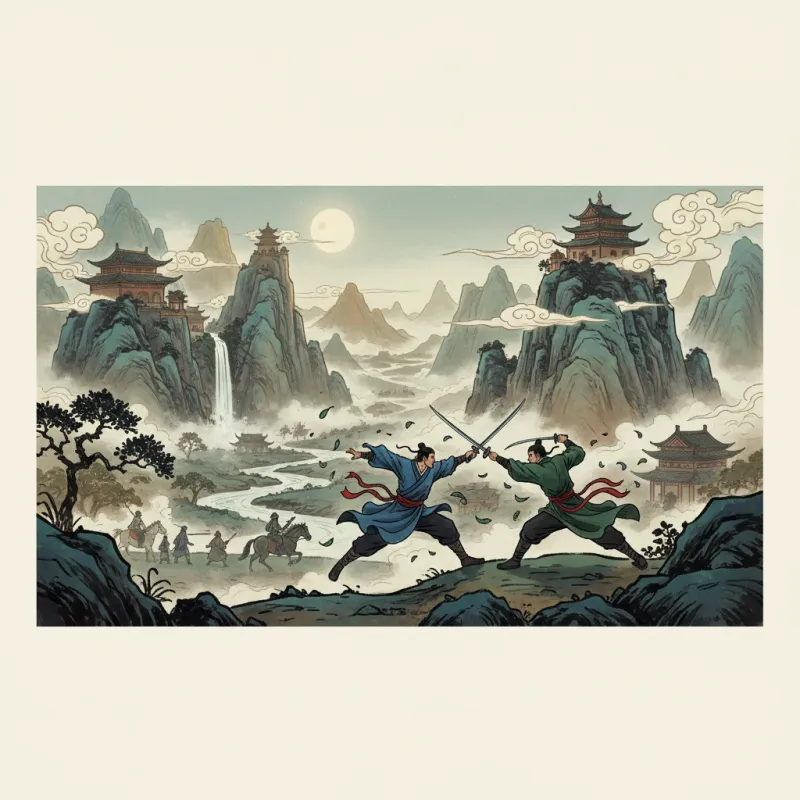
A swordsman leaps from a bamboo grove, his blade singing through mist as he defends a tea house from bandits who've never heard his name. This scene—repeated in countless variations across centuries of Chinese storytelling—captures the essence of wuxia (武侠, wǔxiá), a genre that transforms martial arts into poetry and violence into philosophy. Unlike Western action heroes who fight for nations or causes, wuxia protagonists navigate the jianghu (江湖, jiānghú), that shadowy realm between law and chaos where personal honor matters more than imperial edicts.
The Jianghu: A World Beyond the Emperor's Reach
The jianghu literally means "rivers and lakes," but this translation barely scratches the surface. It's the parallel society where martial artists, wandering heroes, bandits, and sect members operate by their own codes. When Jin Yong (金庸) wrote in The Legend of the Condor Heroes (1957) that "where there are people, there is jianghu," he wasn't being poetic—he was describing a social reality that existed in China for centuries.
This world has its own geography: remote mountain temples where masters train disciples, bustling inns where information flows like wine, and forbidden valleys hiding ancient martial arts manuals. The jianghu operates on reputation rather than law. A hero's word carries more weight than any contract, and a grudge can span generations. It's why characters in wuxia stories obsess over their "face" (面子, miànzi) and why betrayal cuts deeper than any sword wound.
The jianghu emerged from historical reality—the wulin (武林, wǔlín), or martial arts community, really did exist as a semi-autonomous network during the Ming and Qing dynasties. Martial arts schools, bodyguard agencies, and secret societies formed their own hierarchies parallel to imperial bureaucracy. Wuxia fiction took this reality and amplified it into myth.
From Tang Legends to Modern Blockbusters
Wuxia's roots stretch back to Tang dynasty (618-907 CE) tales of knight-errants called youxia (游侠, yóuxiá). These early stories featured warriors who righted wrongs outside official channels—think of Nie Yinniang, the seventh-century assassin whose story inspired Hou Hsiao-hsien's 2015 film The Assassin. But the genre truly crystallized during the Ming dynasty (1368-1644) with novels like Water Margin, which portrayed 108 outlaws as righteous heroes.
The modern wuxia novel emerged in early 20th-century Shanghai, where writers like Xiang Kairan serialized martial arts adventures in newspapers. But the genre's golden age arrived with Jin Yong and Gu Long (古龙) in the 1950s-70s. Jin Yong's fifteen novels—including The Return of the Condor Heroes and Demi-Gods and Semi-Devils—established the template: sprawling narratives spanning decades, intricate martial arts systems, and heroes torn between love and duty. Gu Long brought noir sensibility to wuxia, creating lonely swordsmen like Li Xunhuan who drank too much and loved too deeply.
These novels spawned countless film and television adaptations. Hong Kong cinema transformed wuxia into a visual spectacle—King Hu's A Touch of Zen (1971) and Zhang Che's Shaw Brothers productions made martial arts balletic. Then Tsui Hark's Zu Warriors from the Magic Mountain (1983) added special effects, while Ang Lee's Crouching Tiger, Hidden Dragon (2000) introduced Western audiences to wuxia's emotional depth beneath the flying swordplay.
The Martial Arts That Defy Physics
Wuxia martial arts aren't realistic—they're aspirational. Characters cultivate internal energy called neigong (内功, nèigōng) until they can shatter boulders with palm strikes or walk on water. The most iconic ability is qinggong (轻功, qīnggōng), the "lightness skill" that lets warriors leap onto rooftops and glide between trees. When you watch Zhang Ziyi running across bamboo tops in Crouching Tiger, Hidden Dragon, you're seeing centuries of literary imagination made visual.
These abilities stem from Daoist concepts of qi (气, qì)—life energy that flows through the body's meridians. In wuxia fiction, decades of meditation and training can unlock superhuman powers. The Eighteen Dragon-Subduing Palms, the Six Meridian Divine Sword, the Nine Yin Manual—these aren't just fighting techniques but paths to transcendence. The best wuxia stories use martial arts as character development: a hero's fighting style reflects their personality, and learning new techniques means spiritual growth.
Different sects and schools guard their unique martial arts jealously, leading to endless conflicts over stolen manuals and forbidden techniques. This mirrors real Chinese martial arts culture, where lineages matter and masters carefully select disciples. But wuxia amplifies this into high drama—entire plots revolve around a lost manual that could make someone invincible, like the Sunflower Manual in Jin Yong's The Smiling, Proud Wanderer, which requires self-castration to master.
The Code of Xia: Honor Among Outlaws
What separates a xia (侠, xiá)—a martial hero—from a common thug? The concept of yi (义, yì), often translated as righteousness or loyalty, but really meaning a bone-deep commitment to doing right regardless of personal cost. A true xia keeps promises even when betrayed, protects the weak even when outnumbered, and faces death rather than compromise their principles.
This code creates wuxia's central tensions. In The Return of the Condor Heroes, Yang Guo loves Xiaolongnü, but she was his teacher—their relationship violates Confucian propriety, yet their loyalty to each other embodies yi. In Gu Long's The Legendary Siblings, the protagonist must choose between his adoptive father and his blood brother. These aren't simple good-versus-evil stories; they're explorations of conflicting loyalties and impossible choices.
The xia code also includes gratitude (恩, ēn) and vengeance (仇, chóu) as sacred obligations. If someone saves your life, you owe them a debt that might take years to repay. If someone kills your master, you must seek revenge even if it means your own death. This creates cascading conflicts where today's hero becomes tomorrow's villain depending on perspective. The jianghu remembers everything, and blood debts compound across generations.
Sects, Clans, and the Politics of Power
The jianghu isn't anarchic—it has structure, just not the imperial kind. Martial arts sects like Shaolin Temple, Wudang Mountain, and the Beggars' Sect form the establishment, each with hierarchies, territories, and political agendas. These organizations appear across countless wuxia stories, providing continuity and worldbuilding depth that rivals Tolkien's Middle-earth.
Shaolin represents Buddhist martial arts—external power, rigid discipline, and moral authority. Wudang embodies Daoist principles—internal cultivation, flexibility, and harmony with nature. The rivalry between these two schools drives plots in everything from Jin Yong's Heaven Sword and Dragon Saber to the Once Upon a Time in China films. Meanwhile, the Beggars' Sect—despite its lowly members—often serves as the jianghu's conscience, with information networks spanning all of China.
Then there are the unorthodox sects (魔教, mójiào) practicing forbidden techniques and pursuing power without moral constraints. The Sun Moon Holy Cult in The Smiling, Proud Wanderer or the Ming Cult in Heaven Sword and Dragon Saber blur the line between villain and victim—they're often persecuted by orthodox sects for being different rather than evil. This moral ambiguity makes wuxia more sophisticated than simple adventure stories.
Sect politics mirror Chinese history's factional struggles. Alliance conferences, succession disputes, and ideological purges all have historical parallels. When you read about orthodox sects uniting against a demonic threat, you're seeing echoes of how Chinese dynasties portrayed themselves as civilization defending against barbarian chaos.
Women Warriors Who Refuse to Be Rescued
Wuxia fiction has always featured formidable women warriors, long before Western media discovered "strong female characters." Huang Rong in The Legend of the Condor Heroes is smarter than every man around her, using strategy and wit alongside martial arts. Ren Yingying in The Smiling, Proud Wanderer leads a sect and rescues the male protagonist repeatedly. These aren't token inclusions—they're central to wuxia's appeal.
The genre's treatment of women varies wildly. Jin Yong's heroines often face impossible choices between love and duty, sometimes sacrificing themselves in ways that feel dated. But Gu Long created women like Lin Xian'er, a femme fatale who manipulates men without apology, or Sun Xiuqing, whose martial arts surpass most male characters. More recent works like The Legend of Fei center female protagonists entirely, showing how the genre continues evolving.
What makes wuxia women distinctive is their agency within the jianghu's constraints. They're not waiting in towers—they're fighting alongside men, leading sects, and making choices that drive plots forward. The romance in wuxia often involves equals testing each other through combat, with attraction building through mutual respect for martial skill. When Linghu Chong and Ren Yingying fall in love in The Smiling, Proud Wanderer, it's because they recognize each other as kindred spirits who value freedom over power.
Why Wuxia Still Matters
In an age of superhero franchises and fantasy epics, wuxia offers something different: heroes whose power comes from discipline rather than destiny, who struggle with moral complexity rather than fighting obvious evil, and who exist in a world that feels culturally specific yet emotionally universal. The genre's influence extends far beyond Chinese media—everything from Star Wars' Jedi philosophy to The Matrix's wire-fu action sequences to Avatar: The Last Airbender's martial arts-based magic system draws from wuxia traditions.
Modern wuxia continues evolving. Web novels like Grandmaster of Demonic Cultivation blend wuxia with danmei (boys' love) romance, attracting new audiences. Video games like Black Myth: Wukong and Sword and Fairy bring jianghu worlds to interactive life. Streaming platforms produce lavish adaptations that reach global audiences—The Untamed (2019) became an international phenomenon, proving wuxia's appeal transcends cultural boundaries.
The genre endures because it addresses timeless questions: How do we maintain honor in a corrupt world? When do personal loyalties outweigh social obligations? What price are we willing to pay for freedom? These questions resonated in Tang dynasty China, in 1960s Hong Kong, and in today's interconnected world. The jianghu may be fictional, but the struggles of its heroes reflect real human dilemmas.
For those wanting to explore deeper, understanding the role of sects and schools provides crucial context, while examining iconic weapons and their symbolism reveals how wuxia uses objects to convey character and theme. The world of wuxia is vast, but every journey begins with a single step—or in this case, a single leap across rooftops into a realm where honor matters more than life itself.
Related Reading
- Crouching Tiger, Hidden Dragon: How One Film Changed Everything
- The Wuxia Film Renaissance: Why Hong Kong Cinema Matters
- Wire-Fu: The Art of Flying Swordsmen in Action Cinema
- Best Wuxia TV Dramas: A Streaming Guide for International Viewers
- The Golden Age of Hong Kong Wuxia Cinema
- The Peaches of Immortality: The Most Famous Fruit in Chinese Mythology
- Acupoint Striking (Dianxue): The Deadly Art of Pressure Points
- The Enigmatic World of Shapeshifters in Wuxia Fiction: Unveiling Jianghu Adventures
Explore Chinese Culture
- Explore Jin Yong's martial arts novels
- Explore cultivation fiction and immortal heroes
- Explore the real history behind wuxia