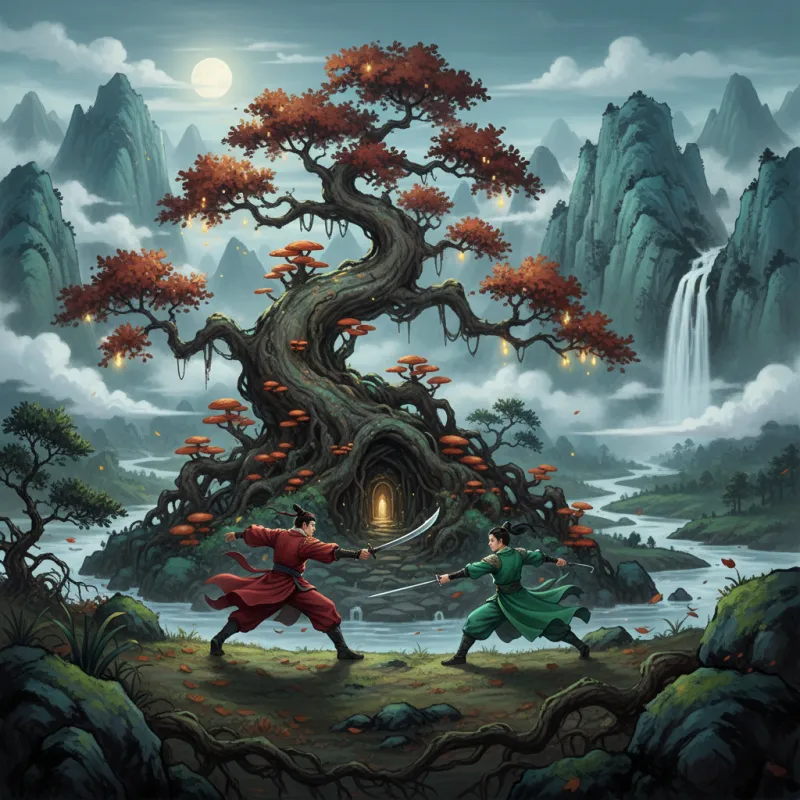
The first emperor of China, Qin Shi Huang, sent hundreds of young men and women across the Eastern Sea to find it. Daoist hermits spent lifetimes searching mountain peaks for a single specimen. Court physicians risked execution if they failed to procure it. What could inspire such desperate quests? A mushroom. Not just any fungus, but the Lingzhi (灵芝 língzhī) — the "spirit plant" that supposedly granted immortality to those fortunate enough to consume it.
From Divine Fungus to Pharmacy Shelf
The Lingzhi occupies a peculiar space in Chinese culture: simultaneously mythological and mundane. You can read about it in the Shanhaijing (山海经 Shānhǎi Jīng, Classic of Mountains and Seas), where it grows on remote peaks guarded by nine-tailed foxes and three-legged birds. You can also buy it at your local Chinese pharmacy for about thirty yuan per hundred grams. This dual existence — as both celestial treasure and common commodity — makes Lingzhi perhaps the most successful "immortality substance" in history. Unlike the Peaches of Immortality that remain forever in the realm of myth, Lingzhi made the jump to reality.
The mushroom appears in texts dating back over two millennia. The Shen Nong Ben Cao Jing (神农本草经 Shén Nóng Běn Cǎo Jīng), traditionally attributed to the Divine Farmer himself around 200 CE, classifies Lingzhi as a "superior" herb — one that could be taken long-term without harm and would extend life indefinitely. The text describes six varieties, each associated with a different color and organ system: red for the heart, black for the kidneys, blue for the liver, white for the lungs, yellow for the spleen, and purple for essence and qi.
The Emperor's Obsession
Qin Shi Huang's quest for Lingzhi wasn't just imperial whimsy — it was a state project that consumed enormous resources. Historical records suggest he sent the court alchemist Xu Fu (徐福 Xú Fú) with a fleet of ships, thousands of young people, and craftsmen of every trade to find the mushroom of immortality. Xu Fu never returned. Some legends claim he reached Japan and became a god there. Others suggest he simply took the emperor's resources and started a new life somewhere beyond imperial reach. Either way, Qin Shi Huang died at forty-nine, his tomb guarded by terracotta warriors but his body very much mortal.
The Han Dynasty emperors learned nothing from this cautionary tale. Emperor Wu of Han (汉武帝 Hàn Wǔ Dì, 156-87 BCE) was equally obsessed, though slightly more successful — at least in obtaining actual Lingzhi specimens. Court records describe elaborate rituals when Lingzhi was discovered growing naturally, treated as auspicious omens worthy of celebration and sacrifice. The emperor would receive the mushroom with great ceremony, and its discovery would be commemorated in official histories.
This imperial fixation had practical consequences for everyone else. Lingzhi became the ultimate tribute item. Local officials scoured their territories for specimens to present to the throne. Foragers risked their lives climbing dangerous peaks. The pressure was so intense that fraud became inevitable — ordinary mushrooms were passed off as Lingzhi, sometimes with fatal consequences when emperors consumed toxic imposters.
Daoist Alchemy and the Six Varieties
For Daoist practitioners, Lingzhi represented something more subtle than simple immortality. It was a bridge between the mortal and transcendent realms, a physical manifestation of the Dao's creative power. The mushroom's ability to grow from dead wood symbolized transformation and renewal — core concepts in Daoist internal alchemy.
The classification of six colored varieties wasn't arbitrary botanical observation. It reflected the Daoist understanding of correspondence between macrocosm and microcosm. Red Lingzhi (赤芝 chìzhī) corresponded to fire, summer, the south, and the heart. Black Lingzhi (黑芝 hēizhī) aligned with water, winter, the north, and the kidneys. This system allowed practitioners to select specific varieties based on their constitutional needs or spiritual goals.
Ge Hong (葛洪 Gě Hóng, 283-343 CE), the great Daoist alchemist and author of the Baopuzi (抱朴子 Bàopǔzǐ), provided detailed instructions for Lingzhi preparation. He described methods for drying, powdering, and combining the mushroom with other substances like cinnabar and jade. Some of his recipes are fascinating; others are terrifying from a modern toxicological perspective. Ge Hong himself claimed to have achieved a form of immortality through his practices, though historical records confirm he died at age sixty — respectable for the era, but hardly eternal.
Wuxia Fiction and the Thousand-Year Specimen
In martial arts novels, Lingzhi follows a clear rule: the older, the better. A ten-year specimen might heal serious injuries. A hundred-year Lingzhi could restore lost internal energy. But a thousand-year specimen? That's the stuff of legend — capable of bringing someone back from the brink of death, granting decades of cultivation progress in a single dose, or even resurrecting the recently deceased.
Jin Yong (金庸 Jīn Yōng) understood this perfectly. In The Return of the Condor Heroes (神雕侠侣 Shéndiāo Xiálǚ), Yang Guo discovers ancient Lingzhi in the Valley of Unrequited Love, mushrooms that have grown for centuries in a unique environment saturated with spiritual energy. These aren't just medicine — they're plot devices that allow characters to survive otherwise fatal injuries and continue their adventures.
Gu Long (古龙 Gǔ Lóng) took a more cynical approach. In his novels, the search for legendary Lingzhi often reveals human greed and desperation. Characters kill each other over rumors of ancient specimens. Fraudsters sell ordinary mushrooms as thousand-year treasures. The real immortality, Gu Long suggests, isn't in the mushroom but in the stories people tell about it.
The wuxia convention of age-equals-potency has some basis in traditional Chinese medicine theory, where older specimens of certain herbs are considered more valuable. But it also serves a narrative function: it creates scarcity and stakes. If Lingzhi were common, it couldn't drive plots. By making the truly powerful specimens rare and ancient, writers ensure that finding one remains a significant achievement.
What Science Actually Says
Modern research on Lingzhi (scientifically known as Ganoderma lucidum) presents a more modest but still interesting picture. The mushroom contains polysaccharides, triterpenes, and other bioactive compounds that show genuine pharmacological effects in laboratory studies. It demonstrates immunomodulatory properties, meaning it can help regulate immune system function. Some studies suggest anti-inflammatory and antioxidant effects.
Does it grant immortality? Obviously not. Can it cure cancer, as some enthusiastic marketers claim? The evidence doesn't support such dramatic assertions. What Lingzhi appears to do is support general health and potentially enhance immune function when taken as part of a broader wellness regimen. It's the difference between a useful medicinal mushroom and a miracle cure.
The irony is that this more modest reality might actually vindicate ancient usage patterns. Traditional Chinese medicine never claimed that a single dose of Lingzhi would make you immortal. The classical texts recommended long-term, consistent use as part of a lifestyle that included meditation, breathing exercises, dietary regulation, and moral cultivation. In this context, Lingzhi was one component of a holistic approach to longevity — which is roughly how modern integrative medicine practitioners view it today.
The cultivation of Lingzhi has become a significant industry, particularly in China and Japan. Modern growing techniques produce consistent, safe specimens — a far cry from the dangerous mountain expeditions of ancient times. This availability has democratized access but also diminished mystique. When you can order Lingzhi extract online with two-day shipping, it loses some of its legendary aura.
The Symbolism That Endures
Walk through any Chinese art museum and you'll see Lingzhi everywhere. It appears in paintings as a symbol of longevity and good fortune. Carved jade Lingzhi served as gifts for birthdays and celebrations. The mushroom's distinctive kidney-shaped cap and lateral stem made it instantly recognizable, a visual shorthand for wishes of long life.
This symbolic function has outlasted the literal belief in immortality. Nobody today seriously expects to live forever by eating Lingzhi, but the cultural association with health and longevity persists. It's similar to how Western culture uses images of apples for health or four-leaf clovers for luck — the original magical thinking has faded, but the symbolic resonance remains.
In contemporary China, Lingzhi products occupy an interesting market position. They're expensive enough to serve as prestigious gifts but not so rare as to be unattainable. A box of high-quality Lingzhi extract makes an appropriate present for elderly relatives or business associates, carrying connotations of respect and wishes for health. The mushroom has successfully transitioned from imperial treasure to middle-class wellness product.
The Lesson of the Spirit Mushroom
What makes Lingzhi's story compelling isn't just its journey from myth to medicine, but what that journey reveals about human nature. We want to believe in shortcuts to immortality, in substances that can grant us more time, more health, more life. Every culture has its version — ambrosia, soma, the philosopher's stone, the fountain of youth.
Lingzhi succeeded where other immortality substances failed because it was real enough to be found, common enough to be studied, and beneficial enough to justify continued use even after the immortality claims faded. It didn't make anyone immortal, but it probably didn't hurt anyone either — which is more than can be said for mercury-based elixirs or lead-contaminated pills that killed more emperors than old age ever did.
The mushroom reminds us that the search for immortality often matters more than the finding. Qin Shi Huang's expedition may have failed, but it generated stories that have lasted two millennia. The Daoist hermits who spent years searching mountain peaks may never have achieved physical immortality, but their dedication became legendary. In seeking to extend their lives, they extended their legacies instead.
Today, when someone offers you Lingzhi tea or suggests a Lingzhi supplement, they're participating in a tradition that stretches back thousands of years. The mushroom won't make you immortal, but drinking it connects you to emperors and alchemists, to wuxia heroes and Daoist sages, to everyone who ever looked at a fungus growing on a tree and saw possibility. That's a different kind of immortality — not of the body, but of culture and story. And unlike the physical kind, it actually works.
Related Reading
- Mythical Plants of the Shanhaijing: Trees That Grant Immortality and Flowers That Kill
- The Bizarre Plants of the Shanhaijing: Trees That Cure Death and Fruits That Grant Flight
- Magical Plants of the Shanhai Jing: Trees That Grant Immortality
- Unraveling the Mystique of Wuxia: A Dive into Jianghu Culture and Kung Fu Novels
- The Smiling Proud Wanderer: A Story About Freedom
- External vs. Internal Martial Arts: The Great Divide in Wuxia
- Celestial Masters and Heavenly Generals: Daoism's Divine Warriors
Explore Chinese Culture
- Explore Jin Yong's martial arts novels
- Explore cultivation fiction and immortal heroes
- Explore the real history behind wuxia