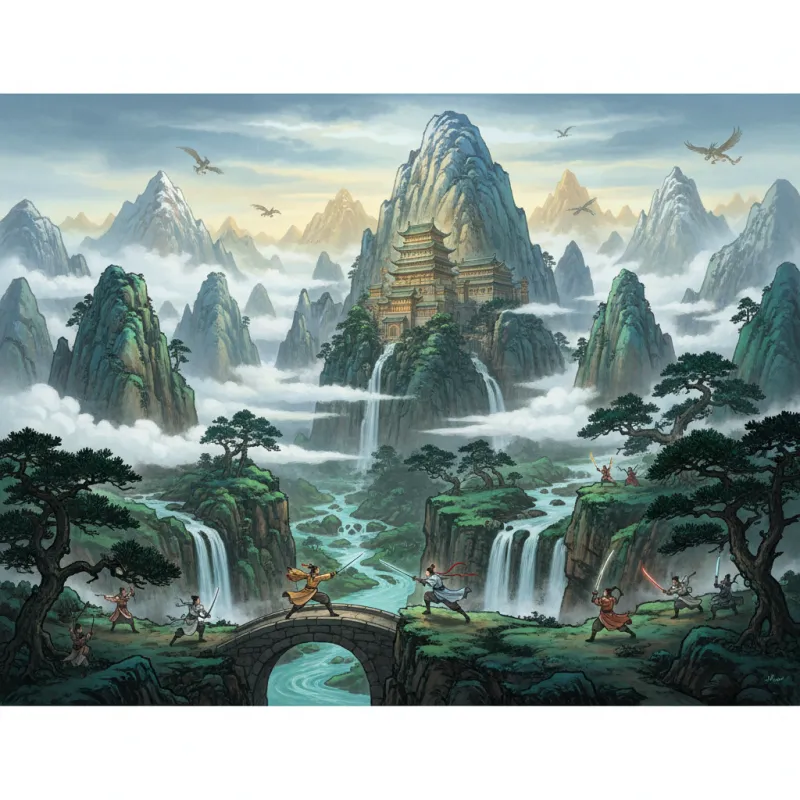
The Queen Mother of the West sits on her jade throne, watching as another mortal climbs toward her palace. He will not make it. They never do. The first gate is guarded by a creature with a human face and a tiger's body. The second by a bird that breathes fire. The third by the Weak Water (弱水 Ruòshuǐ), which cannot support even a feather. And if somehow he passes all these trials, he will still face the Ring of Flame that surrounds the summit. Kunlun Mountain (昆仑山 Kūnlún Shān) does not welcome visitors.
The Architecture of Heaven
The Shanhaijing (山海经 Shānhǎi Jīng, Classic of Mountains and Seas) describes Kunlun with the precision of a surveyor and the imagination of a fever dream. The mountain rises 11,000 li into the sky — that's roughly 5,500 kilometers, which would put its peak well into outer space if we're being literal. But mythology doesn't care about our atmosphere.
The mountain has nine levels, each separated by gates and guardians. The base is surrounded by the Weak Water, which dissolves anything that touches it except the feathers of the wild goose. Beyond that lies the Ring of Flame (炎火之山 Yánhuǒ zhī Shān), an eternal fire that burns without fuel. These aren't just obstacles — they're cosmic boundaries, separating the mortal realm from the divine.
At the summit sits the palace of Xiwangmu (西王母 Xīwángmǔ), the Queen Mother of the West. Her garden contains the Peach Trees of Immortality (蟠桃 Pántáo), which bloom once every 3,000 years and grant eternal life to those who eat their fruit. The Shanhaijing notes that the palace has "five cities and twelve towers," suggesting a complex worthy of any celestial bureaucracy.
The Daoist Transformation
When Daoism emerged as an organized religion during the Han Dynasty (206 BCE - 220 CE), it inherited Kunlun but reimagined it. The mountain became the earthly residence of the immortals (仙人 Xiānrén), a place where adepts could theoretically reach through cultivation rather than divine favor alone.
The Daoist texts added layers of detail. The Huainanzi (淮南子 Huáinánzǐ), compiled around 139 BCE, describes Kunlun as having a jade well that produces the Water of Life. The mountain's trees bear jade fruit. Its soil is made of gold dust. Everything about Kunlun in Daoist literature emphasizes transformation — base matter becoming precious, mortal becoming immortal.
This is where Kunlun diverges from Mount Penglai, the other great immortal realm in Chinese mythology. Penglai is hidden, mobile, possibly unreachable. Kunlun is fixed, mappable, theoretically accessible if you're skilled enough. Penglai represents the mystery of immortality. Kunlun represents its achievement through effort.
The Geography Problem
Here's where things get interesting. Kunlun Mountain exists as a real geographical feature — a mountain range in western China, running through Xinjiang and Tibet. Ancient Chinese geographers knew this. They also knew it didn't match the mythological descriptions at all.
The solution? They didn't care. Chinese cosmology has always been comfortable with multiple truths existing simultaneously. The physical Kunlun range could be the earthly reflection of the cosmic Kunlun, or perhaps the cosmic Kunlun exists in a dimension parallel to our own, accessible only through spiritual cultivation or divine intervention.
The Han Dynasty historian Sima Qian (司马迁 Sīmǎ Qiān) visited the physical Kunlun range and noted its discrepancies with the mythological accounts. His response was essentially: "Well, this is what I saw, but the classics say something different, so make of that what you will." This intellectual flexibility allowed Chinese mythology to maintain its cosmic geography while acknowledging physical reality.
The Imperial Connection
Chinese emperors claimed descent from the Yellow Emperor (黄帝 Huángdì), who according to legend ascended to heaven from Kunlun Mountain. This made Kunlun politically significant. If the emperor's ancestor achieved immortality at Kunlun, then the emperor himself had a cosmic connection to the mountain.
The First Emperor of Qin (秦始皇 Qín Shǐhuáng, 259-210 BCE) was obsessed with Kunlun and immortality. He sent expeditions to find the mountain, or at least to find the immortals who lived there. He never succeeded, but his obsession established a pattern. Emperors throughout Chinese history sponsored expeditions, built temples, and performed rituals connected to Kunlun.
The Tang Dynasty (618-907 CE) poet Li Bai (李白 Lǐ Bái) wrote extensively about Kunlun, often using it as a metaphor for unattainable perfection. His poem "Climbing Tianmu Mountain in a Dream" describes a journey to a mountain that shares many characteristics with Kunlun — jade palaces, immortal residents, cosmic significance. Whether he meant Kunlun specifically or was using it as a template is debated, but the influence is clear.
Kunlun in Wuxia Fiction
Modern wuxia fiction has had a complicated relationship with Kunlun. The mountain appears frequently, but usually as a sect location rather than a cosmic pillar. Jin Yong (金庸 Jīn Yōng) places the Kunlun Sect (昆仑派 Kūnlún Pài) in his novels, but they're portrayed as a relatively minor martial arts school, not as guardians of cosmic secrets.
This is actually a clever move. By downplaying Kunlun's mythological significance, Jin Yong makes it more interesting. The Kunlun Sect in his novels is aware of the mountain's legendary status but can't access its divine aspects. They're martial artists living in the shadow of gods, which creates dramatic tension.
Other authors have taken different approaches. Huang Yi (黄易 Huáng Yì) in his fantasy wuxia novels treats Kunlun as a genuine gateway to other dimensions, more faithful to the mythological sources. Gu Long (古龙 Gǔ Lóng) largely ignores Kunlun, preferring to create his own mythological geography.
The most interesting modern interpretation might be in the Xianxia (仙侠 Xiānxiá) genre, which blends wuxia with explicit Daoist cultivation. Here, Kunlun often appears as a high-level cultivation sect, a place where practitioners can access ancient techniques and possibly achieve immortality. This brings the mountain back to its Daoist roots while maintaining the martial arts framework.
The Queen Mother's Garden
No discussion of Kunlun is complete without examining Xiwangmu in detail. She's one of the most complex figures in Chinese mythology — part goddess, part immortal, part cosmic force. Early descriptions in the Shanhaijing portray her as monstrous: "She has a human face, a leopard's tail, tiger's teeth, and is good at whistling." Later traditions softened this into a beautiful woman, but the wildness remained.
Her peach garden is the key to Kunlun's significance. The Peaches of Immortality bloom once every 3,000 years, and when they ripen, Xiwangmu hosts a banquet for the immortals. This is the Peach Banquet (蟠桃会 Pántáo Huì), one of the most important events in Chinese mythological calendar. The novel Journey to the West (西游记 Xīyóu Jì) features Sun Wukong (孙悟空 Sūn Wùkōng) crashing this banquet and eating all the peaches, which is both hilarious and cosmically significant.
The peaches represent more than just immortality — they represent the controlled distribution of immortality. Xiwangmu decides who gets to eat them. She's not just a goddess; she's a gatekeeper, determining who crosses from mortal to immortal. This makes Kunlun not just a place but a threshold, and Xiwangmu its guardian.
The Modern Pilgrimage
Today, the physical Kunlun Mountains attract tourists and pilgrims, though probably not for the reasons the ancient texts suggested. You won't find jade palaces or peach trees of immortality. What you will find is one of the most geologically significant mountain ranges in Asia, the source of several major rivers, and a landscape that genuinely does feel otherworldly.
The disconnect between mythological Kunlun and physical Kunlun remains unresolved, and perhaps that's appropriate. Chinese mythology has always been comfortable with paradox. The mountain can be both real and imaginary, both accessible and unreachable, both a physical location and a spiritual state.
In wuxia fiction, this duality becomes a narrative tool. Characters might journey to the physical Kunlun Mountains seeking the mythological Kunlun, only to discover that the true mountain exists in a different dimension, or within themselves, or was destroyed long ago, or never existed except as a metaphor. Each author makes their own choice, and each choice reveals something about how they understand the relationship between myth and reality.
The genius of Kunlun as a mythological concept is that it doesn't need to be real to be true. It exists as an idea — the idea that somewhere, at the center of the world, there is a place where mortals can become immortal, where heaven and earth meet, where the impossible becomes possible. Whether you can physically travel there is almost beside the point. The journey toward Kunlun, whether geographical or spiritual, is what matters.
And the Queen Mother still sits on her jade throne, watching as mortals attempt the climb. Most fail. Some succeed. All are transformed by the attempt. That's the real magic of Kunlun Mountain — not the peaches, not the jade palaces, but the transformation that comes from seeking something beyond the ordinary world. In that sense, every martial artist in every wuxia novel is climbing Kunlun, whether they know it or not.
Related Reading
- The Fusang Tree: Where the Suns Rise and the World Begins
- Exploring Chinese Martial Arts Fiction and the Mythical Jianghu Culture
- The Four Seas and the Shape of the Ancient Chinese World
- The Beggar Sect: The Largest and Most Unlikely Martial Arts Organization
- The Heroes of Wuxia: What Makes a Xia Different from a Fighter
- Dianxue: The Deadly Art of Pressure Point Strikes
Explore Chinese Culture
- Explore Jin Yong's martial arts novels
- Explore cultivation fiction and immortal heroes
- Explore the real history behind wuxia