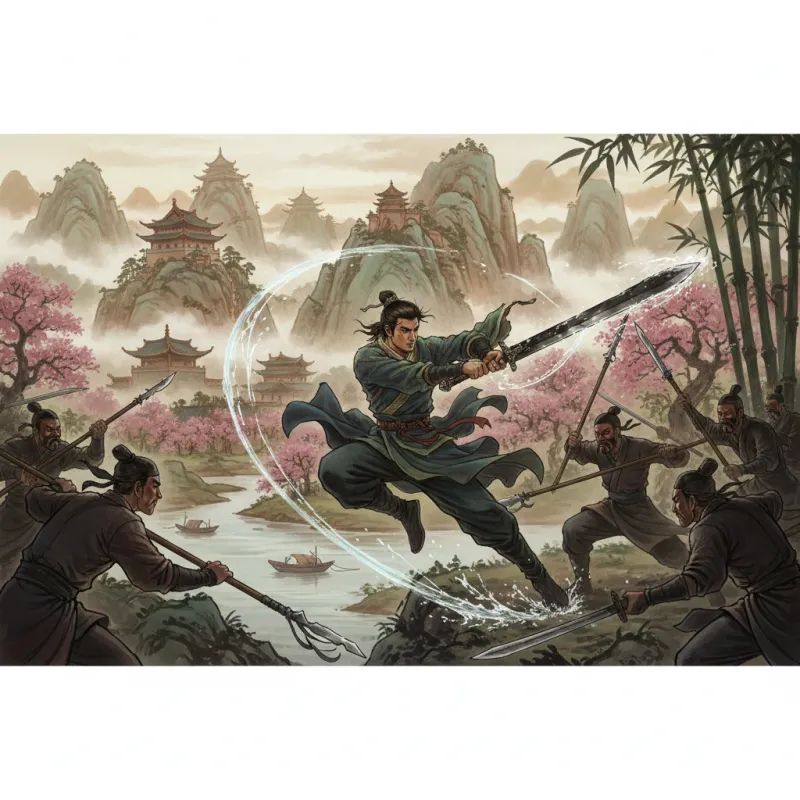
When Yang Guo severed his own arm to escape the Passionless Valley, he didn't just lose a limb—he gained a legend. The moment Jin Yong's protagonist emerged from that poisonous abyss sixteen years later, wielding the Heavy Iron Sword with one arm and commanding martial arts that surpassed his two-armed peers, he shattered every convention about what a wuxia hero should be. This wasn't just another tale of overcoming disability. This was a deliberate dismantling of martial arts orthodoxy itself.
The Orphan Who Refused to Behave
Yang Guo enters The Return of the Condor Heroes (神雕侠侣, Shén Diāo Xiá Lǚ) with the worst possible pedigree. His father, Yang Kang, was a traitor who sided with the Jin invaders. His mother died when he was young. By the time Guo Jing and Huang Rong take him in, he's already a street-smart troublemaker with a chip on his shoulder the size of Zhongnan Mountain.
The Quanzhen Sect (全真教, Quánzhēn Jiào) should have been his salvation. Instead, it became his prison. The Taoist masters saw only his father's treachery in his eyes, treating him with suspicion and cruelty that would have broken a lesser character. But Yang Guo didn't break—he rebelled. When he fled to the Ancient Tomb Sect and became the disciple of Xiao Longnu, he wasn't just escaping abuse. He was choosing a path that would define him: the outsider who refuses to play by jianghu's rules.
This rebellion matters because Jin Yong was writing against the grain of traditional wuxia. Earlier heroes like Guo Jing embodied Confucian virtue—loyal, filial, straightforward. Yang Guo is none of these things. He's sarcastic, impulsive, and driven by personal emotion rather than abstract duty. He falls in love with his master, the ultimate taboo. And somehow, Jin Yong makes us root for him anyway.
The Arm That Changed Everything
The loss of Yang Guo's right arm isn't a random plot device—it's the crucible that forges him into something unprecedented. After Guo Fu's jealous sword strike severs his arm at the shoulder, Yang Guo spends sixteen years in isolation, transforming his disability into his greatest weapon. This period, often glossed over in adaptations, represents one of Jin Yong's most sophisticated explorations of martial arts philosophy.
Consider what Yang Guo accomplishes with one arm. He masters the Dugu Nine Swords (独孤九剑, Dúgū Jiǔ Jiàn) principles without formal instruction, understanding that true swordplay transcends physical technique. He trains with the massive Heavy Iron Sword, building strength that compensates for his missing limb. Most remarkably, he creates entirely new martial arts forms designed specifically for one-armed combat, including techniques that use his empty sleeve as a weapon itself.
This isn't inspiration porn. Jin Yong is making a pointed argument about the nature of martial arts mastery. The orthodox sects—Shaolin, Wudang, Quanzhen—all emphasize complete, symmetrical forms. They teach that martial arts perfection requires physical perfection. Yang Guo proves them catastrophically wrong. His one-armed style defeats grandmasters who've spent lifetimes perfecting two-armed techniques. He becomes the Divine Eagle Knight (神雕侠, Shén Diāo Xiá), a title that acknowledges his transcendence of conventional limitations.
The symbolism cuts deeper when you consider Jin Yong's historical moment. Writing in the early 1960s, he was watching China struggle with its own sense of incompleteness—the loss of traditional culture, the trauma of recent wars, the amputation of Hong Kong and Taiwan from the mainland. Yang Guo's triumph suggests that wholeness isn't about having all your pieces. It's about mastering what remains.
The Forbidden Love That Defined Him
Yang Guo's relationship with Xiao Longnu (小龙女, Xiǎo Lóngnǚ) remains one of the most controversial romances in Chinese literature. She's his master. She's sixteen years older. Their love violates every Confucian principle about proper relationships. And yet, Jin Yong writes it with such emotional authenticity that it becomes the emotional core of the entire novel.
What makes this relationship work narratically is that both characters are outsiders. Xiao Longnu, raised in the Ancient Tomb with no understanding of jianghu conventions, doesn't see why their love should be forbidden. Yang Guo, already rejected by orthodox society, has nothing left to lose by defying it further. Their romance becomes an act of rebellion against a hypocritical martial world that preaches righteousness while practicing cruelty.
The sixteen-year separation—when Xiao Longnu leaves a message saying she'll return in sixteen years, not knowing if she'll survive her injuries—tests Yang Guo in ways no martial opponent could. He waits. He grieves. He nearly throws himself off a cliff multiple times. This emotional constancy, this refusal to move on or compromise, transforms him from a rebellious youth into a tragic romantic hero. When they finally reunite at the bottom of Passionless Valley, it's not just a happy ending. It's a vindication of love that refuses to bow to social pressure.
Compare this to the relationship between Guo Jing and Huang Rong, which follows traditional courtship patterns despite Huang Rong's unconventional personality. Jin Yong is deliberately showing us two models of heroic love—one that works within the system, one that burns it down.
The Divine Eagle and Martial Transcendence
The giant divine eagle that becomes Yang Guo's companion after his arm loss is more than a pet or plot convenience. It's a symbol of martial arts enlightenment that exists outside human systems. The eagle, which once belonged to the legendary Dugu Qiubai (独孤求败, Dúgū Qiúbài), represents a lineage of martial arts mastery that has nothing to do with sects, schools, or orthodox transmission.
Dugu Qiubai—"Lonely Seeking Defeat"—never appears in the novel except through his legacy. He was a swordsman so skilled that he couldn't find worthy opponents, who eventually abandoned the sword entirely because weapons became meaningless at his level of mastery. The eagle leads Yang Guo to Dugu's cave, where he finds four swords representing different stages of martial development: the sharp sword of youth, the soft sword of maturity, the heavy iron sword of strength, and finally no sword at all—the wooden sword that represents ultimate transcendence.
Yang Guo's training with the Heavy Iron Sword is particularly significant for a one-armed fighter. While others might compensate for missing an arm by using lighter, faster weapons, Yang Guo goes the opposite direction. He chooses the heaviest possible sword, building such tremendous strength in his remaining arm that he can wield it with the force of two arms. This counterintuitive approach—meeting disability not with accommodation but with overwhelming power—defines his entire martial philosophy.
By the novel's end, Yang Guo has effectively inherited Dugu Qiubai's mantle. He's the swordsman who transcends swordsmanship, the hero who achieves mastery by abandoning orthodox paths. The eagle, which cannot speak but understands everything, becomes the perfect companion for someone who's moved beyond human martial arts politics.
The Hero Who Saved Xiangyang
Yang Guo's finest moment comes during the defense of Xiangyang against the Mongol invasion. This is where Jin Yong reconciles Yang Guo's personal rebellion with traditional heroic duty. Despite his conflicts with Guo Jing, despite his rejection of orthodox jianghu, Yang Guo shows up when it matters. He assassinates Mongol Khan Möngke with a single stone, thrown with such precision that it changes the course of history.
This act is crucial for understanding Yang Guo's character arc. He's not a nihilist or a pure individualist. He's someone who rejects hypocritical authority while maintaining genuine moral principles. He'll defy the Quanzhen Sect's cruelty, but he'll defend China against invasion. He'll violate social taboos for love, but he'll risk his life for strangers. His heroism is selective, personal, and all the more powerful for being chosen rather than obligated.
The title "Divine Eagle Knight" that he earns isn't granted by any sect or authority. It's a grassroots recognition from common people who've witnessed his deeds. This matters in Jin Yong's moral universe. Yang Guo achieves xia (侠, xiá)—the chivalric ideal of using martial arts to help the helpless—without ever submitting to the institutions that claim to define it.
Legacy of the One-Armed Swordsman
Yang Guo's influence on wuxia fiction extends far beyond Jin Yong's novels. He established the archetype of the disabled martial artist who transcends physical limitation through skill and determination. Characters like the one-armed swordsman in Chang Cheh's films, or the blind swordsmen in countless subsequent works, all owe something to Yang Guo's example.
But more importantly, Yang Guo represents a shift in how Chinese popular fiction thinks about heroism itself. He's flawed, emotional, sometimes selfish, often wrong—and still heroic. He proves that you can reject orthodox authority without rejecting moral responsibility. You can break social rules without breaking faith with genuine righteousness. You can lose part of yourself and become more complete in the process.
Jin Yong wrote Yang Guo during a period when Chinese society was grappling with how to be modern while remaining Chinese, how to reject oppressive traditions while preserving cultural identity. Yang Guo's answer—keep what matters, discard what doesn't, and never let anyone else make that choice for you—resonated then and resonates now.
The one-armed swordsman stands at the edge of the cliff, looking out over the jianghu that rejected him and the woman he waited sixteen years to find. He's missing an arm, but he's whole. He's broken every rule, but he's righteous. He's the hero who proved that sometimes the only way to achieve perfection is to embrace your incompleteness and make it your strength.
Related Reading
- Women Warriors of Wuxia: Breaking Boundaries in the Martial World
- Xiao Feng: The Most Tragic Hero in Wuxia
- Huang Rong: The Smartest Heroine in Chinese Fiction
- The Heroes of Wuxia: What Makes a Xia Different from a Fighter
- Qu Yuan: The First Named Poet in Chinese History
- The Three Pure Ones: Supreme Deities of Daoism
- The Enigmatic World of Shapeshifters in Wuxia Fiction: Unveiling Jianghu Adventures
- The Art of War: Exploring Weapons in Chinese Martial Arts (Wuxia) Fiction
Explore Chinese Culture
- Explore Jin Yong's martial arts novels
- Explore cultivation fiction and immortal heroes
- Explore the real history behind wuxia