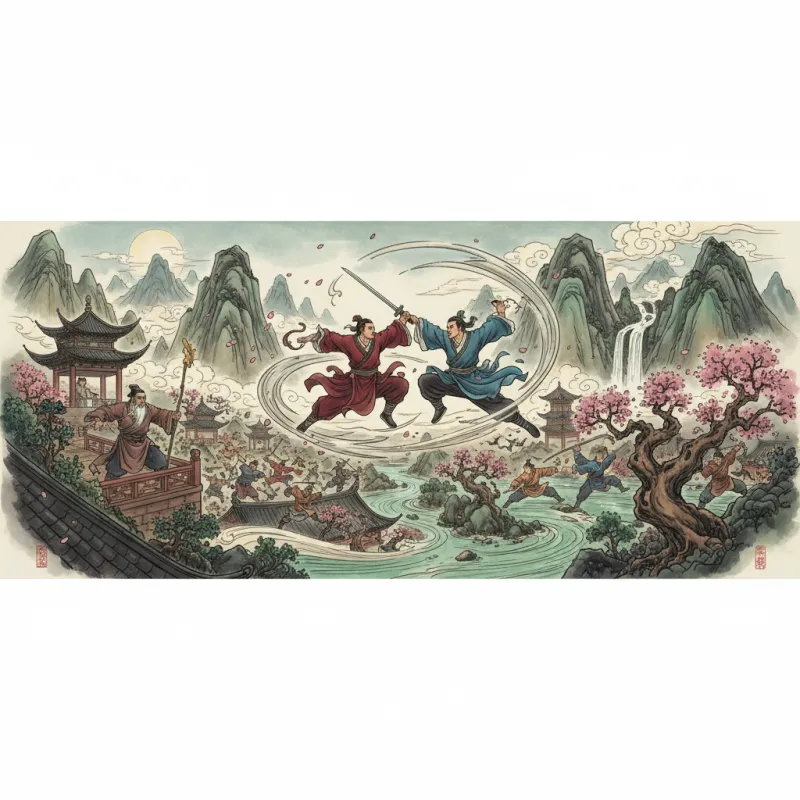
The camera pulls back to reveal a woman in white standing on a single bamboo pole, thirty feet in the air, as a dozen assassins leap toward her from surrounding rooftops. She doesn't flinch. Instead, she spins, her sword tracing a perfect circle, and all twelve attackers freeze mid-air before falling like cherry blossoms. This isn't CGI. This is 1966, and you're watching Come Drink with Me (大醉俠, Dà Zuì Xiá), the film that announced to the world that Hong Kong had cracked the code on how to make wuxia fiction move.
The Shaw Brothers Blueprint
Run Run Shaw didn't invent martial arts cinema, but he industrialized it. By the mid-1960s, Shaw Brothers Studio had constructed what was essentially a wuxia factory in Hong Kong's Clearwater Bay: permanent sets replicating everything from Qing dynasty courtyards to Buddhist temples, contract players trained in both acting and acrobatics, and a production schedule that would make modern filmmakers weep. The studio released upwards of forty films per year at its peak, and a significant portion were wuxia pictures.
What made Shaw Brothers revolutionary wasn't just volume—it was visual coherence. Director King Hu (胡金銓, Hú Jīnquán) established the grammar: wide shots to showcase choreography, rapid cuts to punctuate strikes, and the strategic use of trampolines and wires to suggest qinggong (輕功, "lightness skill"). When Hu left Shaw Brothers in 1966 after disputes with Run Run Shaw, he took this language to Taiwan and refined it further with Dragon Inn (1967) and A Touch of Zen (1971), films that proved wuxia could be both commercially successful and artistically ambitious.
The Shaw aesthetic was unmistakable: saturated colors, elaborate costumes, and fight choreography that prioritized beauty over realism. Lau Kar-leung (劉家良, Liú Jiāliáng), who started as a martial arts instructor and became one of the studio's most important directors, brought authentic kung fu technique to the screen. His The 36th Chamber of Shaolin (1978) remains the gold standard for training sequences, each chamber presenting a different physical and philosophical challenge that the protagonist must overcome.
Golden Harvest and the Bruce Lee Disruption
When Raymond Chow left Shaw Brothers in 1970 to found Golden Harvest, he brought a different philosophy: fewer films, bigger budgets, and creative freedom for directors and stars. This approach attracted Bruce Lee, who had been frustrated by Hollywood's refusal to cast him as anything other than a sidekick. The Big Boss (1971) and Fist of Fury (1972) weren't traditional wuxia—Lee's characters inhabited contemporary or Republican-era settings, and his fighting style emphasized raw power over the balletic grace of Shaw Brothers productions.
But Lee's impact on the genre was seismic. He proved that martial arts films could break out of the Mandarin-speaking market and become global phenomena. More importantly, he shifted the focus from swordplay to hand-to-hand combat, from elaborate costumes to bare-chested intensity. When Lee died in 1973 at age thirty-two, the industry scrambled to find replacements, launching the careers of Jackie Chan, Sammo Hung, and Yuen Biao—performers who would define the next phase of Hong Kong action cinema.
Golden Harvest's willingness to experiment led to some of the era's most innovative films. Enter the Dragon (1973), co-produced with Warner Bros, brought Hollywood production values to Hong Kong choreography. Drunken Master (1978) established Jackie Chan's comedic kung fu style, a deliberate counterpoint to Bruce Lee's grimness. The studio understood that wuxia and kung fu cinema could encompass multiple tones and approaches, from the gritty realism of street fighting techniques to the supernatural elements of traditional jianghu tales.
The New Wave and Tsui Hark's Revolution
By the early 1980s, Hong Kong cinema was ready for another evolution. A generation of directors who had studied film abroad—Tsui Hark, John Woo, Ringo Lam—returned home with new ideas about pacing, editing, and visual effects. Tsui Hark's Zu Warriors from the Magic Mountain (1983) pushed special effects technology to its limits, creating a phantasmagoric wuxia world where swordsmen battled demons and the laws of physics were mere suggestions.
Tsui's most significant contribution was recognizing that wire work could be more than a tool for suggesting qinggong—it could be a form of visual poetry. His A Chinese Ghost Story (1987) and the Swordsman series (beginning in 1990) featured fight scenes that were essentially aerial ballets, with performers spinning through space in ways that would have been impossible even five years earlier. The wire teams, led by innovators like Ching Siu-tung (程小東, Chéng Xiǎodōng), developed increasingly sophisticated rigging systems that allowed for longer, more complex airborne sequences.
This period also saw the rise of the "heroic bloodshed" genre, which applied wuxia's codes of honor and loyalty to contemporary crime stories. John Woo's A Better Tomorrow (1986) and The Killer (1989) featured gunfights choreographed with the same attention to rhythm and spacing as sword duels. The connection to traditional wuxia was explicit: these were jianghu stories transplanted to modern Hong Kong, with pistols replacing swords but the underlying ethics remaining unchanged.
The Female Warriors
Hong Kong's golden age produced some of cinema's most formidable female action stars, and the industry deserves credit for this even as we acknowledge its limitations. Cheng Pei-pei (鄭佩佩, Zhèng Pèipèi), who starred in Come Drink with Me, established the archetype of the female swordsman who needed no male rescuer. Angela Mao brought legitimate martial arts credentials to films like Hapkido (1972), performing her own stunts and fight choreography.
The 1990s saw this tradition reach its apex with Michelle Yeoh and Brigitte Lin. Yeoh, a former beauty queen with no martial arts background, trained intensively and performed stunts that injured numerous male performers. Her work in Yes, Madam (1985) and later in Wing Chun (1994) demonstrated that female-led action films could be both commercially successful and artistically accomplished. Brigitte Lin's portrayal of Dongfang Bubai (東方不敗, "Invincible East") in Swordsman II (1992) remains one of wuxia cinema's most complex characters—a gender-fluid villain whose martial supremacy is matched only by their tragic isolation.
These weren't token female characters or love interests who occasionally picked up a sword. They were the protagonists, and their stories often explored themes—identity, autonomy, the cost of power—that male-centered wuxia films rarely addressed. The genre's willingness to feature women as martial equals, even within a patriarchal industry, distinguished it from most action cinema of the era.
The Choreographers' Art
Behind every memorable fight scene was a choreographer, and Hong Kong's golden age produced several geniuses in this underappreciated art form. Lau Kar-leung brought authentic martial arts technique and philosophy to his choreography, insisting that fights should reflect the characters' training and personality. Sammo Hung pioneered the use of comedy in fight scenes, understanding that humor could heighten rather than undercut tension. Yuen Woo-ping (袁和平, Yuán Hépíng), who would later choreograph The Matrix and Crouching Tiger, Hidden Dragon, developed a style that balanced realism and fantasy, making the impossible look merely difficult.
The working conditions were brutal. Performers trained for hours before shooting, then spent entire days executing dangerous stunts with minimal safety equipment. Jackie Chan famously broke nearly every bone in his body over his career. Stunt performers were paid poorly and received no screen credit. Yet this system produced an extraordinary body of work because everyone involved understood the grammar of action cinema instinctively. A fight scene wasn't just violence—it was a conversation between characters, conducted through movement.
The best choreographers understood pacing: when to accelerate, when to pause, when to introduce a new weapon or technique. They understood geography: how to use the environment—tables, stairs, bamboo scaffolding—as part of the fight. And they understood character: a drunk fighter moves differently than a monk, a desperate fighter differently than a confident one. This sophistication is why Hong Kong fight scenes from the 1980s and 1990s often feel more dynamic than modern CGI-heavy action sequences.
The Decline and Legacy
By the mid-1990s, the golden age was ending. The 1997 handover of Hong Kong to China created uncertainty in the industry. Many top talents—John Woo, Ringo Lam, Tsui Hark—decamped to Hollywood, where they found bigger budgets but less creative freedom. The rise of CGI made wire work seem quaint. Mainland Chinese cinema, with its larger budgets and government support, began to dominate the market.
But the influence persists. When Ang Lee made Crouching Tiger, Hidden Dragon (2000), he hired Hong Kong choreographers and crew. When the Wachowskis conceived The Matrix (1999), they studied Hong Kong films and brought Yuen Woo-ping to Hollywood. Every contemporary action film that features hand-to-hand combat owes a debt to Hong Kong's innovations in fight choreography and wire work.
More importantly, Hong Kong's golden age proved that genre cinema could be art. These weren't prestige pictures—they were commercial entertainments made quickly and cheaply. Yet the best of them—A Touch of Zen, The Killer, Swordsman II—are as formally sophisticated and thematically rich as any art film. They demonstrated that you could make something beautiful and meaningful while also delivering spectacular action, that you could honor tradition while innovating relentlessly, that you could work within a commercial system and still create something personal.
The golden age is over, but its lessons remain. When filmmakers today want to shoot action that thrills rather than numbs, they return to those Hong Kong films from the 1970s and 1980s, studying how a generation of maniacs with wires and trampolines created movie magic that still hasn't been surpassed.
Related Reading
- The Wuxia Film Renaissance: Why Hong Kong Cinema Matters
- Wuxia Video Games: From Chinese RPGs to Global AAA Titles
- The World of Wuxia: Exploring Chinese Martial Arts Fiction and Jianghu Culture
- Crouching Tiger, Hidden Dragon: How One Film Changed Everything
- Wire-Fu: The Art of Flying Swordsmen in Action Cinema
- Pangu and the Cosmic Egg: The Chinese Creation Myth
- Romance in Wuxia: Love, Duty, and the Tragedy Between
- Dianxue: The Deadly Art of Pressure Point Strikes
Explore Chinese Culture
- Explore Jin Yong's martial arts novels
- Explore cultivation fiction and immortal heroes
- Explore the real history behind wuxia