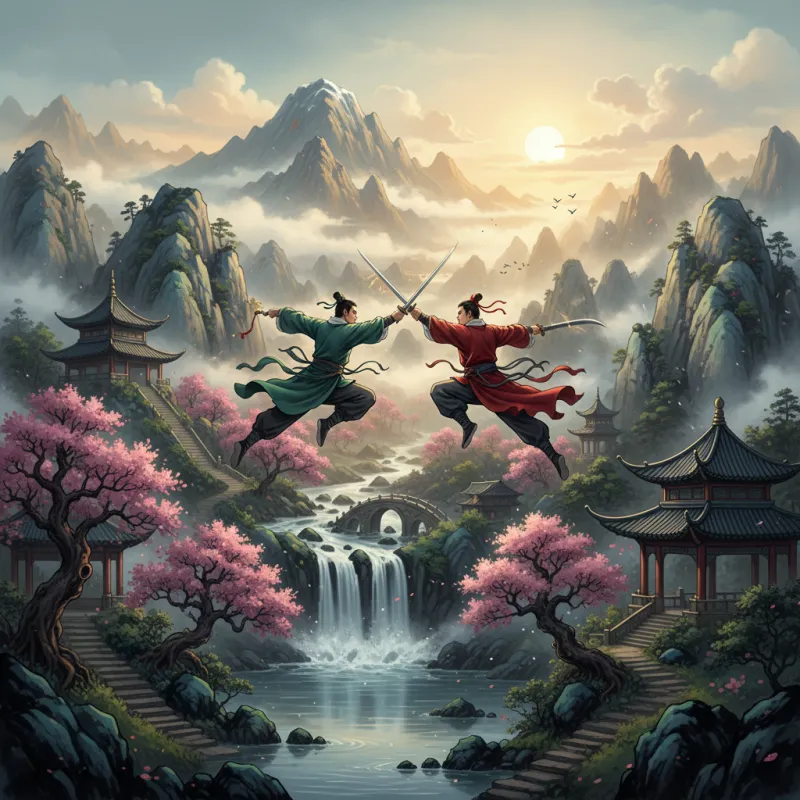
You've just finished The Lord of the Rings for the third time. You loved it, but you're craving something different — martial artists who can shatter boulders with their palms, secret manuals hidden in ancient tombs, revenge plots spanning decades, and a moral universe where loyalty to your master matters more than law. You want wuxia novels, but you don't read Chinese. Ten years ago, you'd be out of luck. Today? You're spoiled for choice, but you need a guide through the chaos.
Jin Yong: The Foundation Everyone Should Read
Jin Yong (金庸, Jīn Yōng) wrote fifteen novels between 1955 and 1972, and he's the undisputed king of the genre. If you read nothing else in wuxia, read him. His work defined what modern wuxia could be — complex political intrigue, flawed heroes, women who actually matter to the plot, and martial arts that feel like they have weight and consequence.
Start with Legends of the Condor Heroes (射雕英雄传, Shèdiāo Yīngxióng Zhuàn). It's the first book in his Condor Trilogy, and it's the most accessible entry point. Guo Jing is a simple, honest protagonist who becomes one of the greatest heroes in the jianghu (江湖, jiānghú) — the martial arts world — not through genius but through relentless effort and moral clarity. The English translation by Anna Holmwood and Gigi Chang is excellent, capturing both the action and the humor.
If you want something darker and more morally complex, go straight to Demi-Gods and Semi-Devils (天龙八部, Tiānlóng Bābù). Three protagonists, each trapped by fate and their own choices. Qiao Feng's storyline alone — a Khitan man raised as Han Chinese, torn between two peoples during the Song Dynasty — is worth the entire four-volume read. This one's harder to find in official translation, but it's coming.
The Deer and the Cauldron (鹿鼎记, Lùdǐng Jì) is Jin Yong's final novel and his most subversive. The protagonist, Wei Xiaobao, can barely fight. He's a con artist, a coward, and a shameless opportunist who stumbles into the Qing court and somehow becomes indispensable. It's a comedy that doubles as a meditation on what heroism actually means. John Minford's translation is a masterpiece — he captures Wei Xiaobao's street-smart voice perfectly.
Gu Long: When You Want Something Rawer
Gu Long (古龙, Gǔ Lóng) is the other giant of wuxia, and he's Jin Yong's opposite in almost every way. Where Jin Yong gives you sprawling epics with detailed worldbuilding, Gu Long gives you noir thrillers. His sentences are short, punchy, almost cinematic. His heroes are lonely, damaged, and often drunk. If Jin Yong is Tolkien, Gu Long is Raymond Chandler with swords.
The Eleventh Son is the best place to start. It's short, brutal, and completely self-contained. A wealthy family's eleven sons are murdered one by one, and the investigation reveals that everyone has secrets worth killing for. The martial arts are less important than the psychology — who can you trust when everyone's lying?
For something longer, try Legendary Siblings (绝代双骄, Juédài Shuāngjiāo). Twin brothers separated at birth, raised in opposite environments, destined to fight each other. It sounds like a cliché, but Gu Long makes it work through sheer emotional intensity. The translation by Huang Yusheng is solid, though it occasionally smooths out Gu Long's deliberately fragmented style.
Fair warning: Gu Long's novels can feel incomplete. He wrote fast, drank heavily, and died at 48. Some of his books have abrupt endings or plot threads that go nowhere. But when he's on, he's untouchable. His fight scenes are the best in the genre — not because of elaborate choreography, but because he understands that the moment before the strike matters more than the strike itself.
Liang Yusheng: The Traditionalist
Liang Yusheng (梁羽生, Liáng Yǔshēng) is less famous than Jin Yong or Gu Long, but he's worth your time if you want wuxia that feels more grounded in actual Chinese history. He was obsessed with getting the details right — the politics of the Ming-Qing transition, the structure of martial arts sects, the way Confucian values shaped the jianghu.
Seven Swordsmen from Mountain Tian (七剑下天山, Qī Jiàn Xià Tiānshān) is his most accessible work in English. Seven warriors unite to resist Qing oppression in the early 1600s. It's more straightforward than Jin Yong — clearer heroes and villains, less moral ambiguity — but the action is excellent and the historical backdrop gives everything weight.
Liang Yusheng's female characters are often stronger than his male ones. In The Bride with White Hair (白发魔女传, Báifà Mónǚ Zhuàn), Lian Nishang is a powerful martial artist who turns her hair white through grief and rage after being betrayed. She's not a love interest who needs rescuing — she's a force of nature who makes her own choices, even when they're destructive.
Modern Wuxia: When You've Read the Classics
Once you've exhausted the big three, you'll want something contemporary. The good news is that modern Chinese authors are doing interesting things with the genre. The bad news is that very few are translated into English yet.
Ballad of Sword and Wine (千秋, Qiānqiū) by Tang Jiuqing isn't traditional wuxia — it's danmei (耽美, dānměi), meaning it centers a romance between two men — but it has everything else you want: intricate martial arts, sect politics, and a revenge plot that spans years. Xiao Chiye and Shen Zechuan are both brilliant strategists trapped in a corrupt imperial court, and watching them navigate their attraction while trying not to get killed is genuinely thrilling. The fan translation by Lianyin is excellent.
If you want something closer to classic wuxia but with modern sensibilities, try Thousand Autumns (千秋, Qiānqiū) by Meng Xi Shi. Yan Wushi is a demonic sect leader who finds a righteous cultivator, Shen Qiao, injured and blind on a mountaintop. He decides to corrupt him for fun. It doesn't go as planned. The philosophical debates between the two protagonists — about morality, power, and what it means to be righteous — are as engaging as the fight scenes.
What About Cultivation Novels?
You'll see a lot of "xianxia" (仙侠, xiānxiá) novels recommended alongside wuxia. They're related but different. Wuxia is grounded — martial artists are still human, even if they can do impossible things. Xianxia adds actual magic, immortality, and power levels that escalate into absurdity. Characters cultivate qi (气, qì) to become immortal, and the stakes eventually involve destroying entire realms.
Some people love this. I find most cultivation novels exhausting — too much grinding, too many repetitive power-ups, protagonists who are either bland or insufferable. But if you want to try one, Grandmaster of Demonic Cultivation (魔道祖师, Módào Zǔshī) by Mo Xiang Tong Xiu is the best gateway. It has the power escalation of xianxia but keeps the emotional core and character focus of good wuxia. Wei Wuxian is a genuinely fun protagonist — clever, irreverent, and willing to break every rule if it means protecting the people he loves.
For a deeper dive into cultivation mechanics and what makes them work (or not), check out Understanding Qi and Internal Energy in Wuxia.
Translation Quality Matters More Than You Think
Here's something nobody tells beginners: a bad translation can ruin a great novel. Wuxia is hard to translate. The martial arts terminology is dense, the cultural references are everywhere, and the prose style — especially in older novels — doesn't map cleanly onto English.
Anna Holmwood's translation of Legends of the Condor Heroes is the gold standard. She doesn't just translate words; she makes choices about how to render the rhythm and feel of Jin Yong's prose. When a character uses a move called "Haughty Dragon Repents" (亢龙有悔, Kàng Lóng Yǒu Huǐ), she keeps the poetry but adds footnotes explaining the I Ching reference.
Fan translations are more variable. Some are excellent — the translators are passionate, they understand the source material, and they're often more willing to take risks than official publishers. Others are barely readable, full of awkward phrasing and inconsistent terminology. If you're reading a fan translation, check the comments. If people are complaining about quality in the first few chapters, find a different version.
Where Wuxia Goes From Here
The English-language wuxia landscape is better than it's ever been, but it's still incomplete. Most of Gu Long's best work isn't translated. Wen Rui'an (温瑞安, Wēn Ruì'ān), who wrote some of the most innovative wuxia of the 1980s and 90s, is almost completely unavailable. Huang Yi (黄易, Huáng Yì), who blended wuxia with science fiction and historical fiction, has only one novel in English.
But publishers are paying attention now. Every year brings a few more translations. Fan translators keep filling gaps. And more English-language readers are discovering that wuxia offers something you can't get anywhere else — a genre where physical skill, moral philosophy, and political intrigue are all equally important, where a fight scene can be a debate about righteousness, and where loyalty to your martial arts sect can matter more than loyalty to the empire.
If you're just starting, read Jin Yong first. If you want something darker, try Gu Long. If you want historical detail, go with Liang Yusheng. And if you want to see where the genre is going, dive into the modern stuff. There's no wrong entry point, just different paths through the jianghu.
For more on the cultural context that shapes these stories, see The Role of Martial Arts Sects in Wuxia Fiction. And if you're curious about the weapons these heroes wield, check out Iconic Weapons in Wuxia Literature.
Related Reading
- 12 Best Wuxia Novels for Beginners: Where to Start Reading
- The Allure of Wuxia: Exploring Chinese Martial Arts Fiction and Jianghu Culture
- Legend of the Condor Heroes: A Complete Reading Guide
- Demi-Gods and Semi-Devils: Themes of Identity and Fate
- Gu Long vs. Jin Yong: Two Masters, Two Visions of Wuxia
- The Beggar Sect: The Largest and Most Unlikely Martial Arts Organization
- Exploring Wuxia Fiction: The Art and Culture of Chinese Martial Arts Novels
- Unveiling Jianghu: The Rich Tapestry of Wuxia and Kung Fu Novels
Explore Chinese Culture
- Explore Jin Yong's martial arts novels
- Explore cultivation fiction and immortal heroes
- Explore the real history behind wuxia