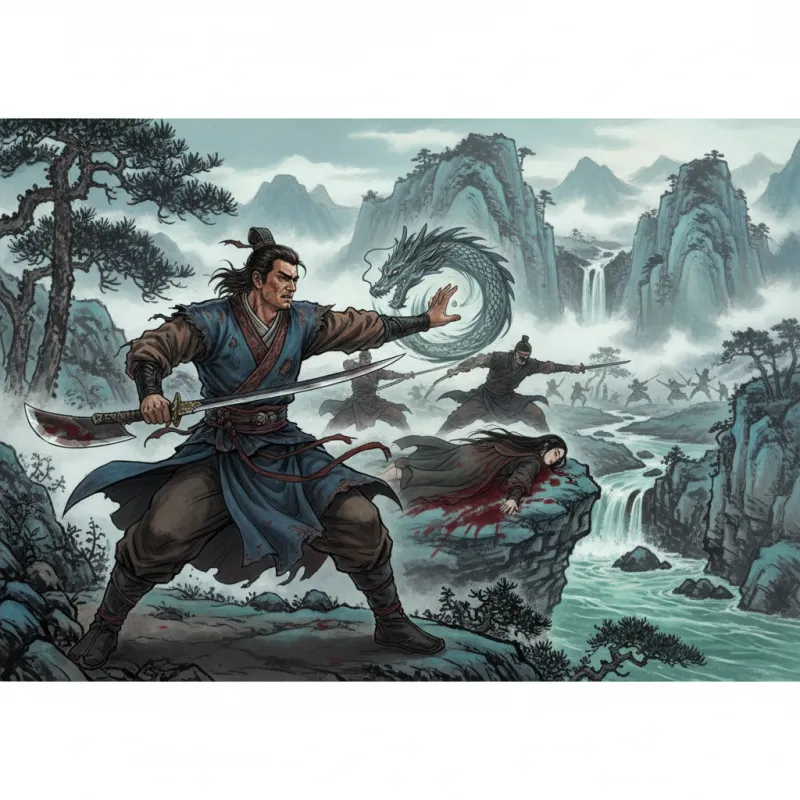
Blood drips from Xiao Feng's hands as he stands atop Yanmen Pass, the wind howling through the mountain gorge where his parents died twenty years before. In his arms lies the woman he loves, an arrow through her heart—an arrow he fired himself. This is not the ending of a villain's tale. This is the fate of Jin Yong's greatest hero, a man whose tragedy cuts so deep that readers still weep over his story sixty years after Demi-Gods and Semi-Devils (天龙八部, Tiānlóng Bābù) was first serialized in 1963.
The Hero Who Had Everything
When we first meet Xiao Feng in Jin Yong's sprawling epic, he's already a legend. As the chief of the Beggars' Sect (丐帮, Gàibāng)—the largest martial arts organization in the jianghu (江湖, the martial arts world)—he commands respect from both righteous heroes and cunning villains. His martial prowess is unmatched; his Eighteen Dragon-Subduing Palms (降龙十八掌, Jiànglóng Shíbā Zhǎng) can shatter stone and split mountains. He's handsome, charismatic, and beloved by his sworn brothers. He drinks wine by the jar, fights injustice wherever he finds it, and embodies everything we admire in a wuxia hero.
But Jin Yong didn't create Xiao Feng to give us a simple power fantasy. He created him to break our hearts.
The Revelation That Destroys Everything
The turning point comes with brutal swiftness. At the Apricot Forest gathering, Xiao Feng learns the truth that will unravel his entire existence: he is not Han Chinese, but Khitan—a member of the Liao Dynasty's ruling ethnic group, the very people the Song Dynasty considers barbarian enemies. His birth name is Qiao Feng (乔峰, Qiáo Fēng), and his biological parents were killed by the same Chinese martial artists who raised him as their own.
What makes this revelation so devastating isn't just the identity crisis—it's the immediate consequences. The martial arts community that once revered him now brands him a spy and traitor. His sworn brothers turn their backs. The Beggars' Sect, which he led with honor and distinction, strips him of his position. In a single day, Xiao Feng loses everything: his identity, his community, his purpose, and his place in the world.
Jin Yong's genius here is showing us that Xiao Feng hasn't changed at all. He's the same righteous, loyal man he was the day before. But in the rigid world of Song Dynasty martial arts politics, ethnicity trumps character. The tragedy isn't that Xiao Feng becomes a villain—it's that he remains a hero in a world that can no longer see him as one.
Caught Between Two Worlds
As Xiao Feng journeys north to discover his roots, he finds himself trapped in an impossible position. The Liao Dynasty welcomes him as a long-lost son, and he rises to become a high-ranking general. But he cannot forget his upbringing in Song China, the values instilled in him by his adoptive father, or the friends who once stood beside him. When war breaks out between Liao and Song, Xiao Feng faces the ultimate dilemma: which side does he fight for?
This is where Demi-Gods and Semi-Devils transcends typical wuxia fiction and becomes something profound. Xiao Feng doesn't choose based on blood or loyalty—he chooses based on justice. He fights to prevent war itself, recognizing that both sides have legitimate grievances and that ordinary people on both sides will suffer. In doing so, he becomes an enemy to both nations, a man without a country who stands alone for a principle that neither side can accept.
Compare this to other tragic heroes in Jin Yong's works—Yang Guo's isolation stems from his forbidden love and unorthodox methods, but he's never truly stateless. Xiao Feng's tragedy is uniquely political and ethnic, reflecting the complex history of China's relationship with its northern neighbors throughout the Song Dynasty (960-1279 CE).
The Weight of Impossible Choices
The most heartbreaking aspect of Xiao Feng's story is watching him make one impossible choice after another, each one costing him something irreplaceable. He kills his adoptive father in self-defense, a moment that haunts him for the rest of his life. He accidentally kills A'Zhu (阿朱), the woman he loves, in a case of mistaken identity—she disguises herself as his enemy to protect him, and he strikes before recognizing her. Later, he kills A'Zhu's sister A'Zi's (阿紫) beloved to prevent further bloodshed.
Each death weighs on him. Unlike typical wuxia protagonists who rack up body counts without psychological consequence, Xiao Feng carries his guilt like physical wounds. Jin Yong shows us a hero who understands that violence, even righteous violence, has costs. This psychological realism elevates Xiao Feng above the archetypal wandering swordsman and makes him feel achingly human.
The Philosophy of Tragedy
Jin Yong was deeply influenced by Buddhist philosophy, and nowhere is this more evident than in Xiao Feng's arc. The novel's title, Demi-Gods and Semi-Devils, comes from Buddhist cosmology, referring to beings trapped in cycles of suffering despite their power. Xiao Feng embodies this perfectly—his martial prowess and noble character cannot save him from the suffering caused by circumstances beyond his control.
The Buddhist concept of karma (业, yè) permeates his story. The massacre at Yanmen Pass that killed his parents sets in motion a chain of events that leads inexorably to his own destruction. But Jin Yong doesn't present this as cosmic punishment for past sins. Instead, he shows how violence begets violence, how ethnic hatred perpetuates itself across generations, and how even the best intentions cannot break these cycles without tremendous sacrifice.
The Final Stand at Yanmen Pass
Xiao Feng's death is one of the most powerful scenes in all of wuxia literature. Standing at Yanmen Pass—the same location where his parents died—he holds the Liao Emperor hostage and extracts a promise: the Liao will not invade Song China for as long as Xiao Feng lives. Then, to ensure lasting peace and to escape the impossible position he's in, he takes his own life.
It's a suicide, yes, but not one born of despair. It's a calculated sacrifice, the only move left to a man who has run out of options. He cannot live as a Liao general knowing he might one day lead armies against his childhood home. He cannot return to Song China, where he's branded a traitor. He cannot continue existing in the liminal space between two worlds, watching people he cares about on both sides die in senseless conflict.
Some readers find this ending too bleak, but I'd argue it's the only honest conclusion to Xiao Feng's story. Jin Yong doesn't give us a convenient resolution because there isn't one. The ethnic and political tensions that destroyed Xiao Feng's life don't disappear with his death—they continue throughout Chinese history. His sacrifice buys temporary peace, nothing more. But in a world of endless conflict, temporary peace achieved through one man's ultimate sacrifice is itself a form of heroism.
Why Xiao Feng Endures
More than six decades after his creation, Xiao Feng remains the gold standard for tragic heroes in Chinese fiction. He's been portrayed in countless television adaptations, with actors like Huang Rihua (1997), Hu Jun (2003), and Yu Rongguang (2013) each bringing their own interpretation to the role. Fans still debate his choices, still argue about whether he could have found another way, still weep at his ending.
What makes Xiao Feng's tragedy so powerful is its universality wrapped in cultural specificity. You don't need to understand Song-Liao relations to grasp the pain of being rejected by the community that raised you. You don't need to be an expert in Chinese history to feel the weight of impossible choices between loyalty and justice. Xiao Feng's story speaks to anyone who has ever felt caught between two worlds, anyone who has sacrificed for principles that others couldn't understand, anyone who has loved and lost.
Jin Yong created many memorable characters—the cunning Wei Xiaobao, the devoted Guo Jing, the passionate Yang Guo—but none cut as deep as Xiao Feng. He gave us a hero who was too good for the world he lived in, a man whose greatest strengths became the source of his destruction, a warrior who won every battle except the one that mattered most: the battle for a place to belong.
In the end, Xiao Feng's tragedy isn't that he dies. It's that he dies alone, misunderstood by both sides, his sacrifice appreciated by few and remembered by fewer. He deserved better. But then again, that's what makes him the most tragic hero in wuxia—the gap between what he deserved and what he received is as wide as the chasm at Yanmen Pass where he drew his final breath.
Related Reading
- Women Warriors of Wuxia: Breaking Boundaries in the Martial World
- ** Unraveling the Legends of Jianghu: The Cultural Allure of Wuxia Heroes
- Yang Guo: The One-Armed Swordsman
- The Complete Guide to Jianghu Heroes in Wuxia Fiction
- Qu Yuan: The First Named Poet in Chinese History
- Wudang Mountain: The Daoist Heart of Internal Martial Arts
- Internal vs External Martial Arts: The Great Debate
- The Three Pure Ones: Supreme Deities of Daoism
Explore Chinese Culture
- Explore Jin Yong's martial arts novels
- Explore cultivation fiction and immortal heroes
- Explore the real history behind wuxia