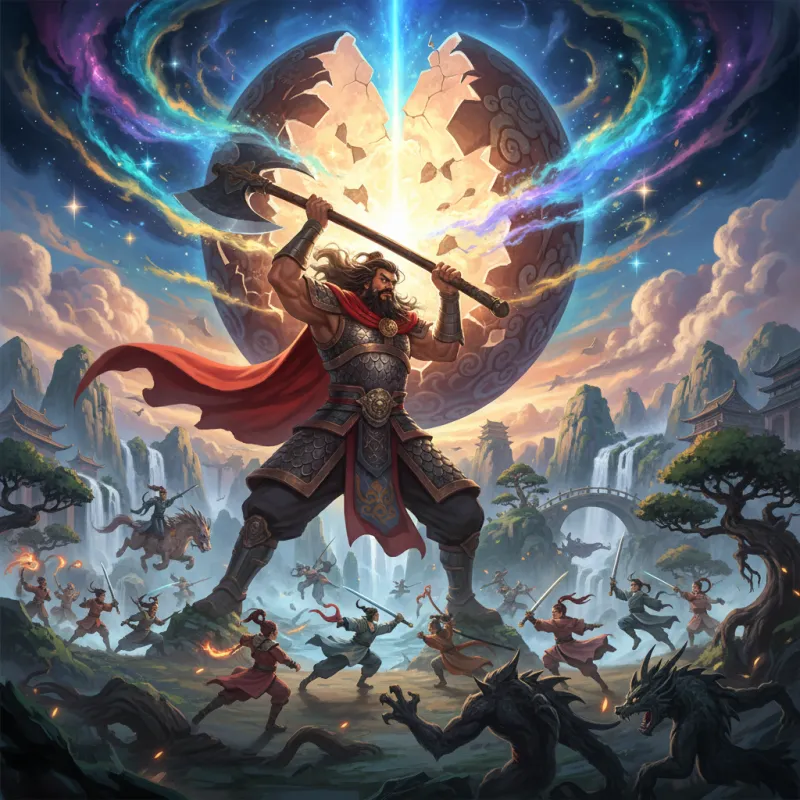
Before there was anything — before sky, before earth, before light or dark or the concept of "before" — there was an egg. And inside that egg, sleeping for eighteen thousand years, was Pangu (盘古 Pángǔ). When he finally woke up, he cracked the universe open with an axe. That's the Chinese creation myth in a nutshell, and it's wilder than most people realize.
The Egg and the Axe
The earliest surviving written version comes from the Sanwu Liji (三五历纪 Sānwǔ Lìjì), compiled by Xu Zheng (徐整 Xú Zhěng) during the Three Kingdoms period (三国 Sānguó, 220–280 CE). The text describes the primordial state as hundun (混沌 hùndùn) — chaos, formlessness, an undifferentiated mass shaped like a chicken's egg.
Inside this cosmic egg, Pangu grew. For eighteen thousand years he slept, and as he slept, the clear and light elements (yang 阳 yáng) began to separate from the heavy and turbid elements (yin 阴 yīn). When Pangu finally woke, he found himself trapped in darkness. So he grabbed an axe — where he got it, nobody says — and swung it with all his strength. The egg shattered. The light elements rose to become the sky (tian 天 tiān), and the heavy elements sank to become the earth (di 地 dì).
But here's where it gets interesting. Pangu didn't just crack the egg and call it a day. He stood between heaven and earth, holding them apart with his own body. Every day, the sky rose ten feet higher. Every day, the earth grew ten feet thicker. And every day, Pangu grew ten feet taller. This went on for another eighteen thousand years.
The Body Becomes the World
After thirty-six thousand years of existence, Pangu finally died. And when he died, his body didn't just decompose — it transformed into the entire physical world. His breath became the wind and clouds. His voice became thunder. His left eye became the sun, his right eye the moon. His four limbs and five extremities became the four cardinal directions and the five sacred mountains (五岳 Wǔyuè). His blood became rivers, his muscles became the soil of fields, his hair and beard became the stars in the sky.
The details vary depending on which text you're reading. Some versions say his sweat became rain and dew. Others claim his bones became minerals and precious stones, his marrow became jade and pearls. The parasites on his body — and yes, the myth specifically mentions parasites — became human beings, blown into life by the wind.
That last detail always struck me as both humbling and oddly fitting. We're not molded from clay by a benevolent creator. We're the fleas on a dead giant's corpse, given consciousness by accident. There's something very Chinese about that — pragmatic, unsentimental, and weirdly profound.
The Southern Origins
Here's what most people don't know: Pangu wasn't originally a Han Chinese myth. The story likely originated among the Miao (苗 Miáo), Yao (瑶 Yáo), and other ethnic groups in southern China. Even today, some Yao communities still worship Pangu as their ancestor, and their oral traditions contain versions of the myth that predate the written Han Chinese accounts.
The Han Chinese didn't really adopt Pangu into their cosmological framework until relatively late — around the third century CE, which is practically yesterday in terms of Chinese civilization. Before that, the dominant creation narrative involved figures like Nüwa (女娲 Nǚwā), who repaired the broken sky and created humanity from yellow earth, or Fuxi (伏羲 Fúxī), who taught humans the arts of civilization.
Why did Pangu suddenly become popular during the Three Kingdoms period? Probably because China was fragmenting into warring states, and people needed a myth about cosmic order emerging from chaos. When your world is falling apart, stories about someone literally holding heaven and earth together have a certain appeal.
Pangu in Wuxia and Popular Culture
You don't see Pangu show up much in classical wuxia novels, but his influence is everywhere. The idea that the universe operates on the principle of yin and yang separation — that's Pangu's doing. The concept that a single individual can stand between heaven and earth, defying cosmic forces through sheer will and physical strength — that's the Pangu archetype.
Jin Yong (金庸 Jīn Yōng) never wrote Pangu into his novels directly, but the philosophical framework is there. When Zhang Wuji learns the Qiankun Danuoyi (乾坤大挪移 Qiánkūn Dànuóyí, Great Art of Cosmic Shift) in The Heaven Sword and Dragon Saber, he's essentially manipulating the same yin-yang forces that Pangu separated at the beginning of time. The internal energy cultivation practiced by martial artists mirrors Pangu's own growth — the gradual accumulation of power over impossibly long periods.
Modern fantasy novels have been more explicit. Huang Yi's (黄易 Huáng Yì) Xunqin Ji (寻秦记 Xúnqín Jì, A Step into the Past) references Pangu's axe as a legendary weapon. Several xuanhuan (玄幻 xuánhuàn, fantasy) web novels have featured protagonists who discover they're reincarnations of Pangu or who find fragments of his axe scattered across the world.
The Axe That Split Reality
Let's talk about that axe for a moment. In most versions of the myth, it's called the Pangu Fu (盘古斧 Pángǔ Fǔ), and it's not just a tool — it's the first weapon, the original instrument of separation and distinction. Before the axe, there was only unity. After the axe, there was duality: heaven and earth, yin and yang, light and dark.
This makes Pangu's axe philosophically different from other legendary weapons in Chinese mythology. The Yellow Emperor's sword, Xuanyuan (轩辕剑 Xuānyuán Jiàn), was a weapon of conquest and unification. Houyi's bow was an instrument of precision and justice. But Pangu's axe was an instrument of creation through destruction, of order through violence.
You can see echoes of this in wuxia weapon philosophy. The greatest weapons aren't just tools of combat — they're instruments that reshape reality. When Dugu Qiubai (独孤求败 Dúgū Qiúbài) progressed from sharp swords to heavy swords to wooden swords to no sword at all, he was following a path that leads back to Pangu: the understanding that true power lies not in the weapon but in the wielder's ability to impose their will on the fundamental structure of existence.
Philosophical Implications
The Pangu myth does something interesting that Western creation myths often don't: it makes creation a physical, exhausting process. God speaks and light appears. But Pangu has to stand there for eighteen thousand years, growing taller every day, holding the sky up with his own body. And then he dies from the effort.
This reflects a deeply Daoist understanding of the universe. The Dao De Jing (道德经 Dàodéjīng) says that the Dao produces the One, the One produces the Two, the Two produces the Three, and the Three produces all things. Pangu is that process embodied — literally. He's not a transcendent creator standing outside his creation. He becomes the creation. His death isn't a tragedy; it's a transformation, a necessary sacrifice that allows multiplicity to emerge from unity.
This is why Pangu resonates so strongly with martial arts philosophy. The greatest martial artists in wuxia fiction don't just learn techniques — they transform themselves. They break through their limitations, shatter their old selves, and become something new. Zhang Sanfeng (张三丰 Zhāng Sānfēng) creating Taijiquan (太极拳 Tàijíquán) after watching a snake and a crane fight. Dugu Qiubai achieving the realm of "no sword." These are Pangu moments — instances where an individual's transformation creates something that didn't exist before.
The Myth We Still Live In
Here's my take: we're still living inside Pangu's body. Every time you practice martial arts, you're working with the same yin-yang forces he separated. Every time you cultivate your internal energy, you're following the same pattern of gradual growth over time. Every time you push past your limits and transform yourself, you're reenacting the moment when Pangu cracked open the cosmic egg.
The myth isn't just about how the world began. It's about how transformation happens — slowly, painfully, through sustained effort over impossible spans of time. Eighteen thousand years of sleep. Eighteen thousand years of standing. That's not a creation myth for people who want quick results.
But it's the perfect creation myth for anyone who's ever spent years mastering a martial art, or cultivating their qi, or trying to understand the deeper patterns of existence. Pangu teaches us that real change — the kind that reshapes reality — requires you to put your whole body into it. Sometimes literally.
The next time you see a wuxia hero standing alone against impossible odds, holding back chaos through sheer determination, remember: they're channeling Pangu. The first hero. The one who held up the sky.
Related Reading
- Real Chinese Martial Arts Schools That Inspired Wuxia Fiction
- The Real History Behind Wuxia Fiction
- The Real History Behind Wuxia: Knight-Errants of Ancient China
- The Knight-Errant (游侠): Real Warriors Who Inspired Wuxia
- The Enigmatic World of Jianghu: A Deep Dive into Wuxia Fiction and Kung Fu Novels
- Internal vs External Martial Arts: The Great Debate
- Romance in Wuxia: Love, Duty, and the Tragedy Between
- The Wuxia Film Renaissance: Why Hong Kong Cinema Matters
Explore Chinese Culture
- Explore Jin Yong's martial arts novels
- Explore cultivation fiction and immortal heroes
- Explore the real history behind wuxia