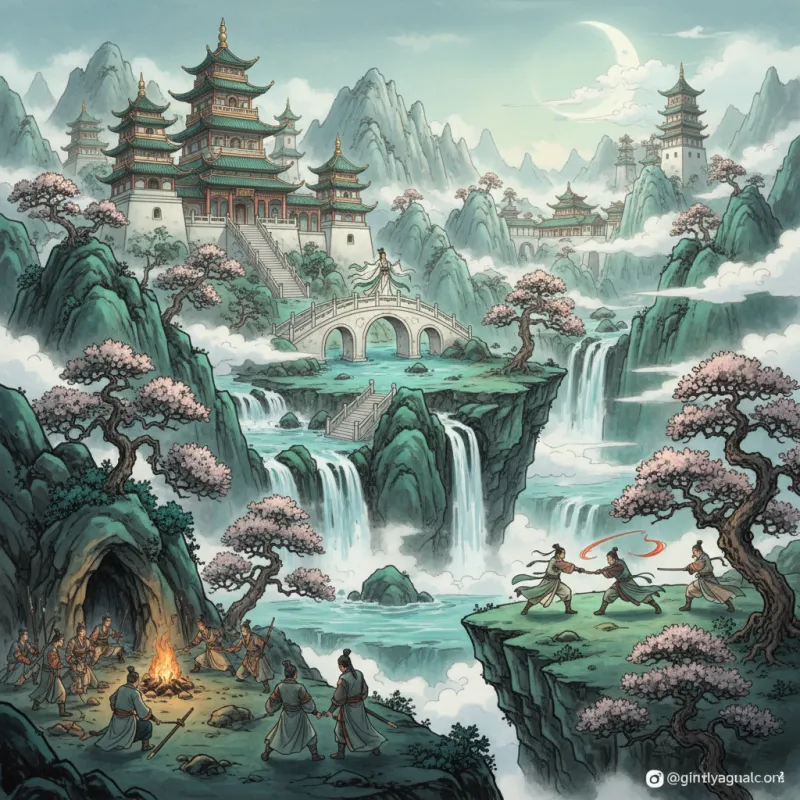
The peach trees bloom once every three thousand years. When they do, every deity, immortal, and celestial bureaucrat in the Chinese cosmos receives an invitation to the most exclusive party in existence — the Peach Banquet at the Jade Palace of Kunlun. Miss this event, and you've missed your chance at immortality for another three millennia. The hostess? The Queen Mother of the West (西王母 Xīwángmǔ), who rules from a palace so magnificent that even the Jade Emperor himself shows up on time.
The Palace That Defines Immortality
The Jade Palace (瑶池宫 Yáochí Gōng) isn't just architecture — it's a statement of cosmic authority. Built entirely from jade that glows with its own inner light, the palace sits at the summit of Kunlun Mountain (昆仑山 Kūnlún Shān), the axis mundi of Chinese cosmology. According to the Shanhaijing (山海经 Shānhǎi Jīng), the earliest geographical text we have, Kunlun rises so high that its peak touches the lowest layer of heaven. The palace itself straddles this boundary, making it the only place where mortals can theoretically reach the divine realm without dying first.
The palace complex includes the famous Jade Pool (瑶池 Yáochí), from which the entire residence takes its alternate name. This isn't decorative water — it's liquid immortality, fed by springs that flow from the roots of the cosmic tree. The Huainanzi (淮南子 Huáinánzǐ), compiled during the Han Dynasty, describes the pool's water as having the consistency of mercury and the taste of sweet dew. Drink from it, and your mortal body begins its transformation into something eternal.
The Queen Mother's Domain
The Queen Mother of the West predates most of Chinese mythology. Early texts from the Warring States period describe her not as the elegant matron of later stories, but as a wild deity with tiger teeth and a leopard's tail. By the Han Dynasty, she'd undergone a complete image makeover, transforming into the refined goddess we know today — but her power never diminished. She controls the Peaches of Immortality, manages the celestial bureaucracy's guest list, and serves as the ultimate authority on who gets to live forever.
Her palace reflects this dual nature. The outer courtyards maintain perfect Confucian order, with ranks of immortal attendants performing their duties with bureaucratic precision. But venture deeper into the complex, past the formal reception halls, and you'll find gardens where phoenixes nest in jade trees and nine-tailed foxes serve as palace guards. The innermost sanctum, where the Queen Mother herself resides, exists partially outside normal space-time — visitors report that hours inside feel like minutes, while minutes can stretch into days.
The Peach Garden That Broke Sun Wukong
The most famous feature of the Jade Palace is undoubtedly the Peach Garden (蟠桃园 Pántáo Yuán). Journey to the West (西游记 Xīyóu Jì) dedicates an entire chapter to Sun Wukong's rampage through this garden, and for good reason — these aren't ordinary fruit trees. The garden contains three thousand peach trees, divided into three tiers based on their ripening cycles.
The front tier trees ripen every three thousand years. Eat one of these peaches, and you gain basic immortality — you stop aging, but you're not invincible. The middle tier ripens every six thousand years, granting not just immortality but also the ability to fly and eternal youth. The back tier, the trees that grow closest to the palace itself, ripen every nine thousand years. These peaches grant complete transcendence — eat one, and you become equal to heaven and earth itself, your lifespan matching the cosmos.
When Sun Wukong ate his way through all three tiers in a single afternoon, he didn't just commit theft — he disrupted the entire celestial hierarchy. The Peach Banquet had to be cancelled, immortals who'd been counting on their three-thousand-year boost were left mortal, and the Queen Mother herself had to wait another cycle to replenish her supply. No wonder the Jade Emperor mobilized the entire heavenly army to bring the Monkey King down.
Architecture of Transcendence
The palace's design follows principles that predate human architecture. The main hall features nine levels, each corresponding to one of the nine heavens in Chinese cosmology. The pillars are carved from single pieces of jade so large that their origins remain mysterious — no earthly mountain contains jade deposits of that size. The roof tiles are made from phoenix feathers that never decay, and the floors are polished to such perfection that they reflect not your current appearance but your true spiritual form.
The throne room deserves special mention. Here, the Queen Mother receives petitioners, judges disputes between immortals, and makes decisions that ripple through both heaven and earth. The throne itself is carved from a single piece of kunlun jade (昆仑玉 Kūnlún yù), a material that exists nowhere else in creation. Sitting on this throne grants the occupant perfect clarity of thought and the ability to see through any deception — which explains why so few dare to lie in the Queen Mother's presence.
The Banquet That Structures Heaven
The Peach Banquet (蟠桃会 Pántáo Huì) isn't just a party — it's the social event that maintains cosmic order. Held once every three thousand years when the front-tier peaches ripen, the banquet serves as a census of the immortal population, a renewal of celestial hierarchies, and a reminder of who really holds power in heaven. The guest list is curated with ruthless precision. Miss an invitation, and you've essentially been declared irrelevant by the highest authority in the cosmos.
The banquet hall can accommodate ten thousand guests simultaneously, yet it never feels crowded. Space inside the palace operates on different principles than normal geometry — there's always room for one more immortal, one more table, one more toast to eternal life. The menu includes not just the famous peaches but also delicacies from across the three realms: dragon liver, phoenix marrow, jade wine that sparkles with starlight, and dishes whose names have been lost to mortal memory.
Modern Echoes in Wuxia Fiction
Contemporary wuxia novels have seized on the Jade Palace as the ultimate destination for martial artists seeking transcendence. In these stories, reaching Kunlun and gaining an audience with the Queen Mother represents the pinnacle of martial achievement — beyond mere mastery of internal energy cultivation or legendary weapons. The palace becomes a test: can you maintain your humanity while standing in the presence of absolute immortality?
Some authors place fragments of the palace in the mortal world — a jade pavilion that appears once a century, a pool whose waters grant temporary immortality, a peach tree that somehow took root in the jianghu. These echoes serve as plot devices, certainly, but they also reflect something deeper: the human desire to believe that transcendence isn't locked away in an unreachable heaven but might be found, with enough dedication and luck, in our own world.
The Palace That Watches
Here's what the old texts don't emphasize but the careful reader notices: the Jade Palace isn't just a residence. It's an observation post. From her throne, the Queen Mother can see everything that happens in the three realms. She watches martial artists perfect their techniques, observes emperors rise and fall, and tracks the movements of every immortal under heaven's jurisdiction. The palace's position at the axis of the cosmos isn't just symbolic — it's strategic.
This surveillance explains why so few immortals dare to scheme against the celestial order. You can't plot rebellion when the Queen Mother might be watching from her jade throne, sipping tea made from thousand-year-old leaves while your conspiracy unfolds in her peripheral vision. The palace isn't just the home of immortality — it's the panopticon that keeps the cosmos running smoothly.
The Jade Palace endures in Chinese mythology because it represents something we all understand: the place where power lives is never just a building. It's a symbol, a warning, and a promise all at once. The Queen Mother's residence reminds us that immortality comes with a price — eternal life under eternal observation, freedom from death but not from hierarchy, transcendence that still requires you to show up to the banquet on time.
Related Reading
- Sacred Objects of Chinese Mythology: Seals, Mirrors, and Cauldrons
- The Hetu and Luoshu: Magical Diagrams from the Rivers
- Exploring the Cultural Depth of Wuxia: The Art of Chinese Martial Arts Fiction
- Huang Rong: The Smartest Heroine in Chinese Fiction
- Exploring the Evolution of Wuxia: Modern Influences on Chinese Martial Arts Fiction
- Chinese Internet Ghost Stories: The Creepypasta of the East
Explore Chinese Culture
- Explore Jin Yong's martial arts novels
- Explore cultivation fiction and immortal heroes
- Explore the real history behind wuxia