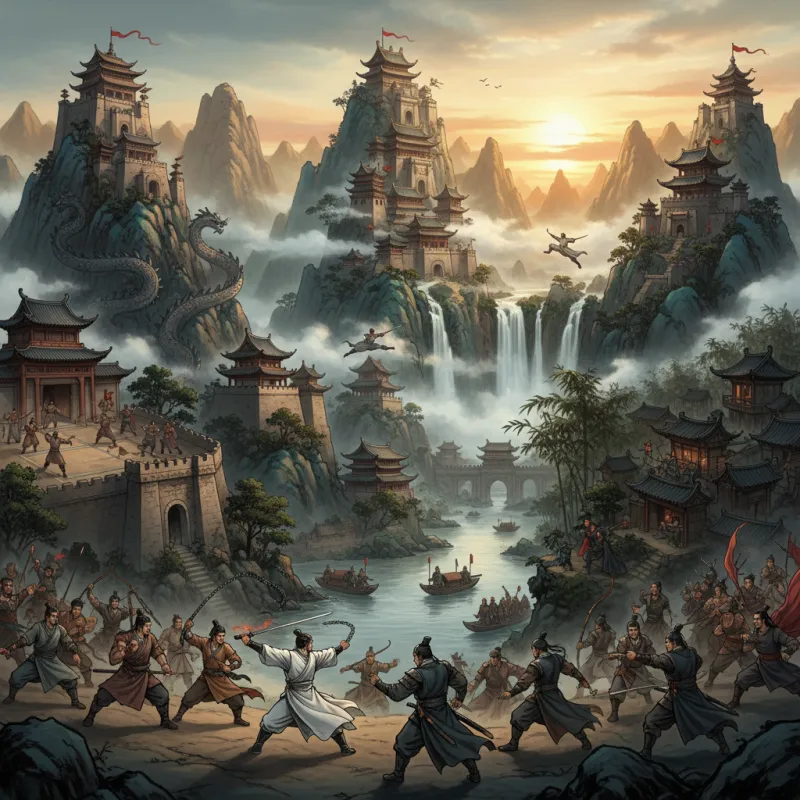
The abbot's hand trembles as he signs the alliance treaty. Around the table sit representatives from eight major sects, each one capable of fielding a thousand fighters. Outside, their disciples wait in tense formation. One wrong word, one perceived slight, and the Wulin Conference could dissolve into bloodshed. This is the martial world (江湖, jiānghú) — not a romantic landscape of wandering heroes, but a cutthroat political arena where organizations wield more power than any individual master.
The Sect vs. Clan Divide
Most readers treat "sect" and "clan" as interchangeable terms. They're not. A sect (门派, ménpài) recruits disciples based on talent and accepts outsiders. A clan (世家, shìjiā) passes martial arts through bloodlines and guards its techniques like state secrets. The Wudang Sect takes in orphans and peasants who show promise. The Murong Clan of Gusu? You're born into it or you're forever an outsider.
This distinction shapes everything. Sects grow larger and more diverse but face constant internal power struggles as ambitious disciples challenge their masters. Clans maintain tighter control and loyalty but risk stagnation when the bloodline produces mediocre martial artists. Jin Yong understood this tension perfectly — in Demi-Gods and Semi-Devils, the Murong Clan's obsession with bloodline purity becomes their tragic flaw, while Shaolin's open recruitment policy makes them the dominant force in jianghu.
The political implications run deep. Sects form alliances through shared philosophy or mutual enemies. Clans marry into each other, creating Byzantine webs of obligation and betrayal. When Guo Jing marries Huang Rong in The Legend of the Condor Heroes, he's not just winning a bride — he's binding the Beggar Clan to the Peach Blossom Island alliance network.
The Big Five: Orthodox Sect Hierarchy
Ask any jianghu veteran to name the orthodox sects (正派, zhèngpài), and you'll hear the same five names. Shaolin Temple (少林寺, Shàolín Sì) sits at the apex, its thousand-year history and Buddhist legitimacy making it the moral authority of the martial world. When Shaolin speaks, other sects listen — or at least pretend to.
Wudang Mountain (武当山, Wǔdāng Shān) runs a close second, founded by the legendary Zhang Sanfeng during the Yuan Dynasty. Their Taoist philosophy positions them as Shaolin's intellectual counterweight. The rivalry between Buddhist hard styles and Taoist soft styles isn't just martial — it's ideological warfare played out through forms and techniques.
Emei Sect (峨眉派, Éméi Pài) holds the third position, notable for being female-dominated in a male-controlled jianghu. Don't mistake this for progressive politics — Emei's nuns can be as ruthless and dogmatic as any male sect leader. Guo Xiang founded Emei after her heartbreak over Yang Guo, and that romantic tragedy infused the sect with a peculiar mix of Buddhist compassion and bitter pragmatism.
The Kunlun Sect (昆仑派, Kūnlún Pài) and Kongtong Sect (崆峒派, Kōngtóng Pài) round out the five, though their influence waxes and wanes depending on which novel you're reading. They're the middle management of jianghu politics — powerful enough to matter in alliance negotiations, not powerful enough to dictate terms.
Heterodox Sects: The Loyal Opposition
The term "heterodox sect" (邪派, xiépài) is orthodox propaganda. These organizations — the Ming Cult (明教, Míngjiào), the Sun Moon Holy Cult (日月神教, Rìyuè Shénjiào), the Venom Sect (毒派, Dú Pài) — practice martial arts that orthodox sects find disturbing. Poison techniques. Seduction arts. Methods that corrupt qi or damage the practitioner's body.
But "heterodox" doesn't mean evil. Jin Yong's The Heaven Sword and Dragon Saber systematically deconstructs this binary. The Ming Cult practices Zoroastrianism and fights against Mongol oppression — they're religious minorities and political rebels, not cartoon villains. Meanwhile, the "righteous" orthodox sects scheme, betray, and murder with the best of them. They just do it while quoting Confucius.
The political reality is simpler: heterodox sects threaten the status quo. They recruit from society's margins — criminals, outcasts, ethnic minorities. They don't respect the territorial boundaries that orthodox sects have carved up over centuries. And they refuse to acknowledge Shaolin's moral authority, which is the real crime in orthodox eyes.
The Beggar Clan: Democracy in Jianghu
The Beggar Clan (丐帮, Gàibāng) deserves its own section because it breaks every rule. It's not a sect — beggars don't train in monasteries. It's not a clan — bloodline means nothing when you're sleeping in gutters. Yet it's consistently portrayed as one of the most powerful organizations in jianghu, with branches in every city and an intelligence network that would make modern spy agencies jealous.
The Clan's strength comes from its structure. Leadership is determined by merit, specifically by mastering the Dog Beating Staff Technique (打狗棒法, Dǎgǒu Bàngfǎ) and possessing the Dog Beating Staff itself. This creates a meritocracy rare in jianghu — Hong Qigong rose from street beggar to Clan Leader purely through skill. Compare this to hereditary sect leadership, where mediocre masters inherit power because their surname is right.
The Beggar Clan also maintains strict internal discipline through its bag system. Nine-bag elders command respect equal to major sect leaders. Four-bag members are competent fighters. New recruits start with no bags and earn them through service. It's a military hierarchy disguised as a beggar's organization, and it works because beggars understand something wealthy sect disciples don't — survival requires discipline.
Sect Politics: The Real Martial Arts
The most devastating techniques in wuxia aren't martial arts — they're political maneuvers. Succession crises destroy more sects than external enemies. In Smiling, Proud Wanderer, the Huashan Sect's split between Sword Sect and Qi Sect factions weakens them so thoroughly that they become pawns in Yue Buqun's schemes. The actual martial arts dispute (should we emphasize swordplay or internal energy?) matters less than the power struggle it enables.
Sect conferences (武林大会, wǔlín dàhuì) are political theater. The nominal purpose — discussing threats to jianghu, forming alliances, resolving disputes — takes a backseat to status displays and power plays. Who sits where? Who speaks first? Which sect's disciples guard the doors? Every detail signals relative power, and every sect leader is calculating advantages.
The Jianghu Code theoretically governs these interactions, but it's more like international law — honored when convenient, ignored when not. Sects invoke the code to justify their actions and condemn their enemies' identical actions. The code against killing sect members? Doesn't apply when those members are "traitors." The prohibition on stealing martial arts manuals? Doesn't count when you're "recovering" techniques that were "originally" yours.
The Economics of Martial Arts
Here's what wuxia novels rarely discuss: sects need money. Lots of it. Shaolin Temple maintains thousands of monks, a massive library, training facilities, and weapons. Where does the funding come from? Temple donations, sure, but also land holdings, business investments, and protection arrangements that look suspiciously like extortion.
Wealthy clans have it easier — the Murong family's fortune funds their martial arts obsession. But even they need to manage assets, collect rents, and occasionally engage in less savory business. The Beggar Clan runs an information brokerage. Wudang sells talismans and medicinal pills. The Ming Cult, during its Persian origins, controlled trade routes.
This economic reality shapes sect politics. Territorial disputes are often about controlling profitable regions. Alliance negotiations include trade agreements. When sects go to war, they're fighting over resources as much as honor. The Martial Arts Manuals that sects guard so jealously? They're intellectual property worth fortunes.
The Cycle of Rise and Fall
No sect rules forever. Shaolin's dominance in the Tang Dynasty gave way to Wudang's rise in the Yuan. The Ming Cult went from heretical rebels to legitimate power brokers. Sects rise through military victory, charismatic leadership, or developing superior martial arts. They fall through internal corruption, succession failures, or simply being on the wrong side of dynastic politics.
Jin Yong's novels span centuries, and you can track this cycle. The Xiaoyao Sect in Demi-Gods and Semi-Devils is ancient and powerful. By The Smiling, Proud Wanderer, set centuries later, it's extinct — its techniques scattered, its disciples dead or absorbed into other sects. Meanwhile, new organizations emerge. The Sun Moon Holy Cult didn't exist in earlier eras but dominates the jianghu of Linghu Chong's time.
This impermanence is the point. Wuxia fiction uses sect politics to explore how institutions corrupt, how power concentrates, and how even the most righteous organizations eventually become what they once opposed. The orthodox sects that fought the Ming Cult's "heresy" in one generation become the oppressive establishment that the next generation's heroes must resist. The martial world turns, and the sects turn with it — or fall beneath its wheels.
Related Reading
- Exploring Chinese Martial Arts Fiction and Jianghu Culture in Kung Fu Novels
- Shaolin Temple: The Sacred Mountain of Martial Arts
- The Beggars Sect: How a Gang of Homeless People Became the Largest Organization in the Martial World
- The Beggar Sect: The Largest and Most Unlikely Martial Arts Organization
- Shaolin Temple: The Birthplace of Chinese Martial Arts
- Legendary Weapons of Wuxia: The Swords That Have Names
- The Mountain Gods: Nature Deities in the Daoist Pantheon
- The Enigmatic World of Jianghu: A Deep Dive into Wuxia Fiction and Kung Fu Novels
Explore Chinese Culture
- Explore Jin Yong's martial arts novels
- Explore cultivation fiction and immortal heroes
- Explore the real history behind wuxia