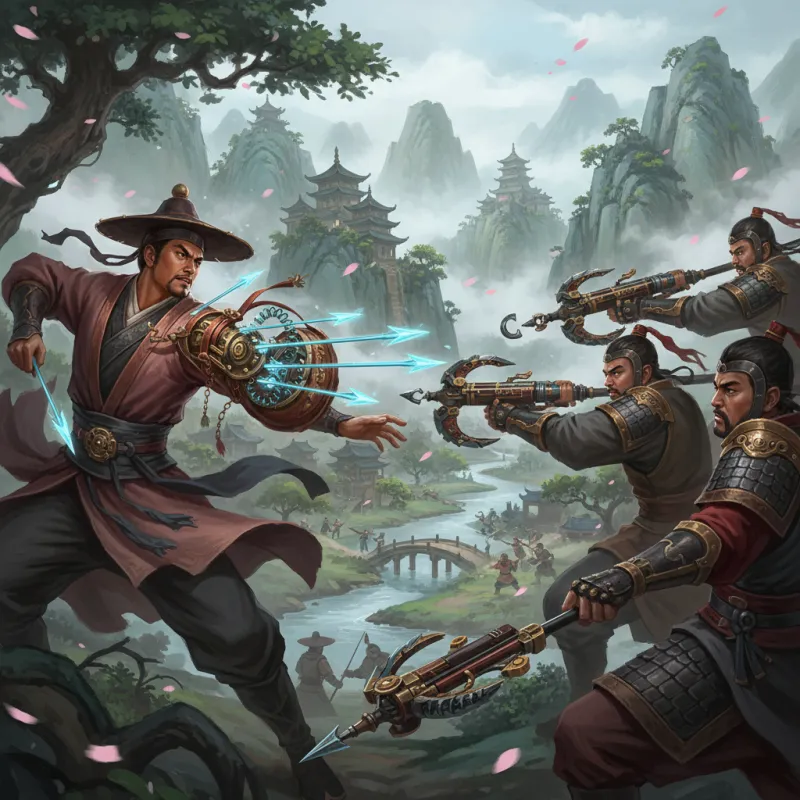
A Tang Sect disciple raises their arm, and three men collapse before anyone hears the click. No dramatic sword draw, no shouted technique names, no warning at all. Just a subtle gesture and the whisper of spring-loaded death. This is the sleeve arrow (袖箭 xiùjiàn) — the weapon that turned assassination into an art form and made "hidden weapon master" one of the most feared titles in jianghu.
The Mechanics of Instant Death
Strip away the mystique and a sleeve arrow is elegant engineering: a spring mechanism, a release trigger, and a projectile channel, all compact enough to strap beneath your sleeve. The genius isn't in complexity — it's in the marriage of concealment and lethality. While a sword announces your intentions from across the room, a sleeve arrow stays invisible until the moment it matters.
The classic design uses a coiled spring compressed by a catch mechanism. Flex your wrist in a specific way, and a hidden trigger releases the tension, launching a dart at velocities that would make crossbow manufacturers jealous. The best versions, like those described in Gu Long's novels, could fire multiple projectiles in sequence — three, five, even seven shots before reloading. The Tang Sect (唐门 Tángmén) in particular elevated this to an art, with their sleeve arrows capable of firing poison-tipped needles that could kill with a scratch.
What makes sleeve arrows particularly nasty in wuxia fiction is their synergy with internal energy. A martial artist with strong qi (气 qì) control doesn't just rely on the spring — they can add force to the projectile mid-flight, curve its trajectory, or even split one dart into multiple strikes. In "Demi-Gods and Semi-Devils," Murong Fu's family techniques include methods for catching incoming sleeve arrows and redirecting them back at the attacker, turning the weapon into a psychological trap as much as a physical one.
The Crossbow's Smaller, Meaner Cousin
If sleeve arrows are pistols, then wrist crossbows (腕弩 wànnǔ) are the sawed-off shotguns of hidden weapons. Slightly larger, more powerful, and absolutely devastating at close range. The mechanism is similar — spring-loaded tension — but the bolt is heavier, the draw strength greater, and the stopping power enough to punch through light armor.
The Zhuge repeating crossbow (诸葛连弩 Zhūgě liánnǔ), named after the legendary Three Kingdoms strategist, represents the pinnacle of this design philosophy. Historical versions could fire ten bolts in fifteen seconds — a rate of fire that wouldn't be matched by handheld weapons until the advent of revolvers. In wuxia fiction, these get upgraded to absurd levels. Jin Yong's version in "The Heaven Sword and Dragon Saber" fires poison bolts that can drop a master-level fighter in seconds, and the reload mechanism is fast enough to maintain suppressive fire.
What's interesting is how these weapons democratize combat. A low-level disciple with a Zhuge crossbow can threaten a master who's spent thirty years in closed-door cultivation. This creates tension in the narrative — the weapons become equalizers, which is why orthodox sects often look down on them as "unrighteous" (邪道 xiédào) tools. The subtext is clear: if skill doesn't guarantee victory, what's the point of the martial hierarchy?
Mechanisms That Would Make Rube Goldberg Proud
Wuxia fiction loves its elaborate death machines. The Tang Sect's hidden weapon arsenal reads like a Renaissance inventor's fever dream crossed with a paranoid assassin's wish list. Spring-loaded blades that deploy from belt buckles. Rings that fire needles when you make a fist. Boots with retractable spikes. Fans that double as blade launchers. Every surface, every accessory, every piece of clothing becomes a potential weapon.
The mechanical complexity serves a narrative purpose. These aren't just tools — they're character statements. When a fighter relies on mechanical hidden weapons, they're announcing a philosophy: preparation over improvisation, certainty over chance, engineering over enlightenment. The Tang Sect's reputation doesn't come from their martial arts prowess (though that's formidable) — it comes from their willingness to turn their bodies into walking arsenals.
Consider the "Rainstorm Pear Blossom Needle" (暴雨梨花针 Bàoyǔ Líhuā Zhēn) from Gu Long's works. A cylinder loaded with dozens of needles, triggered by a single mechanism, creating a cone of death that's nearly impossible to dodge. The name is poetic, the function is brutal, and the message is clear: sometimes overwhelming firepower beats elegant technique. The weapon appears in "The Legendary Siblings," where it's used to devastating effect against opponents who assumed their lightness skills (轻功 qīnggōng) would keep them safe.
The Philosophy of the Spring-Loaded Strike
Here's where it gets interesting: wuxia fiction treats mechanical weapons as philosophically distinct from traditional martial arts. A sword is an extension of your body, your qi, your will. A sleeve arrow is a tool — effective, reliable, but somehow less "pure." This distinction matters because it creates a class system within the martial world.
Orthodox sects (正派 zhèngpài) tend to view mechanical weapons with suspicion. They're associated with the unorthodox path (邪派 xiépài), with assassins and poisoners and people who strike from shadows rather than facing opponents honorably. But this is propaganda, not reality. The Shaolin Temple might preach about righteous combat, but they're not above using hidden weapons when the situation demands it. The difference is framing — when heroes use sleeve arrows, it's "tactical adaptation." When villains use them, it's "cowardly ambush."
The Tang Sect exists in this interesting middle ground. They're respected for their craftsmanship and feared for their lethality, but never quite accepted by the orthodox establishment. Their mechanical weapons are too effective, too reliable, too independent of traditional cultivation methods. A Tang Sect disciple with a sleeve full of poison darts can threaten a Wudang master who's spent decades perfecting their sword forms. That's not just dangerous — it's ideologically threatening.
Engineering Meets Internal Energy
The really sophisticated applications come when mechanical weapons interface with internal energy cultivation. A basic sleeve arrow relies on spring tension. An advanced one channels the user's qi through the mechanism, amplifying force, adding spin, or even imbuing the projectile with elemental properties.
In "The Smiling, Proud Wanderer," the Sun Moon Holy Cult's hidden weapon masters can fire needles that carry their internal energy, allowing them to disrupt an opponent's qi flow on impact. The mechanical launch is just the delivery system — the real weapon is the energy payload. This creates interesting tactical scenarios where blocking the physical projectile isn't enough; you need to also defend against the energy attack riding along with it.
The Murong family's "Returning You With Your Own Methods" (以彼之道还施彼身 yǐ bǐ zhī dào huán shī bǐ shēn) technique takes this further. They can catch incoming projectiles — arrows, darts, needles — and redirect them using their internal energy, effectively turning any mechanical weapon into a boomerang. This makes sleeve arrows particularly risky against high-level opponents who've mastered energy manipulation. Your weapon becomes their weapon, and the spring mechanism that seemed so reliable becomes a liability.
The Arms Race Nobody Talks About
Wuxia fiction rarely dwells on this, but there's an implicit arms race happening in the background. As hidden weapons become more sophisticated, defensive techniques evolve to counter them. Protective qi barriers (护体罡气 hùtǐ gāngqì) that can deflect projectiles. Sensory techniques that detect the click of a release mechanism. Movement arts that make targeting impossible.
This creates an escalation cycle. Weapons get faster, more powerful, more numerous. Defenses get stronger, more comprehensive, more paranoid. The Tang Sect develops needles thin enough to slip through qi barriers. Orthodox sects develop detection methods sensitive enough to hear a spring compress. Back and forth, innovation driving counter-innovation, until you get scenarios like the one in "Demi-Gods and Semi-Devils" where Duan Yu's Six Meridians Divine Sword can intercept individual needles mid-flight by firing focused qi beams.
The economic implications are fascinating too. A quality sleeve arrow mechanism isn't cheap. The springs need to be precisely calibrated, the release mechanism reliable under stress, the mounting secure enough to handle repeated firing. This means mechanical weapons create a market — craftsmen, materials, maintenance, upgrades. The Tang Sect's wealth doesn't come from their martial arts manuals; it comes from being the jianghu's premier weapons manufacturer.
Why Mechanisms Matter More Than Mysticism
At the end of the day, sleeve arrows and mechanical weapons represent something crucial in wuxia fiction: the acknowledgment that not every problem can be solved by meditating harder. Sometimes you need engineering. Sometimes you need a spring-loaded surprise. Sometimes the difference between life and death is whether you remembered to reload.
The best wuxia stories understand this. They don't treat mechanical weapons as lesser or cowardly — they treat them as different tools for different situations. A sleeve arrow won't help you achieve enlightenment or break through to the next cultivation level, but it will absolutely save your life when three assassins jump you in an alley. And in the jianghu, where survival often comes down to split-second decisions, that reliability matters more than philosophical purity.
The sleeve arrow endures in wuxia fiction because it's the great equalizer, the weapon that says skill and preparation can triumph over raw power. It's the underdog's choice, the pragmatist's tool, and the assassin's signature. One click, one flick of the wrist, and the entire balance of a fight shifts. That's not just good engineering — that's good storytelling.
Related Reading
- The Tang Clan: Masters of Hidden Weapons and Poison
- Unveiling Hidden Weapons in Wuxia: The Intrigue of Jianghu Culture
- Throwing Knives, Needles, and Darts: The Hidden Weapon Arsenal
- Hidden Weapons in Wuxia: The Deadly Art of Surprise
- The Concealed Weapon Arsenal: Every Hidden Weapon in the Jianghu
- Chinese Mythology in Hollywood: From Mulan to Shang-Chi
- Penglai Island: The Legendary Isle of Immortals
- Jianghu Terminology Glossary: Essential Martial World Vocabulary
Explore Chinese Culture
- Explore Jin Yong's martial arts novels
- Explore cultivation fiction and immortal heroes
- Explore the real history behind wuxia