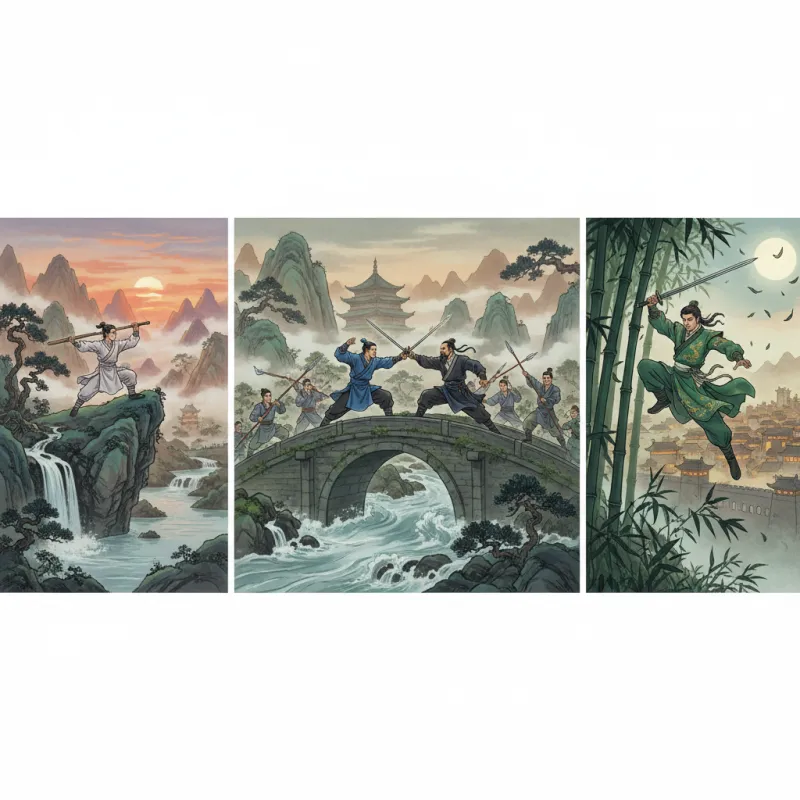
The young swordsman plummets through mist and pine branches, his scream swallowed by the gorge. Three months later, he walks back into the jianghu with eyes that have seen the void—and hands that can split mountains. Every wuxia reader knows this moment. We've watched it happen to Zhang Wuji, Linghu Chong, Duan Yu, and dozens of others. The training montage isn't just a narrative shortcut in Chinese martial arts fiction—it's a philosophical statement about transformation, suffering, and what it actually takes to become extraordinary.
The Anatomy of Ascension
Wuxia training sequences follow patterns so reliable they've become genre DNA. The hero doesn't just "get better at kung fu." They undergo complete reconstruction—physical, mental, and spiritual. Jin Yong's (金庸 Jīn Yōng) characters exemplify this perfectly. When Zhang Wuji learns the Jiuyang Shengong (九阳神功 Jiǔyáng Shéngōng, Nine Yang Divine Skill) in The Heaven Sword and Dragon Saber, he spends years circulating qi through meridians while trapped in a cave. The novel dedicates chapters to his internal cultivation, describing how the technique purges poison from his body while rebuilding his foundation from nothing.
Compare this to Western training montages—Rocky running up stairs, Karate Kid painting fences. Those sequences emphasize repetition and grit. Wuxia training emphasizes enlightenment. The hero doesn't just practice moves; they comprehend principles. Linghu Chong (令狐冲 Lìnghú Chōng) masters the Dugu Nine Swords (独孤九剑 Dúgū Jiǔjiàn) not through drilling forms, but by understanding the philosophy of "no moves." The training is intellectual and mystical as much as physical.
The Miraculous Encounter Economy
Chinese readers call it qíyù (奇遇 qíyù)—the miraculous encounter. It's become so ubiquitous that modern web novels parody it relentlessly. The hero falls off a cliff and finds: a skeleton holding a manual, a dying master who transfers their power, a hidden sect's forbidden technique, a magical fruit that transforms their constitution, or an ancient spirit trapped in a ring who becomes their mentor.
Gu Long (古龙 Gǔ Lóng) subverted this trope brilliantly. His heroes often train through suffering and experience rather than convenient discoveries. Li Xunhuan (李寻欢 Lǐ Xúnhuān) in Sentimental Swordsman, Ruthless Sword perfected his flying dagger through heartbreak and tuberculosis, not through finding a secret manual. The training happened in the margins of his tragic life, making his skill feel earned rather than gifted.
But Jin Yong understood something crucial: the miraculous encounter isn't lazy writing—it's a test of character. Duan Yu (段誉 Duàn Yù) stumbles into the Beiming Divine Skill and Lingbo Weibu techniques in Demi-Gods and Semi-Devils, but his gentle nature means he refuses to use them violently. The power doesn't corrupt him because his foundation was already solid. The encounter reveals character; it doesn't create it.
Suffering as Curriculum
The most memorable wuxia training sequences involve extraordinary suffering. This isn't sadism—it's rooted in Buddhist and Daoist concepts about transformation through tribulation. Yang Guo (杨过 Yáng Guò) spends sixteen years separated from Xiaolongnü, and that suffering becomes his training. His Dismal Ecstasy Palm (黯然销魂掌 Ànrán Xiāohún Zhǎng) draws power directly from heartbreak. The technique literally cannot be learned without experiencing profound loss.
Xiao Feng (萧峰 Xiāo Fēng) in Demi-Gods and Semi-Devils undergoes a different kind of suffering—identity crisis and moral anguish. His training isn't about learning new techniques; it's about maintaining his principles while his entire world collapses. When he finally uses the Eighteen Dragon-Subduing Palms (降龙十八掌 Jiàng Lóng Shíbā Zhǎng) at Yanmen Pass, the power comes from his resolved character, not from any secret manual.
Modern cultivation novels have industrialized this concept into "tribulations" (劫 jié)—literal cosmic tests that practitioners must survive to advance. But they often miss the psychological depth that made Jin Yong's suffering meaningful. Zhang Wuji's years of poison and isolation taught him compassion. Yang Guo's separation taught him devotion. The suffering had narrative purpose beyond power-leveling.
The Master-Student Dynamic
The shifu (师父 shīfu, master) relationship defines many training sequences. But wuxia masters are terrible teachers by conventional standards. They're cryptic, absent, or outright abusive. Hong Qigong (洪七公 Hóng Qīgōng) teaches Guo Jing (郭靖 Guō Jìng) the Eighteen Dragon-Subduing Palms between meals, treating martial arts instruction as casual conversation. Feng Qingyang (风清扬 Fēng Qīngyáng) appears for a few days to teach Linghu Chong, then vanishes forever.
This reflects Daoist and Chan Buddhist teaching methods—the master provides the key, but the student must unlock the door themselves. Direct instruction is considered inferior to sudden enlightenment. When Dugu Qiubai (独孤求败 Dúgū Qiúbài) leaves behind his swords and cryptic notes rather than a detailed manual, he's forcing future students to comprehend principles rather than memorize techniques.
The worst masters often produce the best students. Zhou Botong (周伯通 Zhōu Bótōng) is a childish eccentric who teaches Guo Jing the Seventy-Two Empty Hands while playing games. Huang Yaoshi (黄药师 Huáng Yàoshī) is a morally ambiguous hermit who barely tolerates students. Yet both produce exceptional martial artists because they teach understanding, not obedience.
Time Compression and Transformation
Wuxia training exists in strange temporal spaces. A hero enters a cave and emerges years later, but the reader experiences it in paragraphs. This compression serves a purpose—it emphasizes the result over the process. We don't need to watch every day of Zhang Wuji's cultivation because the point isn't the repetition; it's the transformation.
Some novels play with this brilliantly. In The Smiling, Proud Wanderer, Linghu Chong learns the Dugu Nine Swords in days, while others spend decades mastering lesser techniques. The novel suggests that true understanding transcends time—when the student is ready, the teaching happens instantly. This aligns with Chan Buddhist concepts of sudden enlightenment (顿悟 dùnwù) versus gradual cultivation (渐悟 jiànwù).
Modern cultivation novels have made this explicit with "closed-door cultivation" (闭关 bìguān)—practitioners enter seclusion for years or centuries, emerging transformed. But they often lose the narrative tension. Jin Yong's training sequences maintained stakes because the world continued moving. Zhang Wuji's enemies didn't pause while he cultivated. His emergence was dramatic because he'd been absent from the story, creating anticipation.
The Return and Recognition
The training montage culminates in the return—when the transformed hero re-enters the jianghu. This moment is pure catharsis. Zhang Wuji walks into a confrontation that would have killed him months earlier and casually defeats masters who once terrified him. Yang Guo returns after sixteen years and his mere presence shifts the balance of power in the martial world.
But the best returns include non-recognition. The hero has changed so fundamentally that old friends don't recognize them. This isn't just physical transformation—it's spiritual. Linghu Chong returns from learning the Dugu Nine Swords and his entire approach to swordsmanship has changed. He's not just stronger; he sees the world differently.
The recognition scene often involves the hero demonstrating their new abilities in ways that shock observers. When Duan Yu accidentally uses Lingbo Weibu to dodge attacks, experienced martial artists recognize the legendary technique and realize they're witnessing something extraordinary. These moments work because wuxia worlds have martial arts hierarchies where knowledgeable observers can assess skill levels instantly.
The Modern Evolution
Contemporary web novels have transformed training montages into elaborate systems. Cultivation levels, breakthrough bottlenecks, resource gathering, and technique libraries have turned training into RPG mechanics. Some novels spend hundreds of chapters on training arcs, detailing every minor advancement.
This has strengths and weaknesses. The systematization makes progression satisfying—readers can track growth numerically. But it often loses the philosophical depth and character development that made classic wuxia training meaningful. When training becomes about consuming spirit stones and breaking through realms, it's less about transformation and more about accumulation.
The best modern novels blend both approaches. They maintain systematic progression while preserving meaningful character development. The hero doesn't just level up; they confront their flaws, make difficult choices, and emerge genuinely changed. The training montage remains what it always was in great wuxia fiction—a crucible that reveals and refines character, not just a power-up sequence.
Related Reading
- Exploring Chinese Martial Arts Fiction: Training and Tradition in Wuxia Novels
- The Wuxia Training Montage: How Heroes Are Made
- Internal Energy (Neigong): The Hidden Power Behind Every Martial Art
- How Wuxia Heroes Train: From Waterfall Meditation to Iron Palm
- The Poison Arts: Wuxia Fiction's Most Feared Discipline
- Unveiling Hidden Weapons in Wuxia: The Intrigue of Jianghu Culture
- The Peaches of Immortality: The Most Famous Fruit in Chinese Mythology
- Qinggong: The Art of Lightness in Wuxia Fiction
Explore Chinese Culture
- Explore Jin Yong's martial arts novels
- Explore cultivation fiction and immortal heroes
- Explore the real history behind wuxia