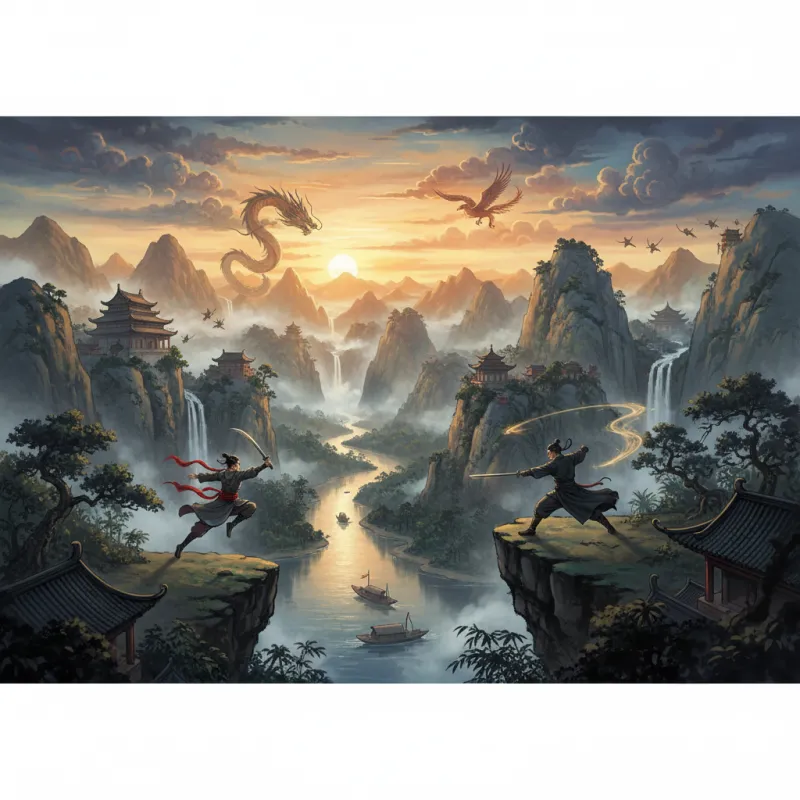
When Disney's Mulan hit theaters in 1998, Chinese audiences had mixed feelings. Here was a Hollywood studio attempting to tell one of China's most beloved folk tales — and they'd added a wisecracking dragon voiced by Eddie Murphy. The film grossed $304 million worldwide, but in China, many viewers wondered: is this what Americans think we're like?
Fast forward to 2021, and Marvel's Shang-Chi and the Legend of the Ten Rings earned $432 million globally, with Chinese mythology woven throughout its narrative fabric. Between these two films lies a fascinating evolution in how Hollywood approaches Chinese mythological content — sometimes stumbling, occasionally soaring, but always revealing the immense challenge of translating one culture's deepest stories for another's entertainment.
The Mulan Experiments: Animation vs. Live-Action
Disney's animated Mulan took significant liberties with the original Ballad of Mulan (木兰辞 Mùlán Cí), a poem from the Northern Wei dynasty (386-534 CE). The addition of Mushu the dragon, the ancestors as comic relief, and a romance subplot all served Western narrative expectations. Yet the film succeeded in capturing something essential: the tension between individual desire and family duty (孝 xiào) that drives much of Chinese storytelling.
The 2020 live-action remake tried to course-correct by removing Mushu and adding a phoenix, incorporating qi (气 qì) as a mystical force, and introducing a shapeshifting witch played by Gong Li. The result felt more "authentically Chinese" to Western audiences but struck many Chinese viewers as oddly sterile. The witch character, inspired by fox spirits (狐狸精 húlijīng) from texts like Strange Tales from a Chinese Studio (聊斋志异 Liáozhāi Zhìyì), lacked the moral complexity that makes these creatures fascinating in Chinese literature. She was simply evil — a Western villain wearing Chinese costume.
The live-action Mulan also stumbled by filming near Xinjiang and thanking controversial government entities in its credits, turning what should have been a cultural celebration into a political minefield. Sometimes the mythology isn't the problem; it's everything surrounding it.
Shang-Chi: Marvel Does Its Homework
Shang-Chi and the Legend of the Ten Rings represents Hollywood's most successful integration of Chinese mythology to date. Director Destin Daniel Cretton and writer Dave Callaham worked with cultural consultants to weave authentic mythological elements throughout the film. The result feels less like Chinese mythology grafted onto a Western story and more like a genuine fusion.
The film draws heavily from the concept of Taoluo (桃洛 Táoluò), a hidden village protected by mystical forces — echoing the "peach blossom spring" (桃花源 táohuā yuán) tradition in Chinese literature where utopian communities exist outside normal space and time. The Great Protector, a massive dragon that guards the village, references the dragon kings (龙王 lóngwáng) who rule over water and weather in Chinese mythology, particularly from texts like Journey to the West (西游记 Xīyóu Jì).
More impressively, the film incorporates the Hundun (混沌 Hùndùn) — primordial chaos creatures from the Shanhaijing (山海经 Shānhǎi Jīng, Classic of Mountains and Seas). These soul-eating monsters aren't just generic CGI threats; they represent a genuine mythological concept about the formless void that existed before creation. When Shang-Chi's father releases them, he's literally unleashing chaos upon the world — a metaphor that works in both Chinese and Western contexts.
The film's treatment of martial arts also shows sophistication. Rather than presenting kung fu as mere fighting technique, it's portrayed as a spiritual practice connected to qi cultivation, similar to the internal martial arts (内家拳 nèijiā quán) tradition that influences so much wuxia literature.
The Monkey King Problem
No discussion of Chinese mythology in Hollywood is complete without addressing the Monkey King (孙悟空 Sūn Wùkōng). This character from Journey to the West is arguably China's most famous mythological figure — yet Hollywood has never successfully brought him to the screen.
Netflix's 2016 series The New Legends of Monkey was a well-intentioned disaster. The 2014 film The Monkey King starring Donnie Yen had impressive action but lacked the character's essential trickster spirit. Even Jackie Chan's 2008 film The Forbidden Kingdom, which should have been a slam dunk with both Chan and Jet Li, reduced the Monkey King to a supporting character in a white teenager's hero journey.
The problem isn't lack of trying — it's that Sun Wukong embodies contradictions that don't translate easily. He's simultaneously a Buddhist pilgrim and an irreverent rebel, a loyal servant and a chaos agent, enlightened and childish. Western narratives prefer clear character arcs; Sun Wukong is a circle that contains all possibilities. He's already achieved enlightenment in some sense, yet still needs to journey toward it. This paradox, central to Buddhist and Daoist thought, doesn't fit neatly into Hollywood's three-act structure.
What Hollywood Gets Wrong (And Why It Matters)
The most common mistake Hollywood makes with Chinese mythology is treating it as a aesthetic rather than a worldview. Dragons become cool visual effects rather than symbols of imperial power and cosmic balance. Yin and yang (阴阳 yīn yáng) become simplistic "light versus dark" dualism rather than complementary forces in constant flux. Immortals (仙 xiān) become generic wizards rather than beings who achieved transcendence through cultivation practices.
Consider Kung Fu Panda (2008), which many Chinese audiences actually loved despite — or because of — its American protagonist. The film succeeded because it took Chinese philosophy seriously. Master Oogway's teachings about living in the present moment reflect genuine Daoist and Buddhist concepts. The Dragon Warrior scroll's revelation that "there is no secret ingredient" captures the Zen Buddhist idea of sudden enlightenment (顿悟 dùnwù). The film used Chinese mythology as a framework for meaning, not just decoration.
Contrast this with The Great Wall (2016), which featured Matt Damon fighting the Taotie (饕餮 Tāotiè) — mythological creatures from the Shanhaijing known for their insatiable greed. The film reduced these complex symbolic beings to generic monsters in a zombie-horde scenario. The Taotie in Chinese mythology represent the dangers of unchecked desire and consumption; in the film, they're just CGI threats to be killed. The mythology became wallpaper.
The Representation Question
Behind every discussion of Chinese mythology in Hollywood lurks a thornier question: who gets to tell these stories? When Disney cast Liu Yifei in the live-action Mulan, they chose a Chinese actress — but one whose political statements alienated many viewers. When Marvel created Shang-Chi, they cast Simu Liu, a Chinese-Canadian actor, but the character's comic book origins are rooted in problematic "yellow peril" stereotypes from the 1970s.
The involvement of Chinese-American creatives has proven crucial. Shang-Chi benefited enormously from having Asian-American writers and cultural consultants who understood both cultures. They could identify which elements would translate and which needed adaptation. They knew that Chinese audiences would recognize the bamboo forest fight scene as an homage to Crouching Tiger, Hidden Dragon (卧虎藏龙 Wòhǔ Cánglóng), itself a film that successfully bridged Eastern and Western sensibilities.
Yet even well-intentioned representation can stumble. The 2020 Mulan removed the romance subplot to avoid the "woman needs a man" trope, but Chinese audiences noted that the original ballad never had a romance — that was Disney's addition in the first place. Sometimes Hollywood's attempts to "fix" its previous mistakes reveal how little it understood the source material to begin with.
Beyond Blockbusters: Mythology in Streaming
The streaming era has opened new possibilities for Chinese mythology in Western media. Netflix's The Witcher isn't Chinese, but its success proved that Western audiences will embrace complex mythological systems if given time to understand them. This bodes well for future adaptations of Chinese fantasy literature, which often requires multiple episodes to establish its intricate world-building.
Amazon's upcoming Three-Body Problem adaptation, while science fiction rather than mythology, will test whether American audiences can handle narratives that don't center Western protagonists or values. The original novel by Liu Cixin draws heavily on Chinese historical and philosophical concepts; how much of this survives translation to screen will be telling.
Meanwhile, Chinese streaming platforms like iQiyi and Tencent Video are producing high-budget fantasy series based on novels like The Untamed (陈情令 Chénqíng Lìng) and Ashes of Love (香蜜沉沉烬如霜 Xiāngmì Chénchén Jìn Rú Shuāng). These shows, increasingly available with English subtitles, let Western audiences experience Chinese mythology on its own terms rather than filtered through Hollywood's lens. The question becomes: does Hollywood need to adapt Chinese mythology, or can audiences simply access the original?
The Future: Collaboration or Appropriation?
As Hollywood continues mining Chinese mythology for content, the line between cultural exchange and cultural appropriation remains contested. The most successful adaptations have involved genuine collaboration between Chinese and Western creatives, not just hiring Chinese actors for authenticity points.
Shang-Chi worked because Marvel Studios partnered with Chinese fight choreographers, cultural consultants, and creatives who understood both the mythology and how to make it work within the Marvel Cinematic Universe framework. The film didn't try to be a Chinese movie; it was an American movie that treated Chinese culture with respect and curiosity.
The next frontier may be co-productions that split creative control more evenly. Films like The Meg (2018) and Pacific Rim: Uprising (2018) attempted this with mixed results, but they were action films first, mythology second. What happens when a genuinely mythological story receives this treatment?
The Shanhaijing still sits largely untapped, containing thousands of creatures and stories that could fuel decades of films. The Fengshen Yanyi (封神演义 Fēngshén Yǎnyì, Investiture of the Gods), China's epic tale of gods and demons, remains virtually unknown in the West despite being comparable in scope to Greek mythology's Titanomachy. The Strange Tales from a Chinese Studio offers hundreds of ghost stories and fox spirit tales perfect for horror and fantasy adaptations.
Hollywood has barely scratched the surface. Whether it digs deeper with respect and understanding, or continues to treat Chinese mythology as exotic decoration, will determine whether we get more Shang-Chi successes or more Great Wall disappointments. Chinese audiences — and increasingly, global audiences who've discovered Chinese media through streaming — are watching closely. They know the difference between homage and appropriation, between adaptation and exploitation.
The mythology is there, rich and deep and waiting. The question is whether Hollywood is ready to truly listen to these ancient stories rather than simply putting them in modern dress.
Related Reading
- Exploring the Evolution of Wuxia: Modern Influences on Chinese Martial Arts Fiction
- Shanhai Jing Creatures in Modern Video Games
- Shanhai Jing in Modern Art: Contemporary Illustrations of Ancient Beasts
- Chinese Horror Novels That Will Keep You Up at Night
- The Enigma of Jianghu: Discovering the Roots of Chinese Wuxia Literature
- The Enigmatic World of Shapeshifters in Wuxia Fiction: Unveiling Jianghu Adventures
Explore Chinese Culture
- Explore Jin Yong's martial arts novels
- Explore cultivation fiction and immortal heroes
- Explore the real history behind wuxia