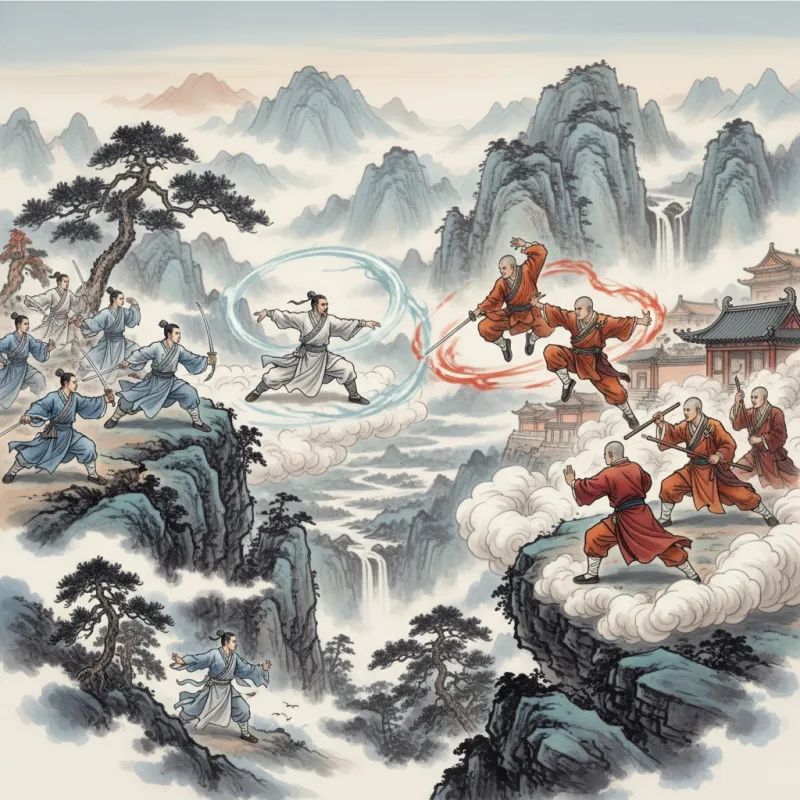
The abbot raises his staff. The Daoist priest draws his sword. They circle each other in the courtyard, and every spectator knows what's really at stake: not just victory, but the vindication of an entire worldview. This is the fantasy that has powered a thousand wuxia novels—Wudang versus Shaolin, internal versus external, Daoist versus Buddhist, soft versus hard. The only problem? It's almost entirely made up. And that's precisely what makes it so revealing about how Chinese martial arts actually work.
The Real Shaolin (And Why It Matters)
Shaolin Temple (少林寺, Shàolín Sì) exists. You can visit it. You can buy a ticket, watch the monks perform, and purchase a commemorative staff in the gift shop. Founded in 495 CE during the Northern Wei dynasty, it sits at the foot of Song Mountain in Henan province, and its martial tradition is documented back to at least the Ming dynasty (1368-1644). The famous story of Bodhidharma (菩提达摩, Pútídámó) teaching the monks exercises to strengthen their bodies? That's later embellishment. But by the 16th century, Shaolin monks were definitely practicing staff fighting, and they were good enough that the Ming government recruited them to fight Japanese pirates.
Here's what matters: Shaolin's reputation was built on real martial competence, not mysticism. The monks trained hard. They developed systematic methods. They passed down specific techniques through lineages. When novelists later needed a martial arts institution with credibility, Shaolin was the obvious choice. It had the history, the location, the mystique. It was a brand before branding existed.
The irony is that Shaolin's actual martial arts were probably not that different from what soldiers and bodyguards practiced elsewhere. Staff work, basic striking, conditioning exercises. Effective, practical, unglamorous. The elaborate forms, the animal styles, the philosophical overlay—much of that came later, after the temple had already become famous.
The Invented Wudang
Now let's talk about Wudang Mountain (武当山, Wǔdāng Shān). It's real too—a stunning Daoist sacred site in Hubei province, with temples dating back to the Tang dynasty. What's not real? The martial arts tradition supposedly founded there by Zhang Sanfeng (张三丰, Zhāng Sānfēng) in the 13th or 14th century.
Zhang Sanfeng probably existed. He shows up in Ming dynasty records as a Daoist eccentric, possibly a hermit, possibly a charlatan, definitely not the founder of an entire martial arts system. The connection between Zhang Sanfeng and Wudang martial arts was invented by novelists in the early 20th century, most influentially by Jin Yong (金庸, Jīn Yōng) in his novel The Heaven Sword and Dragon Saber (倚天屠龙记, Yǐtiān Túlóng Jì, 1961). Jin Yong needed a counterweight to Shaolin, a rival institution with equal prestige but opposite philosophy. So he took a real mountain, a semi-legendary figure, and the existing concept of internal martial arts, and he welded them together into Wudang.
It worked so well that people now believe it's historical. Wudang Mountain now has martial arts schools. They teach "Wudang taijiquan" and "Wudang sword" to tourists and serious practitioners alike. The tradition is maybe sixty years old, but it's presented as if it stretches back centuries. This isn't fraud—it's how martial arts traditions actually develop. Someone invents something, it proves useful or appealing, others adopt it, and within a generation or two it feels ancient.
The Philosophy That Wasn't (Until It Was)
The supposed philosophical divide between Wudang and Shaolin goes like this: Shaolin practices external martial arts (外家拳, wàijiāquán), emphasizing strength, speed, and hard techniques. Wudang practices internal martial arts (内家拳, nèijiāquán), emphasizing qi cultivation, softness, and using the opponent's force against them. Shaolin is Buddhist, focused on discipline and direct action. Wudang is Daoist, focused on naturalness and yielding.
This is a beautiful dichotomy. It's also nonsense.
The internal-external distinction does exist in Chinese martial arts discourse, but it doesn't map neatly onto Shaolin versus Wudang. The terms "neijia" and "waijia" first appear in the 17th century, and they were used inconsistently. Some people used "internal" to mean arts that emphasized qi cultivation. Others used it to mean arts from a particular lineage. Still others used it as a marketing term—"my art is internal (sophisticated, refined) while yours is external (crude, brutish)."
What Jin Yong and other novelists did was take this fuzzy distinction and crystallize it into a rivalry. They needed narrative conflict, and philosophical opposition is great for narrative conflict. So Shaolin became the embodiment of external martial arts, and Wudang became the embodiment of internal martial arts, and suddenly every martial arts debate in Chinese fiction could be framed as a proxy war between these two institutions.
The genius of this framework is that it resonates with real tensions in Chinese culture. Buddhism versus Daoism. Discipline versus spontaneity. Effort versus effortlessness. These are genuine philosophical poles, and mapping them onto martial arts institutions makes them concrete and dramatic. It doesn't matter that the historical Shaolin monks probably practiced breathing exercises and the historical Wudang priests probably hit things hard. The symbolic opposition is too useful to abandon.
How Novels Created Reality
Jin Yong didn't invent the Wudang-Shaolin rivalry from nothing. Earlier wuxia novels had already established Shaolin as the preeminent martial arts institution. What Jin Yong did was give Shaolin a worthy rival, and he did it so convincingly that it retroactively shaped how people understood martial arts history.
In The Heaven Sword and Dragon Saber, Zhang Sanfeng is the founder of the Wudang sect and the creator of Wudang martial arts, including taijiquan. He's portrayed as Shaolin's equal—not in terms of hard power, but in terms of sophistication and depth. His student Zhang Cuishan marries into a family connected to the demonic cults, creating a complex web of loyalties that drives the plot. The novel's protagonist, Zhang Wuji, learns martial arts from multiple sources, including both Shaolin and Wudang techniques, and his journey involves reconciling these different approaches.
This wasn't just entertainment. Jin Yong's novels were read by millions, adapted into countless TV shows and films, and absorbed into popular consciousness. When people in the 1960s and 70s thought about Chinese martial arts, they thought about Jin Yong's version. And Jin Yong's version had Wudang as Shaolin's great rival.
Other novelists followed suit. Gu Long (古龙, Gǔ Lóng), Liang Yusheng (梁羽生, Liáng Yǔshēng), and later writers all used the Wudang-Shaolin framework. It became a trope, a shorthand, a way to instantly communicate what kind of martial arts story you were telling. If your protagonist studied at Shaolin, readers knew what to expect: rigorous training, powerful techniques, moral righteousness. If your protagonist studied at Wudang, readers expected something more subtle: internal cultivation, strategic thinking, Daoist philosophy.
The Tourist Economy of Invented Tradition
Here's where it gets really interesting: the invented tradition became real. Wudang Mountain, which had no particular martial arts reputation before the 20th century, is now a major center for martial arts training. Schools there teach "authentic Wudang martial arts" to Chinese and international students. The local government promotes Wudang as the birthplace of taijiquan and internal martial arts. There are competitions, demonstrations, and certification programs.
Is this fake? Not exactly. The techniques being taught are real martial arts—they're just not historically connected to Wudang Mountain in the way the marketing suggests. Many of them are drawn from existing taijiquan and xingyiquan lineages, which do have legitimate histories, just not histories that run through Wudang. The teachers are often skilled practitioners who genuinely believe in what they're teaching. The students learn functional martial arts and meaningful philosophy.
What's happened is that the fictional tradition has been filled in with real content. It's like building a house on a foundation that turns out to be imaginary—but then discovering that the house stands up anyway because you used good materials and solid construction. The Wudang martial arts tradition is now about sixty years old, which is young by Chinese standards but not nothing. Give it another century and it will be indistinguishable from "authentic" traditions.
Shaolin has gone through a similar process, though in reverse. It had a real martial tradition, but that tradition was disrupted by the Cultural Revolution and other 20th-century upheavals. The Shaolin you can visit today is partly a reconstruction, partly a reinvention, and partly a theme park. The monks perform spectacular demonstrations that are more acrobatic than martial. The temple makes millions from tourism and media licensing. Is this the "real" Shaolin? It's as real as anything else in the 21st century.
What the Rivalry Reveals
The Wudang-Shaolin rivalry, invented though it is, tells us something true about Chinese martial arts: they've always been as much about storytelling as about fighting. The techniques matter, but the narratives around the techniques matter just as much. Who taught whom, which lineage is superior, what philosophy underlies the practice—these questions have driven martial arts discourse for centuries.
This isn't unique to China. Every martial arts tradition has origin myths, legendary founders, and exaggerated claims. What's distinctive about Chinese martial arts is how explicitly the storytelling is acknowledged and celebrated. Wuxia novels aren't pretending to be history—they're openly fictional—but they shape how people understand martial arts anyway. The boundary between fiction and reality is porous, and everyone knows it, and that's fine.
The rivalry also reveals the deep Chinese cultural investment in complementary opposites. Yin and yang, internal and external, Buddhist and Daoist—these pairs structure how Chinese philosophy thinks about the world. The Wudang-Shaolin rivalry gives these abstract oppositions a concrete form. It lets people argue about philosophy by arguing about martial arts, which is more fun and more accessible than arguing about philosophy directly.
And finally, the rivalry reveals how traditions are made. Not through unbroken transmission from ancient masters, but through creative synthesis, strategic invention, and collective belief. Zhang Sanfeng didn't found Wudang martial arts in the 14th century. Jin Yong founded them in the 20th century. But now they exist, and they're as real as any other martial arts tradition, because enough people practice them and believe in them and pass them on.
The Rivalry Today
Walk into any Chinese martial arts school today and ask about Wudang versus Shaolin, and you'll get an earful. Some practitioners will defend the historical reality of the rivalry. Others will acknowledge it's mostly fictional but argue it's still useful as a teaching framework. Still others will roll their eyes and say it's all marketing nonsense that distracts from serious training.
All of these positions are defensible. The rivalry is fictional, but it's not meaningless. It provides a vocabulary for talking about different approaches to martial arts. It gives students a sense of lineage and identity. It makes training more interesting by embedding it in a larger narrative. These are real benefits, even if the history is invented.
The deeper lesson is that martial arts traditions are always being invented and reinvented. The concept of internal martial arts itself is a relatively recent construction, codified in the 19th and 20th centuries. The idea that taijiquan is a Daoist martial art connected to Zhang Sanfeng? That's early 20th century. The notion that Shaolin represents external martial arts? That's even more recent.
None of this makes the martial arts themselves less real or less effective. A punch is a punch, whether it comes from a thousand-year-old lineage or a system invented last Tuesday. What changes is the meaning we attach to the punch, the story we tell about where it comes from and what it represents. And in Chinese martial arts, those stories have always mattered as much as the techniques themselves.
The Wudang-Shaolin rivalry is the perfect embodiment of this principle. It's a fiction that became a framework, a framework that became a tradition, and a tradition that now shapes how millions of people understand and practice martial arts. The abbot and the priest are still circling each other in that courtyard, and they probably always will be. Not because they're enemies, but because we need them to be.
Related Reading
- The Greatest Palm Techniques in Wuxia Fiction, Ranked
- External vs. Internal Martial Arts: The Great Divide in Wuxia
- Exploring the Intricate World of Wuxia: Legends, Culture, and Kung Fu Novels
- Martial Arts Systems in Wuxia: Internal vs External, Orthodox vs Unorthodox
- Acupoint Striking (Dianxue): The Deadly Art of Pressure Points
- Crouching Tiger, Hidden Dragon: How One Film Changed Everything
- Sacred Objects of Chinese Mythology: Seals, Mirrors, and Cauldrons
- Tragic Heroes of Wuxia: When Honor Leads to Destruction
Explore Chinese Culture
- Explore Jin Yong's martial arts novels
- Explore cultivation fiction and immortal heroes
- Explore the real history behind wuxia