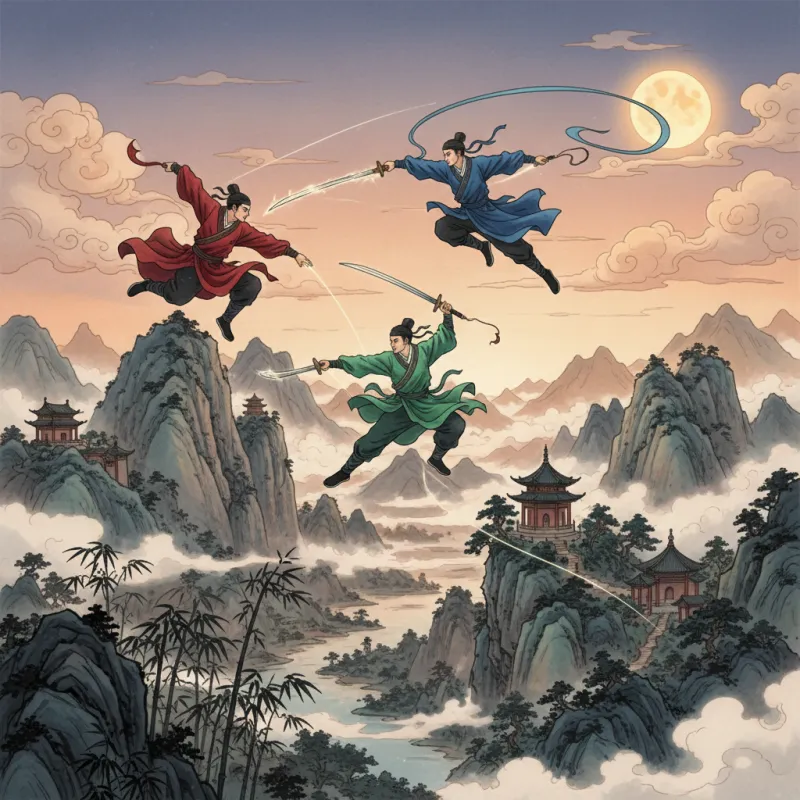
The first time you see someone run up a wall, leap across rooftops, and land silently on a bamboo branch that barely bends under their weight, you're watching a lie. But it's the most beautiful lie cinema ever told. Wire-fu — the art of suspending actors on near-invisible steel cables to simulate the impossible physics of wuxia — didn't just make martial arts films more exciting. It made an entire literary tradition visible. Before wires, qinggong was just words on a page. After wires, it became the defining visual language of an entire genre.
The Technology That Made Heroes Fly
Wire-fu emerged from Hong Kong's Shaw Brothers studios in the 1960s, but its conceptual roots go back to Peking Opera, where performers used hidden harnesses to execute aerial stunts on stage. The innovation wasn't the idea of suspension — it was making the wires thin enough and the movements fluid enough to convince a camera. Early attempts were clunky. Watch Come Drink with Me (1966) and you can see Cheng Pei-pei's movements have a certain stiffness, a visible pause before each leap. The wires were doing the work, but they weren't yet invisible.
The real breakthrough came with choreographer Yuen Woo-ping in the 1970s and 80s. Yuen understood that wire-fu wasn't about defying gravity — it was about redefining it. His work on Drunken Master (1978) and later The Matrix (1999) demonstrated that wires could create a new physics where momentum, weight, and inertia followed different rules. When Neo dodges bullets in slow motion, he's not breaking the laws of physics. He's operating under wuxia physics, where internal energy (内力 nèilì) determines what's possible.
The technical setup is deceptively simple: high-tensile steel wires, typically 1-2mm thick, attached to a harness worn under the costume. The wires run through pulleys controlled by a team of technicians who must coordinate pulls with split-second timing. A single wire can support up to 500 pounds, but most stunts use multiple wires for control and safety. The real skill isn't in the equipment — it's in making the actor's body move as if the wires don't exist.
The Physics of Impossible Movement
Good wire-fu creates its own internal logic. Watch Jet Li in Once Upon a Time in China (1991) and notice how his movements have weight even when he's airborne. He doesn't float — he arcs, accelerates, and lands with impact. This is the difference between wire-fu as spectacle and wire-fu as storytelling. The wires aren't there to make actors weightless. They're there to make them move with a different kind of weight, one that corresponds to their martial cultivation level.
In wuxia literature, qinggong (轻功 qīnggōng, "lightness skill") isn't flight — it's the ability to manipulate your body's relationship with gravity through internal energy cultivation. A master can run across water, leap between treetops, or balance on a sword blade not because they're weightless, but because they've achieved such control over their qi that they can redistribute their mass at will. Wire-fu's job is to make this metaphysical concept physically visible.
The best wire choreographers understand this distinction. When Zhang Ziyi fights in the bamboo forest in Crouching Tiger, Hidden Dragon (2000), the bamboo bends and sways under her weight. She's not defying physics — she's operating under enhanced physics. The wires allow her to land on branches that would normally snap, but the branches still react. This attention to secondary motion is what separates masterful wire-fu from the cheap stuff you see in low-budget productions where actors just float around like balloons.
The Danger Nobody Talks About
Here's what Western critics who dismiss wire-fu as "cheating" don't understand: it's one of the most dangerous forms of stunt work in cinema. Wires can snap. Harnesses can fail. Timing errors can send an actor crashing into walls, floors, or other actors at high speed. Michelle Yeoh broke her back during a wire stunt. Maggie Cheung suffered multiple injuries. Even Jackie Chan, who famously does his own stunts without wires when possible, has said wire work terrifies him more than any ground-level stunt.
The physical demands are brutal. Actors must maintain precise body positions while suspended, often for multiple takes. The harness digs into your ribs and hips. The sudden jerks and stops can cause whiplash. And unlike ground stunts where you can roll with impact, wire stunts offer no such cushioning. When you land wrong, you land hard.
Then there's the skill required to make it look effortless. Watch Donnie Yen in Hero (2002) — his wire work looks so natural you almost forget he's suspended. That's because he's doing most of the work himself, using the wires for enhancement rather than support. His body positioning, his timing, his ability to initiate rotation mid-air — these are skills that take years to develop. The wires are just tools. The artistry is in the performer.
When Wire-Fu Went Global
The Matrix changed everything. Suddenly Hollywood wanted what Hong Kong had been doing for decades. Yuen Woo-ping was hired to choreograph, and he brought wire-fu to American audiences who had never seen anything like it. The lobby scene, the rooftop jump, Neo's training sequences — all pure wuxia physics translated into a science fiction context. The Wachowskis understood something crucial: wire-fu isn't just a technique, it's a visual language for depicting superhuman ability.
But the global spread of wire-fu also diluted it. Hollywood productions often use wires as a shortcut rather than an art form. They wire actors who haven't trained in martial arts, then fix everything in post-production with CGI. The result looks weightless in the wrong way — floaty, disconnected, video-game-like. Compare the wire work in Crouching Tiger, Hidden Dragon to something like The Last Airbender (2010) and you'll see the difference immediately. One uses wires to enhance trained performers. The other uses wires to replace performance entirely.
The best contemporary wire-fu comes from directors who understand the tradition. Tsui Hark's Detective Dee series, Zhang Yimou's wuxia films, and even some anime adaptations like Rurouni Kenshin (2012) demonstrate that wire-fu can evolve without losing its essence. These productions blend wires with CGI, using digital effects to erase the wires and enhance the environment, but keeping the physical performance at the core.
The Art of Invisible Support
Modern wire removal is done digitally, but the principle remains the same: the wires must be thin enough and positioned carefully enough that they're easy to paint out in post. This is why lighting matters so much in wire-fu sequences. Harsh overhead lighting creates shadows that make wires visible. Diffused lighting from multiple angles minimizes wire shadows and makes digital removal easier.
Some directors embrace the wires. In certain Hong Kong productions from the 1980s, you can see the wires if you look carefully, and nobody cares. The audience has agreed to the illusion. We know the actors are suspended, but we choose to see qinggong instead. This is the same suspension of disbelief that makes any cinema work, but wire-fu makes it literal — we're suspending our disbelief about suspension itself.
The future of wire-fu is probably hybrid. Pure CGI flight looks wrong because it lacks the physical constraints that make movement believable. Pure wire work is limited by what's physically possible with cables and pulleys. But combining the two — using wires for the core movement and CGI for enhancement and wire removal — creates something that honors the tradition while pushing it forward. Watch The Yin-Yang Master (2021) and you'll see this approach in action: real performers on real wires, enhanced with digital effects that would make Yuen Woo-ping proud.
Why It Still Matters
Wire-fu matters because it solved an impossible problem: how do you film something that exists only in imagination? Wuxia novels describe movements that defy physics, battles that take place across rooftops and treetops, heroes who can leap over walls and run across water. For decades, these were considered unfilmable. Wire-fu made them possible.
But more than that, wire-fu created a visual vocabulary that's now part of global cinema language. When you see superhero movies with characters leaping between buildings, when you see fantasy films with impossible acrobatics, when you see action sequences that treat gravity as a suggestion rather than a law — you're seeing wire-fu's influence. The technique that started in Hong Kong studios has become the standard way cinema depicts superhuman movement.
The irony is that wire-fu's greatest success might be its invisibility. Modern audiences watch Shang-Chi and the Legend of the Ten Rings (2021) and don't think "wire work" — they just accept that this is how martial arts masters move. The wires have disappeared so completely that we've forgotten they were ever there. We see the qinggong, not the technology that makes it visible.
And maybe that's exactly as it should be. The best special effects are the ones you don't notice. The best wire-fu is the kind that makes you believe, just for a moment, that people really can fly. Nobody actually flies. But when the wires are right, the choreography is perfect, and the performer commits fully to the movement — everybody believes they do. That's not a cheat. That's cinema magic at its finest.
For more on how these techniques translate literary concepts to screen, see Adapting Wuxia Novels to Film and The Evolution of Martial Arts Choreography.
Related Reading
- The Golden Age of Hong Kong Wuxia Cinema
- Best Wuxia TV Dramas: A Streaming Guide for International Viewers
- The Wuxia Film Renaissance: Why Hong Kong Cinema Matters
- The World of Wuxia: Exploring Chinese Martial Arts Fiction and Jianghu Culture
- Wuxia Video Games: From Chinese RPGs to Global AAA Titles
- Shanhai Jing Creatures in Modern Video Games
- The Enigma of Jianghu: Discovering the Roots of Chinese Wuxia Literature
- Poison Needles and Flying Daggers: Hidden Weapons in Wuxia Combat
Explore Chinese Culture
- Explore Jin Yong's martial arts novels
- Explore cultivation fiction and immortal heroes
- Explore the real history behind wuxia