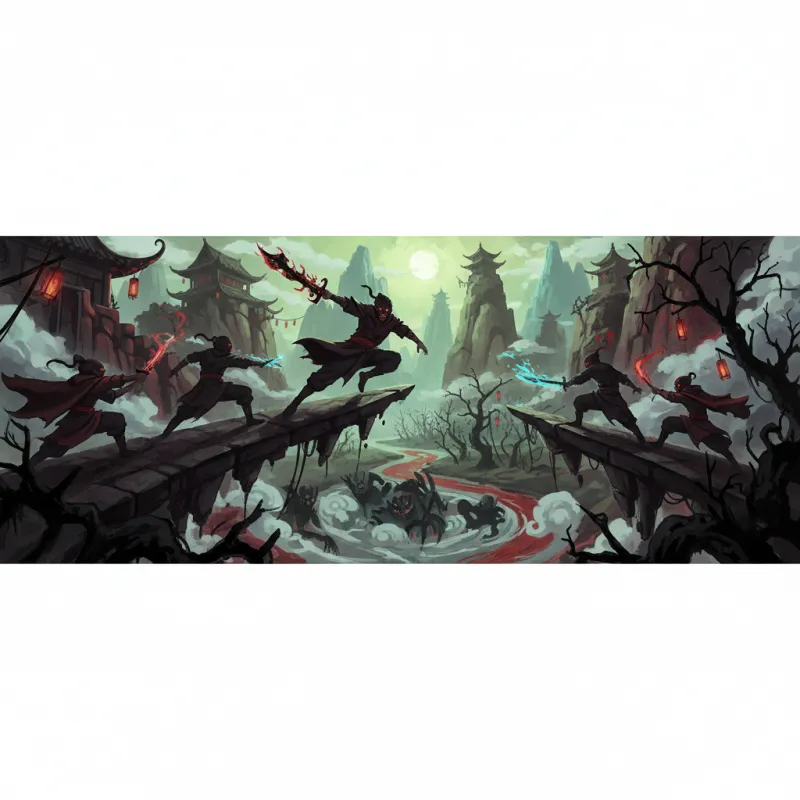
The first time you read a Chinese horror novel at 2 AM, you'll understand why your Chinese friends warned you not to. It's not the jump scares or the gore — Western horror has that covered. It's the way these stories crawl into the spaces between what you see and what you know is there, the way they make you question whether that shadow in the corner is just a shadow or something that's been watching you for three generations.
The Weight of Four Thousand Years
Chinese horror literature carries a burden that would crush most traditions: it's competing with its own legendary past. When Gan Bao (干宝 Gān Bǎo) compiled the Soushen Ji (搜神记 Sōushén Jì, "In Search of the Supernatural") in the fourth century, he wasn't inventing ghost stories — he was documenting a supernatural worldview that already felt ancient. By the time Pu Songling (蒲松龄 Pú Sōnglíng) wrote Strange Tales from a Chinese Studio (聊斋志异 Liáozhāi Zhìyì) in the Qing Dynasty, the fox spirits (狐狸精 húlijīng) and vengeful ghosts (厉鬼 lìguǐ) had become so refined, so psychologically complex, that they made Western Gothic literature look like it was still learning to walk.
Modern Chinese horror writers don't just compete with this canon — they weaponize it. They know you've heard about the hungry ghosts (饿鬼 èguǐ) and the jiangshi (僵尸 jiāngshī, hopping vampires). They're counting on it. The best contemporary horror fiction takes these familiar elements and twists them until they're unrecognizable, or worse, until they're exactly what you feared they always were.
Cai Jun and the Birth of Modern Chinese Horror
If you want to understand contemporary Chinese horror, start with Cai Jun (蔡骏 Cài Jùn). His 2001 novel Virus (病毒 Bìngdú) didn't just launch his career — it created a template that hundreds of writers would follow. Cai Jun understood something crucial: Chinese readers didn't want Western-style horror translated into Chinese settings. They wanted stories that felt authentically Chinese, that drew on the specific anxieties of rapid modernization, urban isolation, and the collision between traditional beliefs and contemporary skepticism.
The Nineteenth Floor of Hell (第十九层地狱 Dì Shíjiǔ Céng Dìyù) remains his masterpiece. The novel takes the Buddhist concept of hell realms (地狱 dìyù) and transforms it into a psychological thriller about guilt, memory, and the impossibility of escape. What makes it terrifying isn't the supernatural elements — it's the way Cai Jun makes you realize that hell isn't a place you go after death. It's the place you've been living all along, and you just didn't notice until now. The influence on Chinese Ghost Stories and Their Cultural Significance cannot be overstated.
Zhou Dedong's Suburban Nightmares
Zhou Dedong (周德东 Zhōu Dédōng) writes horror for the generation that grew up in China's new suburbs, those endless apartment complexes that sprang up in the 1990s and 2000s. His novels feel claustrophobic even when they're set in wide-open spaces, because the real horror isn't the ghosts — it's the realization that you're surrounded by millions of people and you've never felt more alone.
The Door (门 Mén, 2003) is deceptively simple: a woman moves into a new apartment and discovers a door that shouldn't exist. But Zhou Dedong isn't interested in cheap scares. He's interested in what that door represents — the secrets we keep from our neighbors, the lives we pretend to live, the way modern urban existence turns us all into ghosts haunting our own lives. The novel sold over a million copies because it articulated something Chinese readers felt but couldn't name: the horror of being invisible in a crowd.
His later work, Ghost Hotel (鬼旅馆 Guǐ Lǚguǎn), takes the familiar setup of a haunted hotel and transforms it into a meditation on memory and identity. The guests aren't just staying at the hotel — they're trapped in their own past traumas, and the hotel is feeding on their inability to move forward. It's the kind of psychological horror that makes you check your own memories, wondering which ones are real and which ones you've constructed to protect yourself from something worse.
The Internet Horror Revolution
The real explosion in Chinese horror came with the rise of online literature platforms in the mid-2000s. Suddenly, writers didn't need publishers or editors — they just needed readers willing to stay up until dawn clicking "next chapter." This democratization produced a flood of mediocre work, but it also unleashed writers who would never have survived traditional publishing's gatekeepers.
Zhuang Qin (庄秦 Zhuāng Qín) built his reputation entirely online with The Apartment (公寓 Gōngyù), a serial novel that updated daily and kept readers obsessively refreshing their browsers. The premise sounds like standard horror: a cursed apartment building where residents keep dying in mysterious ways. But Zhuang Qin's genius was in the pacing — he understood that online readers wanted constant tension, not the slow build of traditional horror. Each chapter ended with a hook that made it impossible not to read the next one, and the next one, until you realized the sun was coming up and you'd spent the entire night reading about people who made the mistake of signing a lease they didn't fully understand.
The online format also allowed for experimentation that traditional publishing would never permit. Cai Junyu's (蔡骏宇 Cài Jùnyǔ) The Whispering Corridor (耳语走廊 Ěryǔ Zǒuláng) incorporated reader comments into the narrative itself, blurring the line between fiction and reality in ways that made readers question whether they were reading a story or participating in something more dangerous. Some readers reported hearing whispers after reading certain chapters — probably suggestion and sleep deprivation, but the fact that multiple readers reported the same experience suggests Cai Junyu tapped into something primal.
The Return of Folk Horror
The most interesting development in recent Chinese horror is the return to rural settings and folk beliefs. After decades of urban horror, writers like Namo Kasaya (那多袈裟 Nàduō Jiāshā) are rediscovering the terror of the countryside, where old beliefs never really died — they just went underground.
The Paper Man (纸人 Zhǐrén) takes the traditional funeral practice of burning paper offerings for the dead and asks a simple question: what if the paper servants (纸扎 zhǐzhā) we burn for our ancestors aren't just symbolic? What if they're real, and they're waiting? The novel follows a young woman who returns to her grandmother's village for a funeral and discovers that the paper figures her family has been burning for generations have been accumulating, waiting for someone to acknowledge them. It's folk horror in the truest sense — the terror comes from realizing that the old ways your grandparents practiced weren't superstition. They were containment protocols, and you just broke them.
This revival of folk horror connects directly to anxieties about modernization and cultural loss. As rural China empties out and traditional practices disappear, these novels ask what happens to the supernatural entities that those practices were designed to appease or control. The answer, in most of these novels, is nothing good. The comparison to The Role of Supernatural Elements in Wuxia Fiction reveals how differently horror and wuxia treat the same folkloric material.
Why Chinese Horror Hits Different
Western readers who discover Chinese horror often report the same experience: it gets under your skin in ways Western horror doesn't. Part of this is cultural — Chinese horror draws on a completely different set of fears and taboos. The concept of filial piety (孝 xiào) means that ghosts of ancestors aren't just scary — they're morally complicated. You can't just exorcise your grandmother's ghost. You have to figure out what you did wrong, what obligation you failed to fulfill.
But there's something deeper at work. Chinese horror understands that the scariest thing isn't the monster — it's the realization that the world operates according to rules you don't understand and can't control. Western horror often provides explanations, closure, resolution. Chinese horror leaves you with questions. Did the protagonist survive, or are they already dead and just don't know it? Was the ghost real, or was it a manifestation of guilt? The ambiguity isn't a flaw — it's the point.
Reading Recommendations for the Brave
If you're ready to dive into Chinese horror, start with Cai Jun's The Nineteenth Floor of Hell — it's been translated into English and provides a perfect introduction to contemporary Chinese horror's themes and techniques. Follow it with Zhou Dedong's The Door if you can find a translation, though be warned: it's best read in a well-lit room with other people nearby.
For readers who can handle Chinese, the online platforms Qidian (起点 Qǐdiǎn) and Jinjiang (晋江 Jìnjiāng) host thousands of horror serials, though quality varies wildly. Look for works with high ratings and completion status — unfinished horror serials are their own special kind of torture.
And remember: Chinese horror novels are best read during the day. Your ancestors didn't warn you about reading ghost stories at night because they were superstitious. They warned you because they knew something you're about to learn.
Related Reading
- Unraveling the Mystique of Wuxia: Horror Elements in Chinese Martial Arts Fiction
- The Best Chinese Horror Films: A Genre Guide
- Chinese Internet Ghost Stories: The Creepypasta of the East
- Shanhai Jing Creatures in Modern Video Games
- Romance in Wuxia: Love, Duty, and the Tragedy Between
- The Tang Clan: Masters of Hidden Weapons and Poison
Explore Chinese Culture
- Explore Jin Yong's martial arts novels
- Explore cultivation fiction and immortal heroes
- Explore the real history behind wuxia