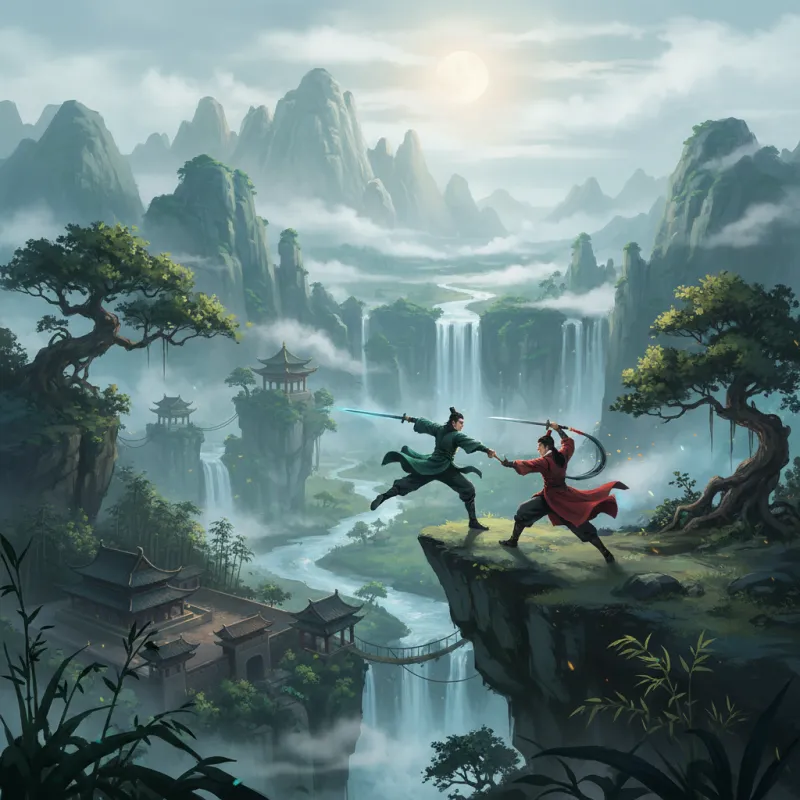
A swordsman stands at the edge of a cliff, his white robes billowing in the mountain wind. Below him, the jianghu—that lawless realm of martial artists, wandering heroes, and blood feuds—stretches endlessly. He leaps, and for a moment, gravity means nothing. This is wuxia, and it has captivated Chinese readers for over a millennium with a promise that still resonates today: in a world of corruption and injustice, individual mastery and moral courage can change everything.
The Ancient Roots of Martial Chivalry
Wuxia (武侠, wǔxiá)—literally "martial heroes"—didn't emerge fully formed from Jin Yong's typewriter in the 1950s. The genre's DNA stretches back to the Tang dynasty (618-907 CE), when tales of youxia (游侠, yóuxiá), wandering knights-errant, circulated in teahouses and marketplaces. These early stories, collected in works like Extensive Records of the Taiping Era, featured assassins who could shrink themselves to the size of insects or warriors who defended the powerless against corrupt officials.
By the Song dynasty (960-1279 CE), vernacular storytelling had transformed these legends into something more structured. The storytellers in Kaifeng's entertainment districts weren't reciting classical poetry—they were spinning serialized adventures that common people could understand. This oral tradition eventually crystallized into written novels during the Ming dynasty, most notably Water Margin (水浒传, Shuǐhǔ Zhuàn), completed around 1400 CE. The 108 outlaws of Liangshan Marsh became the template for countless wuxia heroes to come: skilled fighters who operated outside the law but adhered to a strict moral code.
The Jianghu: A World Within the World
The jianghu (江湖, jiānghú)—literally "rivers and lakes"—is the parallel universe where wuxia stories unfold. It's not a physical place you can find on a map, but rather a social ecosystem that exists in the margins of imperial China. Think of it as the underworld, but not necessarily criminal: a realm where martial artists, monks, merchants, beggars, and outlaws interact according to their own rules, largely invisible to government authority.
What makes the jianghu fascinating is its alternative hierarchy. In the official world, your status depends on passing imperial examinations or inheriting noble rank. In the jianghu, reputation is everything. A beggar who has mastered the Dog Beating Staff technique commands more respect than a wealthy merchant. The leader of a martial arts sect wields more practical power than a county magistrate. This inversion of social order explains why wuxia fiction has always appealed to readers who feel constrained by conventional society.
The jianghu operates on unwritten codes: repay kindness with kindness, avenge wrongs, honor your shifu (师父, shīfu, master), and never betray your sect. Break these rules, and you become a target for every righteous hero in the realm. The martial arts sects that populate this world—from the Shaolin Temple to the Wudang Mountains—function as quasi-governments, each with their own territories, politics, and martial techniques.
The Golden Age: Jin Yong and His Contemporaries
Modern wuxia fiction exploded in 1950s Hong Kong, when newspaper serialization created a perfect storm of accessibility and addiction. Jin Yong (金庸, Jīn Yōng, pen name of Louis Cha) published The Book and the Sword in 1955, launching a career that would produce fifteen novels and reshape Chinese popular culture. His contemporary Gu Long (古龙, Gǔ Lóng) took a different approach, infusing wuxia with noir sensibility and psychological complexity.
Jin Yong's genius lay in grounding fantasy in historical detail. The Deer and the Cauldron unfolds during the Kangxi Emperor's reign, with real historical figures interacting with fictional martial artists. His heroes aren't invincible supermen—Guo Jing in The Legend of the Condor Heroes is famously slow-witted, succeeding through persistence rather than brilliance. This relatability, combined with intricate plots spanning decades and hundreds of characters, created what Chinese readers call "Jin Yong addiction."
Gu Long, meanwhile, stripped away the historical scaffolding. His novels read like existential thrillers set in a timeless jianghu. Li Xunhuan in Sentimental Swordsman, Ruthless Sword is a melancholic hero whose throwing daggers never miss—but his real battles are internal, wrestling with loneliness and lost love. Where Jin Yong gives you epic scope, Gu Long delivers concentrated emotional intensity.
Martial Arts as Philosophy
The kung fu in wuxia fiction isn't just choreographed violence—it's a physical manifestation of philosophical principles. The distinction between internal (内功, nèigōng) and external (外功, wàigōng) martial arts reflects Daoist and Buddhist concepts about the relationship between mind and body. A master of internal arts cultivates qi (气, qì), the vital energy that flows through meridians, allowing them to perform seemingly impossible feats: walking on water, deflecting sword strikes with bare hands, or healing injuries through meditation.
Different martial arts embody different philosophies. Shaolin kung fu, rooted in Chan Buddhism, emphasizes discipline and compassion—Shaolin monks are formidable fighters who ideally use violence only as a last resort. Wudang techniques, influenced by Daoism, focus on yielding and redirecting force rather than meeting it head-on. The legendary weapons wielded by heroes carry similar symbolic weight: a sword represents the scholar-warrior ideal, while a saber suggests straightforward martial prowess.
The training sequences in wuxia novels often read like spiritual journeys. Zhang Wuji in The Heaven Sword and Dragon Saber must unlearn all his previous martial knowledge before mastering the Nine Yang Manual, a metaphor for emptying the mind to achieve enlightenment. These aren't just power-ups in a video game—they're transformative experiences that change the hero's character.
Women Warriors and Gender Dynamics
Wuxia fiction has always featured formidable female martial artists, though their portrayal has evolved significantly. Early novels often relegated women to supporting roles or tragic love interests. But characters like Huang Rong in The Legend of the Condor Heroes—brilliant, mischievous, and deadly with a needle—demonstrated that women could be both romantic leads and martial equals.
The genre's treatment of gender remains complicated. Female heroes often possess "soft" martial arts emphasizing agility and internal power rather than brute strength, reinforcing traditional gender assumptions even while subverting them. Yet novels like The Book and the Sword feature the Red Flower Society's female members as full participants in revolutionary activities, not just decoration. The recent popularity of novels with female protagonists, particularly in the online wuxia community, suggests the genre continues to evolve.
The Jianghu's Modern Transformations
Contemporary wuxia has fragmented into multiple subgenres. Xianxia (仙侠, xiānxiá) adds explicit fantasy elements—cultivation systems, immortals, and cosmic power scales that would make Jin Yong's heroes look like beginners. Online platforms have democratized wuxia creation, producing thousands of serialized novels where readers comment on chapters in real-time, influencing plot developments.
The core appeal remains unchanged: the fantasy of personal agency in an unjust world. Whether it's a Tang dynasty swordsman or a modern cultivation protagonist grinding through power levels, wuxia offers the same promise—that individual excellence and moral integrity matter, that you can carve out your own path regardless of birth or circumstance. The jianghu endures because we still need that mythical space where heroes can be heroes, where a single person with sufficient skill and determination can make a difference.
The genre's influence extends far beyond Chinese literature. Hollywood martial arts films, anime series, and video games all draw from wuxia's visual language and narrative structures. When you see a character in a Western fantasy novel cultivating magical energy through meditation, you're seeing wuxia's fingerprints. The jianghu has become a global mythology, proving that stories about honor, mastery, and the search for justice transcend cultural boundaries.
Related Reading
- The Fusang Tree: Where the Suns Rise and the World Begins
- The Four Seas and the Shape of the Ancient Chinese World
- Penglai Island: The Legendary Isle of Immortals
- Kunlun Mountain: The Paradise at the Center of the World
- Shanhai Jing in Modern Art: Contemporary Illustrations of Ancient Beasts
- The Enigmatic World of Shapeshifters in Wuxia Fiction: Unveiling Jianghu Adventures
- The Beggars Sect: How a Gang of Homeless People Became the Largest Organization in the Martial World
Explore Chinese Culture
- Explore Jin Yong's martial arts novels
- Explore cultivation fiction and immortal heroes
- Explore the real history behind wuxia