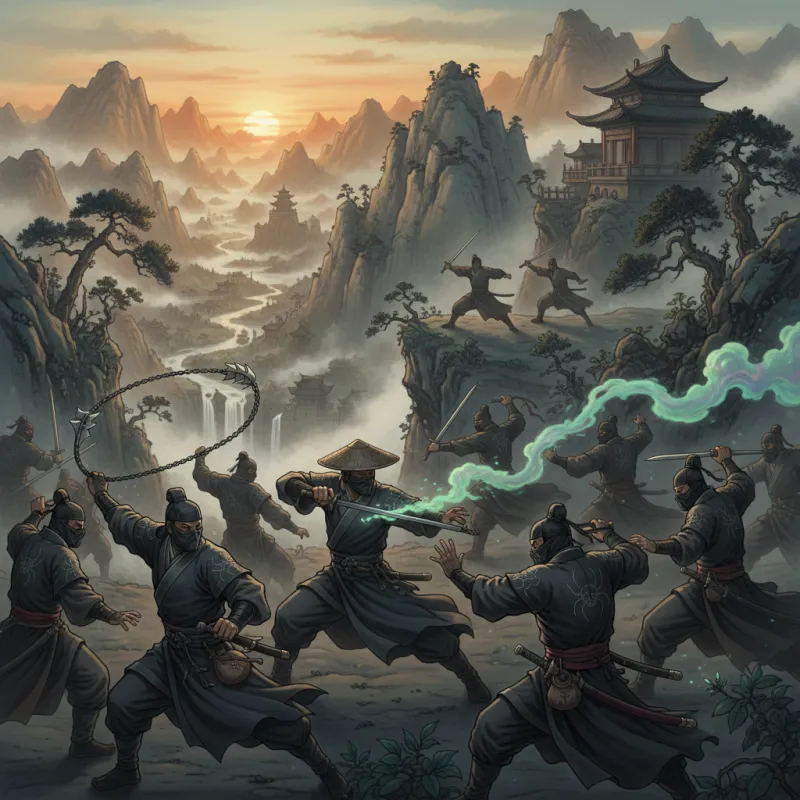
The first time you see a Tang Clan disciple in action, you might miss it entirely. There's no flash of steel, no dramatic sword stance, no shouted technique name. Just a whisper of movement, a glint too small to register, and suddenly the bandit leader is clutching his throat, foam bubbling from his lips. By the time his companions realize what happened, three more are down. The Tang Clan disciple? Already gone, melting into the crowd like morning mist. This is how the Tang Clan (唐門 Tángmén) fights — and why every other sect in the jianghu (江湖 jiānghú) regards them with a mixture of fear and contempt.
The Philosophy of Distance
What separates the Tang Clan from every other martial arts family isn't just their weapons — it's their entire worldview. Traditional wuxia values emphasize face-to-face combat, the clash of equals, the test of skill and character. The Tang Clan rejects all of this as romantic nonsense. Why risk your life in a "fair" fight when you can kill your enemy from fifty paces while he's eating breakfast?
This pragmatism runs so deep that Tang disciples train differently from childhood. While Shaolin monks practice stances and Wudang students meditate on Taoist principles, Tang children learn chemistry, mechanics, and anatomy. They study wind patterns, fabric density, and the precise angle needed to lodge a needle in someone's kidney. Their training halls look less like martial arts schools and more like workshops — or laboratories.
The clan's founder, Tang Wai (唐外), supposedly established this philosophy during the late Tang Dynasty after watching his master die in an "honorable" duel. His conclusion: honor is what the strong call it when they want the weak to fight on their terms. Better to be alive and despised than dead and respected. This cynical wisdom has guided the clan for over a thousand years.
The Arsenal: Engineering Death
The Tang Clan's hidden weapons (暗器 ànqì) are legendary, and for good reason. Their signature weapon, the Rainstorm Pear Blossom Needle (暴雨梨花针 Bàoyǔ Líhuā Zhēn), can fire dozens of poisoned needles in a single burst. Gu Long's novels describe it as the most feared weapon in the jianghu — not the most powerful, but the most feared. There's a crucial difference.
But the needles are just the beginning. Tang armories contain hundreds of specialized tools: sleeve arrows (袖箭 xiùjiàn) that fire from spring-loaded wrist mechanisms, flying claws (飞爪 fēizhuǎ) that can rip out throats from ten feet away, and the infamous Soul-Chasing Nail (追魂钉 Zhuīhún Dīng), which supposedly never misses its target. Each weapon represents generations of refinement, passed down through detailed technical manuals that read like engineering textbooks.
The clan's poison expertise is equally sophisticated. They don't just use common toxins — they breed them. The Tang family maintains gardens of poisonous plants found nowhere else in China, and their venom farms house snakes, spiders, and scorpions selectively bred for maximum lethality. Their signature poison, the Seven-Step Soul-Breaking Powder (七步断魂散 Qībù Duànhún Sǎn), supposedly kills before its victim can take seven steps. Whether this is literally true or just marketing, the psychological effect is undeniable.
The Price of Pragmatism
Here's what makes the Tang Clan fascinating from a narrative perspective: they're almost always right, and almost always villains. Their methods work. Their disciples survive. Their family thrives while other sects rise and fall. And yet, they're rarely the heroes.
This is because wuxia fiction, at its core, is about values — and the Tang Clan represents the wrong values. They're the embodiment of pure effectiveness divorced from honor, loyalty, or righteousness (义 yì). They'll take assassination contracts. They'll poison wells. They'll kill women and children if the price is right. Not because they're evil, but because they see no logical reason not to.
Jin Yong rarely features Tang Clan members as major characters, and when he does, they're usually antagonists or morally compromised figures. Gu Long gives them more nuance — his Tang Clan disciples sometimes struggle with their family's reputation, caught between effectiveness and ethics. But even Gu Long's sympathetic Tang characters usually die, often sacrificing themselves to prove they're more than just poisoners.
The clan's isolation reinforces this outsider status. The Tang family compound in Sichuan is described as a fortress, surrounded by traps and patrolled by disciples who trust no one. They rarely marry outside the clan, rarely take outside disciples, and rarely participate in jianghu affairs unless paid to do so. This insularity breeds both excellence and paranoia.
Tang Clan in Modern Wuxia
Contemporary wuxia has started to rehabilitate the Tang Clan's image, most notably in works like Douluo Dalu (斗罗大陆), where Tang San becomes a heroic protagonist who happens to use hidden weapons. This represents a significant shift — the author essentially asks, "What if Tang Clan methods were used for righteous purposes?"
The answer is interesting: Tang San becomes incredibly powerful, but the narrative constantly has to justify his weapon choices. He uses hidden weapons to protect the weak, never for assassination. He develops non-lethal options. He emphasizes the skill and training required, reframing hidden weapons as a legitimate martial art rather than cowardly tools. In essence, the story works hard to make Tang Clan methods compatible with traditional wuxia values.
This modern interpretation reflects changing attitudes about combat pragmatism. Younger readers, raised on military thrillers and tactical shooters, don't automatically see "fighting from a distance" as dishonorable. The Tang Clan's engineering approach feels almost scientific, even admirable. Why shouldn't martial artists use technology?
The Technical Reality
From a historical perspective, hidden weapons were absolutely used in Chinese martial arts, though perhaps not as dramatically as fiction suggests. Sleeve arrows existed. Throwing needles were real. Poison was definitely a thing. But the Tang Clan as a unified family of poison masters? Pure fiction.
The real Tang family of Sichuan, if they existed, were probably just skilled craftsmen who made weapons and maybe had some medical knowledge about toxins. The wuxia version is an exaggeration — but a revealing one. The Tang Clan represents our fascination with the idea that intelligence and preparation can overcome raw power, that the underdog can win through cleverness rather than strength.
This is why Tang Clan techniques appear in so many training manuals and martial arts schools today, despite their fictional origins. Students want to learn the Rainstorm Pear Blossom Needle technique, even though it never existed. The fantasy of the perfect weapon, the unbeatable trap, the poison that solves all problems — it's compelling precisely because it offers an alternative to endless physical training.
Legacy and Influence
The Tang Clan's influence on wuxia extends beyond their weapons. They established the archetype of the "technical fighter" — the character who wins through preparation, knowledge, and tools rather than raw martial prowess. This archetype appears everywhere now: the strategist who poisons the enemy's water supply, the inventor who builds mechanical defenses, the doctor who knows exactly where to strike to paralyze.
They also represent wuxia's ongoing tension between tradition and innovation. Should martial artists embrace new methods, or preserve ancient techniques? Is effectiveness more important than honor? Can you be a hero while using unheroic methods? These questions don't have easy answers, which is why the Tang Clan remains relevant.
In video games and RPG adaptations, Tang Clan-style characters are inevitably popular. Players love the idea of the prepared fighter, the character with a tool for every situation. The clan's emphasis on consumable items — poisons, needles, traps — translates perfectly to game mechanics. You're not just strong; you're smart.
The Uncomfortable Truth
Perhaps the real reason the Tang Clan makes us uncomfortable is that they're too realistic. Real combat isn't fair. Real warriors throughout history used every advantage they could get — poison, ambush, overwhelming numbers, superior technology. The Tang Clan simply acknowledges this openly, without the comforting fiction of honorable duels and matched opponents.
They're the jianghu's mirror, reflecting back what martial arts culture doesn't want to admit: that all the philosophy and training in the world means nothing against a poisoned needle you never saw coming. That's not a pleasant truth, which is why the Tang Clan will probably always be villains, or at best, complicated anti-heroes.
But they'll also always be fascinating — the family that chose survival over honor, effectiveness over reputation, and pragmatism over every other value the martial world holds dear. In a genre built on romantic ideals, the Tang Clan is the cold splash of reality. And that's exactly why we can't stop writing about them.
Related Reading
- Throwing Knives, Needles, and Darts: The Hidden Weapon Arsenal
- Poison Needles and Flying Daggers: Hidden Weapons in Wuxia Combat
- Hidden Weapons in Wuxia: The Deadly Art of Surprise
- The Concealed Weapon Arsenal: Every Hidden Weapon in the Jianghu
- Sleeve Arrows and Mechanical Weapons in Wuxia Fiction
- Yang Guo: The One-Armed Swordsman
- The Beggar Sect: The Largest and Most Unlikely Martial Arts Organization
- Classic vs. New Wuxia: How the Genre Evolved
Explore Chinese Culture
- Explore Jin Yong's martial arts novels
- Explore cultivation fiction and immortal heroes
- Explore the real history behind wuxia