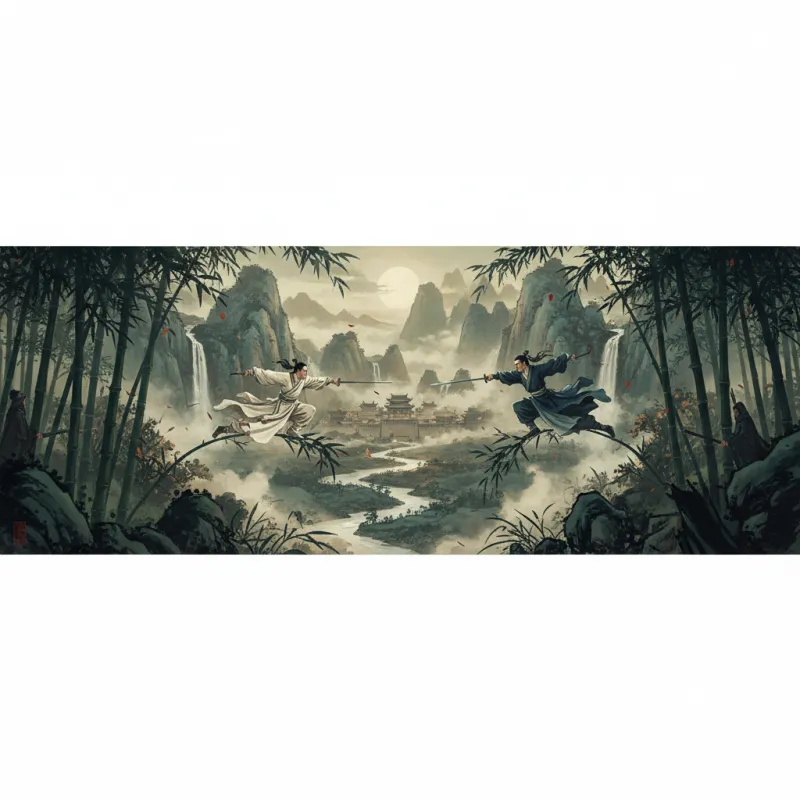
When Michelle Yeoh's Yu Shu Lien (俞秀莲 Yú Xiùlián) and Zhang Ziyi's Jen Yu (玉娇龙 Yù Jiāolóng) fought across rooftops in 2000, their wire-assisted leaps weren't just defying gravity — they were shattering a ceiling that had kept Chinese martial arts cinema trapped in cult status for decades. Western critics who'd dismissed Hong Kong action films as "chop-socky" suddenly discovered poetry in flying daggers and philosophy in sword fights. The irony? Mainland Chinese audiences watched the same film and shrugged.
The Outsider Who Cracked the Code
Ang Lee wasn't the obvious choice to make the definitive wuxia film. Born in Taiwan, educated in America, known for intimate dramas like The Ice Storm and Sense and Sensibility, he'd never directed a martial arts film. He didn't grow up reading Jin Yong (金庸 Jīn Yōng) novels or watching Shaw Brothers classics. That distance turned out to be his advantage.
Lee approached Wang Dulu's (王度庐 Wáng Dùlú) 1941 novel Crouching Tiger, Hidden Dragon — the fourth book in his Crane-Iron Pentalogy — with fresh eyes. Where Hong Kong directors like Tsui Hark and King Hu had spent decades refining wuxia's kinetic language for audiences already fluent in its conventions, Lee treated every element as if explaining it to someone encountering the jianghu (江湖 jiānghú) for the first time. The bamboo forest fight? Choreographed by Yuen Woo-ping to showcase grace over brutality. The Green Destiny sword? Given more screen time and mystique than any weapon in Shaw Brothers history. The romance between Li Mu Bai (李慕白 Lǐ Mùbái) and Yu Shu Lien? Foregrounded in a way that would make traditional wuxia fans uncomfortable.
This wasn't dumbing down. It was translation — finding universal emotional anchors in a genre that had always prioritized spectacle and honor codes over psychological realism.
What Hollywood Saw (And What It Missed)
The Academy Awards ceremony on March 25, 2001, marked a watershed. Four Oscars: Best Foreign Language Film, Best Cinematography, Best Art Direction, Best Original Score. Hollywood had finally recognized that martial arts cinema could be beautiful, not just exciting. Roger Ebert called it "the most exhilarating martial arts movie I have seen." The New York Times praised its "visual splendor and narrative grace."
But Western critics were essentially discovering what Chinese audiences had known for decades — that wuxia could be artful. They just hadn't been paying attention. King Hu's A Touch of Zen (侠女 Xiá Nǚ) won the Grand Prix at Cannes in 1975, but it never achieved mainstream Western recognition. Tsui Hark's Zu Warriors from the Magic Mountain (新蜀山剑侠 Xīn Shǔshān Jiànxiá) in 1983 pushed special effects boundaries that wouldn't be matched in Hollywood for years. Zhang Yimou's Hero (英雄 Yīngxióng), released two years after Crouching Tiger, would prove even more visually stunning.
What Crouching Tiger did differently was package wuxia in a way that felt accessible without feeling foreign. The subtitles were elegant. The pacing allowed for contemplation. The action sequences, while spectacular, never overwhelmed the character drama. For Western audiences raised on Star Wars and The Matrix, the wire work felt like a natural evolution of fantasy cinema rather than a jarring cultural artifact.
The Domestic Disconnect
Here's where it gets interesting: Chinese audiences were lukewarm. The film earned only $16 million in mainland China — respectable but nowhere near its international dominance. Hong Kong viewers were even more critical. Why?
First, the language. Ang Lee insisted on Mandarin dialogue for authenticity, but his cast spoke different dialects. Chow Yun-fat's Cantonese accent was obvious. Michelle Yeoh, Malaysian-born, struggled with Mandarin. For Chinese viewers, this was like watching a Western where the cowboys spoke with thick foreign accents — technically correct but emotionally distancing.
Second, the pacing. Lee's contemplative approach felt slow to audiences accustomed to the breakneck energy of Hong Kong action cinema. Where John Woo would pack a dozen fights into 90 minutes, Crouching Tiger took its time, dwelling on longing glances and unspoken regrets. This worked for Western audiences discovering the genre. For Chinese viewers who'd grown up on Shaw Brothers films, it felt ponderous.
Third, and most significantly, the film's emotional core didn't align with traditional wuxia values. Li Mu Bai's confession of love to Yu Shu Lien violated the genre's unwritten rule: true heroes suppress personal desire for duty and honor. His vulnerability read as weakness. The film's ending — ambiguous, melancholic, arguably tragic — rejected the moral clarity that defines classic wuxia. In Jin Yong's novels, righteousness always triumphs. In Wang Dulu's source material, and in Lee's adaptation, everyone loses something irreplaceable.
The Ripple Effect That Wasn't
You'd expect Crouching Tiger's success to trigger a wuxia renaissance in Hollywood. It didn't quite work out that way. Zhang Yimou's Hero and House of Flying Daggers (十面埋伏 Shímiàn Máifú) found audiences but not the same crossover magic. The Forbidden Kingdom (2008), which finally united Jackie Chan and Jet Li, felt like a missed opportunity — too self-aware, too eager to please. Hollywood's attempts to make its own wuxia films, like The Forbidden Kingdom or the Mortal Kombat reboots, mostly demonstrated that the genre's DNA doesn't transplant easily.
What did change was subtler. Suddenly, wire work became acceptable in mainstream American action films. The Matrix had started this trend in 1999, but Crouching Tiger legitimized it as artistry rather than gimmick. Choreographers like Yuen Woo-ping became sought-after in Hollywood. The idea that action sequences could be balletic, that fights could express character rather than just advance plot — these concepts seeped into everything from superhero films to prestige dramas.
More importantly, Crouching Tiger proved that foreign-language films could be commercially viable in America without compromise. Its $128 million US gross remained the record for a foreign-language film until Parasite in 2019. That eighteen-year gap tells you how rare this achievement was.
The Wuxia That Wuxia Fans Debate
Talk to hardcore wuxia enthusiasts today, and Crouching Tiger remains divisive. Some appreciate its role as ambassador, introducing millions to a genre they might never have discovered. Others see it as a beautiful betrayal — a film that succeeded precisely because it softened wuxia's edges, making it palatable by making it less itself.
Both perspectives have merit. The film's treatment of the jianghu is undeniably romanticized. Real wuxia novels, especially Wang Dulu's source material, are messier, more morally complex, less visually pristine. The bamboo forest fight, gorgeous as it is, would never happen in a traditional wuxia narrative — too impractical, too focused on aesthetics over martial logic. The Green Destiny sword's mystique feels borrowed more from Western fantasy traditions (think Excalibur) than from Chinese martial arts fiction, where weapons are tools of skill rather than magical artifacts.
Yet the film's emotional honesty — its willingness to show heroes as flawed, duty as burden, honor as trap — actually aligns with Wang Dulu's original vision more than most Shaw Brothers adaptations ever did. Wang wrote about the cost of living by the jianghu's codes. His characters suffer for their righteousness. Ang Lee understood this in a way that many Chinese directors, perhaps too close to the genre's conventions, didn't.
Legacy in the Streaming Age
Twenty-three years later, Crouching Tiger's influence persists in unexpected ways. When Netflix released The Witcher, its fight choreography owed obvious debts to Yuen Woo-ping's work. Disney's Raya and the Last Dragon borrowed heavily from wuxia aesthetics. Even Western fantasy literature has started incorporating jianghu-inspired elements — R.F. Kuang's The Poppy War series, Rebecca Roanhorse's Black Sun, these wouldn't exist in their current form without Crouching Tiger making Chinese martial arts fiction visible to Western publishers.
The film also created a template for how to adapt culturally specific genres for global audiences — a template that's been applied to everything from Korean dramas to Japanese anime. Keep the cultural specificity, but find the universal emotions. Explain nothing, but make everything comprehensible through context. Trust your audience to meet you halfway.
For wuxia itself, the film's legacy is more complicated. It didn't spark the international wuxia boom some predicted. Chinese martial arts cinema has largely retreated from trying to court Western audiences, focusing instead on domestic markets and streaming platforms. The big-budget wuxia epics of the 2000s have given way to smaller-scale productions and web series. Modern wuxia adaptations increasingly prioritize romance over martial arts, targeting younger audiences who never saw the Shaw Brothers classics.
But Crouching Tiger proved something important: wuxia could be more than a niche genre. It could be cinema, capital-C. It could win Oscars and break box office records and make critics reconsider their assumptions about what "foreign film" meant. Whether that was good for wuxia as a genre — whether success required compromise — remains an open question.
The Film That Changed Everything (Except Maybe Wuxia)
Here's the paradox: Crouching Tiger, Hidden Dragon changed how the world saw wuxia without changing wuxia itself. The genre continued evolving on its own terms, driven by Chinese audiences and creators who never needed Western validation. Jin Yong's novels remain the gold standard. Hong Kong action cinema kept innovating. Mainland Chinese television produced wuxia series that dwarf Crouching Tiger in scope and popularity, even if they never crossed over internationally.
What Ang Lee's film did was create a bridge — one that mostly carried traffic in one direction. Western audiences got a glimpse of the jianghu, filtered through a director who understood both worlds. Some crossed that bridge and discovered the vast tradition beyond: the novels, the earlier films, the legendary swordsmen and martial arts sects that populate Chinese martial arts fiction. Most didn't. They saw a beautiful film and moved on.
And maybe that's enough. Not every bridge needs to carry millions. Sometimes it's enough to prove the crossing is possible, to show that the distance between cultures isn't as vast as it seems, that a story about duty and desire and flying through bamboo forests can resonate anywhere. Crouching Tiger, Hidden Dragon did that. It made wuxia visible. What audiences chose to do with that visibility — whether to explore deeper or simply enjoy the view — was always going to be up to them.
The film didn't change everything. But it changed enough. And in a genre built on the idea that a single sword stroke can alter destiny, sometimes enough is everything.
Related Reading
- The World of Wuxia: Exploring Chinese Martial Arts Fiction and Jianghu Culture
- Wire-Fu: The Art of Flying Swordsmen in Action Cinema
- Best Wuxia TV Dramas: A Streaming Guide for International Viewers
- The Golden Age of Hong Kong Wuxia Cinema
- The Wuxia Film Renaissance: Why Hong Kong Cinema Matters
- Huang Rong: The Smartest Heroine in Chinese Fiction
- Legendary Swords in Wuxia Fiction
- Gu Long vs. Jin Yong: Two Masters, Two Visions of Wuxia
Explore Chinese Culture
- Explore Jin Yong's martial arts novels
- Explore cultivation fiction and immortal heroes
- Explore the real history behind wuxia