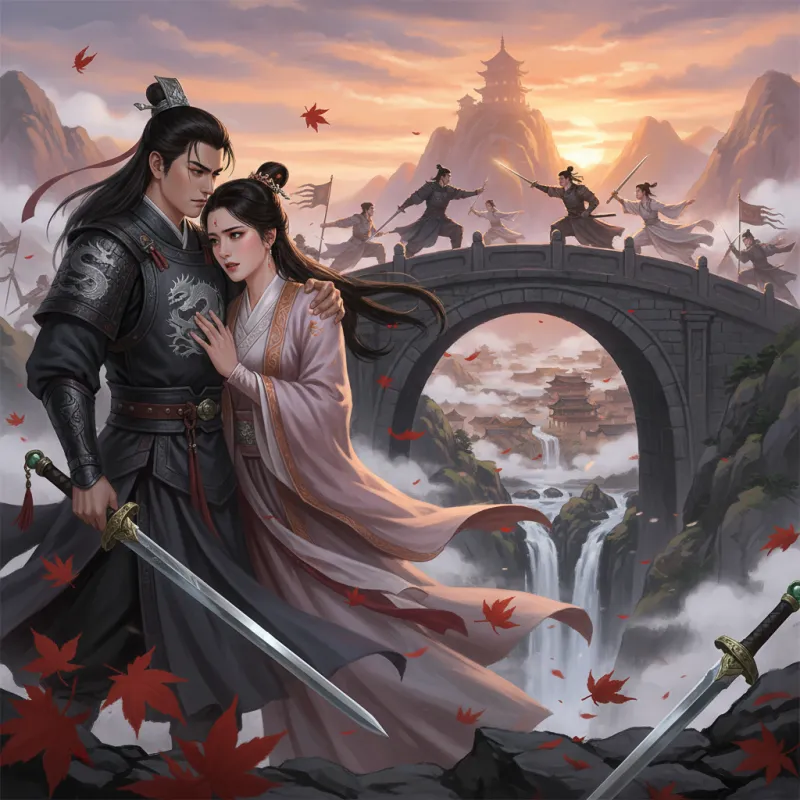
A master swordsman stands at the edge of a cliff, his beloved in his arms, both knowing that saving her means betraying his sect — and betraying his sect means dishonoring the teacher who raised him from childhood. He has perhaps three seconds to choose. This is the moment wuxia romance lives for.
In martial arts fiction, love isn't a reward for the hero's journey. It's the cruelest test the jianghu (江湖 jiānghu, the martial world) can devise. While Western fantasy often treats romance as the prize waiting at the end of the quest, wuxia understands something darker: in a world built on loyalty oaths, blood debts, and sect hierarchies, falling in love is an act of rebellion. And rebellion has consequences.
The Impossible Choice: Love Against the World
Every memorable wuxia romance is built on an impossible choice. Not the kind of choice where one option is clearly better — the kind where both options destroy you, just in different ways.
Take Yang Guo and Xiaolongnü from Jin Yong's Return of the Condor Heroes (神雕侠侣 Shéndiāo Xiálǚ, 1959). Their love violates the teacher-student relationship, breaks the Ancient Tomb Sect's rules, and scandalizes the entire martial world. Yang Guo can have his reputation and standing in the jianghu, or he can have Xiaolongnü. The novel's genius is that it never pretends there's a compromise. He chooses her, and the martial world makes him pay for sixteen years.
Or consider Linghu Chong and Yue Lingshan in The Smiling, Proud Wanderer (笑傲江湖 Xiào'ào Jiānghú, 1967). Linghu Chong loves his junior martial sister, but she marries Lin Pingzhi — not because she doesn't care for Linghu Chong, but because her father's political maneuvering and sect obligations make the choice for her. By the time she realizes her mistake, she's trapped in a marriage to a man consumed by revenge. She dies in Linghu Chong's arms, and her last words are an apology. This is what duty costs.
The pattern repeats across the genre because it reflects the fundamental architecture of the jianghu. You don't exist as an individual — you exist as a node in a network of obligations. Your teacher's enemies are your enemies. Your sect's feuds are your feuds. Your sworn brothers' vendettas are your vendettas. Love asks you to prioritize one person above this entire system. The system doesn't forgive that.
The Tragic Heroine: When Love Means Sacrifice
Wuxia romance has a particular cruelty reserved for its female characters. They don't just face impossible choices — they're often the ones who make the sacrifice so the hero doesn't have to.
Azhu from Demi-Gods and Semi-Devils (天龙八部 Tiānlóng Bābù, 1963) is the template. She loves Qiao Feng, the greatest hero in the martial world, and when he accidentally kills her father while seeking revenge, she disguises herself as the real culprit so Qiao Feng can have his vengeance without living with patricide. She dies by his hand, and he doesn't realize what she's done until it's too late. Her final act is to protect him from his own guilt.
This isn't weakness — it's a different kind of martial arts mastery. Azhu understands that in the jianghu's moral economy, some debts can only be paid in blood. She chooses which blood to spill. That's power, even if it looks like sacrifice.
The same pattern appears in Gu Long's work, though with his characteristic nihilism. In The Legendary Siblings (绝代双骄 Juédài Shuāngjiāo, 1966), Tie Xinlan loves Xiao Yu'er but knows he's destined for someone else. She doesn't fight for him — she steps aside, because she understands that love in the jianghu isn't about what you want. It's about what you can live with losing.
These women aren't passive victims. They're making calculated decisions about which tragedies they can endure. The genre's tragedy is that it forces them to make these calculations at all. For more on how female characters navigate these impossible positions, see Female Martial Artists in Wuxia Fiction.
The Forbidden Love: When Your Beloved Is Your Enemy
The most explosive wuxia romances happen when love crosses the battle lines drawn by sect feuds and family vendettas.
Guo Jing and Huang Rong in The Legend of the Condor Heroes (射雕英雄传 Shèdiāo Yīngxióng Zhuàn, 1957) face this early on. Guo Jing is sworn to avenge his father's death — and the man responsible is Huang Rong's father, Huang Yaoshi. The novel spends considerable time on this tension: Guo Jing's filial duty demands he kill the father of the woman he loves. Huang Rong's filial duty demands she protect her father from the man she loves. Jin Yong resolves this through revelation and reconciliation, but the threat hangs over their relationship for volumes.
Gu Long pushes this dynamic to its logical extreme. In The Book and the Sword (书剑恩仇录 Shū Jiàn Ēnchóu Lù, 1955), Chen Jialuo leads the Red Flower Society against the Qing Dynasty — and then discovers the Qianlong Emperor is his brother. His love interest, Huo Qingtong, is caught between her love for Chen Jialuo and her people's political survival, which depends on Qing favor. There's no good ending here. Chen Jialuo can't have both his revolution and his brother. Huo Qingtong can't have both her people and her love. The novel ends with everyone alive and everyone destroyed.
This is the forbidden love trope at its most sophisticated. It's not forbidden because of arbitrary social rules — it's forbidden because the lovers' fundamental identities are in conflict. You can't love someone and kill their father. You can't marry someone and destroy their people. The jianghu doesn't allow for that kind of compartmentalization.
The Doomed Romance: Love That Cannot Survive the Jianghu
Some wuxia romances are doomed from the start, and everyone knows it except the lovers themselves.
Xiao Feng (Qiao Feng) and A'Zhu in Demi-Gods and Semi-Devils is the genre's most perfect tragedy. They plan to retire from the jianghu, raise horses, live simply. The novel lets you believe this might happen — for about fifty pages. Then Xiao Feng's quest for revenge intersects with A'Zhu's loyalty, and she dies by his hand. The tragedy isn't that they loved each other. It's that they believed love could be enough.
Later, Xiao Feng loves A'Zi, A'Zhu's sister, but this love is poisoned from the start. A'Zi is obsessive, manipulative, and willing to destroy anyone who threatens her claim on Xiao Feng. He doesn't love her the way he loved A'Zhu — he protects her out of guilt and obligation. When he finally jumps off a cliff to avoid killing his own people, she jumps after him. It's romantic and horrifying in equal measure.
Gu Long's The Eleventh Son (萧十一郎 Xiāo Shíyīláng, 1970) offers a different flavor of doomed love. Xiao Shiyi Lang is an outlaw who falls for Shen Bijun, the wife of a righteous sect leader. Their love is impossible not because of external obstacles but because of who they are. She's bound by propriety and duty. He's bound by his nature as someone who exists outside society's rules. They can't be together without one of them fundamentally changing — and if they change, they're no longer the people who fell in love.
The jianghu doesn't allow for retirement. It doesn't allow for escape. Once you're in the martial world, you're in it until death. Romance that requires leaving the jianghu is romance that requires dying.
The Bittersweet Victory: Love That Survives at Great Cost
Not every wuxia romance ends in death. Some end in survival — but survival that costs so much it barely feels like winning.
Linghu Chong and Ren Yingying in The Smiling, Proud Wanderer get their happy ending. They marry, they survive, they even achieve some measure of peace. But Linghu Chong has lost his sect, his martial sister (who died loving someone else), his teacher's approval, and his place in the orthodox martial world. Ren Yingying has watched her father die and inherited leadership of the Sun Moon Holy Cult, a position that will make her enemies for life. They have each other, but they've paid for it with everything else.
This is Jin Yong's version of mercy. The lovers survive, but they're scarred. They've learned that love in the jianghu isn't about happiness — it's about choosing which losses you can endure.
Guo Jing and Huang Rong in The Legend of the Condor Heroes and its sequel The Return of the Condor Heroes seem to have the genre's most successful romance. They marry, have children, defend Xiangyang together. But the sequel reveals the cost: their daughter Yang Guo grows up so constrained by their reputation and expectations that he rebels completely. And history tells us how their story ends — Xiangyang falls to the Mongols, and Guo Jing and Huang Rong die defending it. Their love survives, but it survives into tragedy.
The bittersweet victory is wuxia's acknowledgment that love can endure in the jianghu — but it endures the way a sword endures, through constant testing and tempering. For more on how these relationships shape character development, explore The Warrior Woman Archetype.
Why Wuxia Romance Cuts Deeper
Western fantasy often treats romance as a subplot or a reward. The hero defeats the dragon, saves the kingdom, gets the girl. Wuxia understands that in a world built on honor, duty, and blood debts, romance isn't a reward — it's a complication that makes everything harder.
The genre's romances resonate because they're built on genuine moral dilemmas. When Yang Guo chooses Xiaolongnü over the martial world's approval, he's not choosing love over evil. He's choosing love over duty, personal happiness over collective obligation, his own heart over his teacher's legacy. These are real choices with real costs.
And wuxia never pretends the costs aren't real. Linghu Chong gets Ren Yingying, but he loses Yue Lingshan. Xiao Feng avenges A'Zhu's death, but he can never bring her back. Guo Jing and Huang Rong build a life together, but they build it in the shadow of an invasion they can't stop.
This is why wuxia romance feels more adult than most fantasy romance. It's not about finding your soulmate and living happily ever after. It's about finding someone worth suffering for, and then doing the suffering. The jianghu doesn't care about your happiness. It cares about your choices. And every choice in a wuxia romance is a choice between two kinds of pain.
The sword through the heart heals. The betrayal by a sworn brother can be avenged. But falling in love? That's the wound that never closes. That's the technique no master can defend against. And that's why, after sixty years of wuxia fiction, we're still reading about it.
Related Reading
- Women Warriors in Chinese Martial Arts Fiction: Empowering Jianghu Heroines
- Women Warriors in Wuxia: Beyond the Love Interest
- Hua Mulan and Beyond: Real Women Warriors of China
- Hua Mulan and the Wuxia Tradition of Women Warriors
- Lingzhi: The Mushroom of Immortality from Myth to Medicine
- Legendary Weapons of Wuxia: The Swords That Have Names
- Sun Wukong: The Great Sage Who Challenged Heaven
Explore Chinese Culture
- Explore Jin Yong's martial arts novels
- Explore cultivation fiction and immortal heroes
- Explore the real history behind wuxia