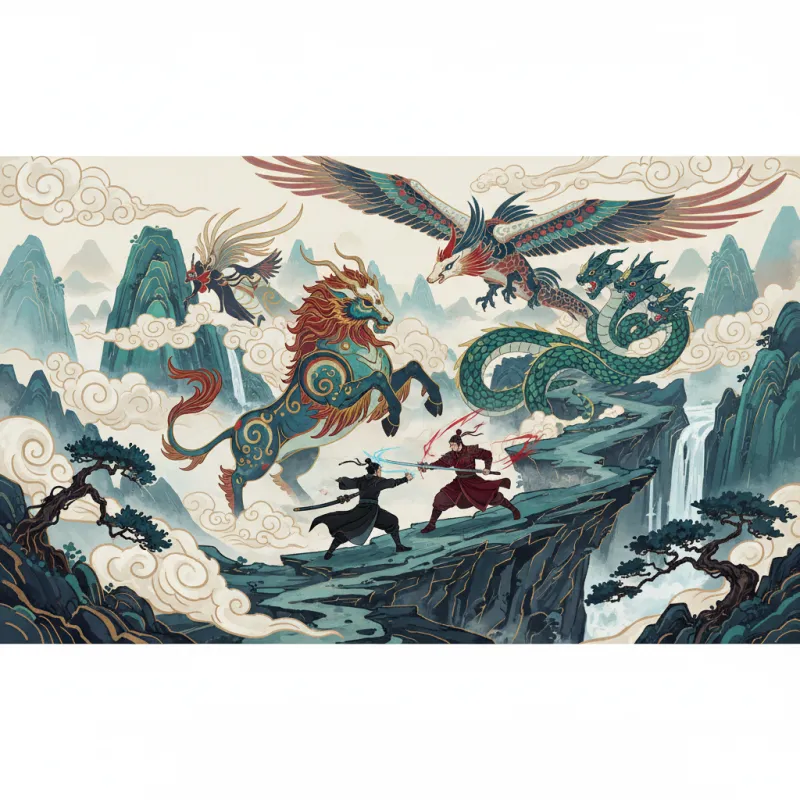
A nine-tailed fox rendered in neon gradients. A Kunpeng (鲲鹏 Kūnpéng) dissolving into digital particles. The Taotie (饕餮 Tāotiè) reimagined as a cyberpunk deity with circuit-board patterns etched into its bronze mask. Walk through any contemporary art gallery in Beijing, Shanghai, or Taipei, and you'll find the creatures of the Shanhaijing (山海经 Shānhǎi Jīng, Classic of Mountains and Seas) staring back at you — not as museum relics, but as living, breathing participants in modern visual culture. This ancient bestiary, compiled over two millennia ago, has become the most influential creative brief in Chinese art history, and contemporary illustrators are writing its latest chapter.
The Generous Ambiguity of Ancient Descriptions
The genius of the Shanhaijing lies in what it doesn't say. Consider the entry for the Zhuque (朱雀 Zhūquè): "There is a bird that looks like a chicken, with colorful patterns and text on its body, called Zhuque." That's it. No color palette. No feather count. No behavioral notes beyond "it eats snakes." This radical brevity isn't a bug — it's a feature that has kept these creatures alive across centuries. Each generation of artists receives the same skeletal description and builds flesh around it according to their own aesthetic vocabulary.
Compare this to Western bestiaries, which often included moral allegories and specific symbolic meanings that calcified over time. The phoenix must represent resurrection. The unicorn must symbolize purity. But the Shanhaijing creatures carry no such baggage. A Bixie (辟邪 Bìxié) can be whatever the artist needs it to be: guardian, monster, metaphor, or pure visual spectacle. This interpretive freedom is why contemporary illustrators keep returning to these ancient texts while medieval European bestiaries remain largely historical curiosities.
From Woodblock to Wacom Tablet
The visual language of Shanhaijing creatures evolved slowly for centuries. Ming dynasty (1368-1644) woodblock prints established certain conventions — the nine-tailed fox always shown in profile, the Taotie rendered as a symmetrical mask, the Kunpeng depicted mid-transformation between fish and bird. These images were copied, refined, and passed down through generations of artists who worked within strict stylistic boundaries.
Then came the digital revolution, and everything exploded. Contemporary illustrators like Zhang Xiaobai and Shan Ze (杉泽 Shān Zé) use Photoshop, Procreate, and 3D modeling software to reimagine these creatures with a freedom that would have been unthinkable even thirty years ago. Shan Ze's 2019 series "Mountains and Seas" presents the Qiongqi (穷奇 Qióngqí) — traditionally described as a winged tiger that eats people — as a biomechanical horror with exposed muscle tissue and crystalline wings. It's simultaneously faithful to the text (winged, tiger-like, terrifying) and completely unprecedented in execution.
The shift isn't just technological. Digital tools allow for rapid iteration and experimentation. An artist can generate fifty variations of the Feiyi (飞翼 Fēiyì) in an afternoon, testing different color schemes, anatomical structures, and compositional approaches. This speed has led to an explosion of diversity in how these creatures are visualized, moving from a single canonical image to a constellation of equally valid interpretations.
The Aesthetic Tribes of Modern Shanhaijing Art
Contemporary Shanhaijing illustration has splintered into distinct aesthetic movements, each with its own philosophy about how to honor the source material. The "Neo-Traditional" school, exemplified by artists like Hu Sansheng (呼三省 Hū Sānshěng), maintains the compositional structure and color palette of classical Chinese painting while incorporating modern rendering techniques. Their creatures exist in misty landscapes with careful attention to brushwork texture, even when created entirely on a tablet.
At the opposite extreme, the "Speculative Biology" movement treats the Shanhaijing as a field guide to an alternate evolutionary timeline. Artists like Chen Shu design creatures with anatomically plausible skeletal structures, muscle attachments, and ecological niches. Her Jiuying (九婴 Jiǔyīng) — the nine-headed water beast — is rendered with the scientific precision of a natural history illustration, complete with hypothetical internal organs and feeding behaviors. It's a fascinating collision between ancient mythology and modern zoological knowledge.
Then there's the "Urban Fantasy" school, which drops these ancient beasts into contemporary settings. The most striking example is probably Luo Yang's 2021 series showing Shanhaijing creatures navigating modern Shanghai — a Lushu (鹿蜀 Lùshū) browsing vegetables at a wet market, a Qinyuan (钦原 Qīnyuán) perched on a subway car. These images ask provocative questions about what happens when the mythological intrudes on the mundane, a theme that resonates with contemporary wuxia narratives about hidden martial arts worlds.
The International Dimension
Western artists have also discovered the Shanhaijing, though their interpretations often reveal interesting cultural blind spots. American illustrator Sarah Webb's 2020 "Mountains and Seas" series is technically accomplished but tends toward a generic "Asian fantasy" aesthetic that could just as easily be Japanese or Korean. The creatures lose their specifically Chinese context, becoming interchangeable with yokai or dokkaebi.
More successful are artists who engage seriously with Chinese visual traditions while bringing their own cultural perspective. Brazilian illustrator Thiago Lehmann's work incorporates elements of Amazonian indigenous art into his Shanhaijing creatures, creating a fascinating cross-cultural dialogue. His Bifang (毕方 Bìfāng) — a one-legged fire bird — features feather patterns inspired by macaw plumage and Kayapo body paint. It's not authentically Chinese, but it's not trying to be. Instead, it asks what happens when one ancient mythological tradition encounters another.
Commercial Applications and Compromises
The explosion of Shanhaijing-inspired art isn't happening in a vacuum. Chinese game companies, animation studios, and publishing houses are hungry for distinctive visual content that feels culturally authentic, and these ancient creatures fit the bill perfectly. The mobile game "Onmyoji" features dozens of Shanhaijing creatures redesigned as playable characters, each with elaborate backstories and multiple costume variations.
This commercialization has produced some genuinely innovative work — the character designs for the 2021 animated film "New Gods: Yang Jian" are stunning — but it's also led to a certain homogenization. When creatures need to be marketable, cute, or sexy, they lose some of their original strangeness. The Taotie becomes a grumpy-but-lovable mascot. The nine-tailed fox becomes a beautiful woman with fox ears and a fluffy tail. The commercial imperative smooths away the rough edges that made these creatures unsettling in the first place.
There's also the question of historical accuracy versus creative freedom. Some scholars argue that modern interpretations have strayed too far from the source material, turning the Shanhaijing into a generic fantasy bestiary. But this criticism misunderstands how mythological traditions work. The text itself is a compilation of earlier oral traditions, already several steps removed from whatever original beliefs inspired it. Every generation has remade these creatures in its own image. We're just doing it faster and more visibly than our ancestors did.
The Digital Archive Problem
One unexpected consequence of the digital illustration boom is the fragmentation of the visual record. Classical Shanhaijing illustrations exist in museums and libraries, carefully preserved and catalogued. But contemporary digital art lives on hard drives, social media platforms, and portfolio websites that may not exist in ten years. Thousands of interpretations are being created and shared, but there's no systematic effort to preserve them.
Some artists are addressing this through print publications. The 2022 anthology "Mountains and Seas: Contemporary Visions" collected work from fifty illustrators, creating a physical record of this moment in Shanhaijing interpretation. But most digital art remains ephemeral, liked and scrolled past and forgotten. Future scholars studying this period will have a much harder time reconstructing the visual conversation than we do looking back at Ming dynasty woodblocks.
Why These Creatures Endure
The Shanhaijing has survived for over two thousand years because it offers something rare: a mythology that doesn't insist on its own interpretation. The creatures are strange enough to be memorable but flexible enough to adapt to changing aesthetic and cultural contexts. They can be terrifying or cute, realistic or abstract, traditional or experimental. They work equally well in classical ink paintings and cyberpunk concept art.
Contemporary illustrators understand this intuitively. They're not trying to capture some authentic original vision of what these creatures "really" looked like — such a thing never existed. Instead, they're participating in an ongoing conversation that stretches back through centuries of artists, each adding their own voice while remaining in dialogue with what came before. The nine-tailed fox in neon gradients is no less legitimate than the nine-tailed fox in Ming dynasty woodblock, because both are responses to the same generous creative brief.
This is why the Shanhaijing remains relevant in an age of infinite digital content. In a world where every fantasy creature has been rendered in exhaustive detail by concept artists and 3D modelers, these ancient descriptions retain their power precisely because they refuse to be pinned down. They're not intellectual property to be protected or canonical designs to be replicated. They're invitations to imagine, and contemporary illustrators are accepting that invitation with unprecedented enthusiasm and creativity.
The conversation continues, and the creatures evolve. Somewhere right now, an artist is opening their tablet and reading about a bird with a human face, and they're about to show us something we've never seen before — even though the description is two thousand years old. That's the magic of the Shanhaijing, and that's why it will outlive us all.
Related Reading
- Shanhai Jing Creatures in Modern Video Games
- Chinese Mythology in Hollywood: From Mulan to Shang-Chi
- Exploring the Evolution of Wuxia: Modern Influences on Chinese Martial Arts Fiction
- The Jade Palace of Kunlun: Home of the Queen Mother of the West
- The Dao of the Sword: Martial Arts as Philosophy in Wuxia
- Neigong: The Art of Internal Energy in Wuxia
Explore Chinese Culture
- Explore Jin Yong's martial arts novels
- Explore cultivation fiction and immortal heroes
- Explore the real history behind wuxia