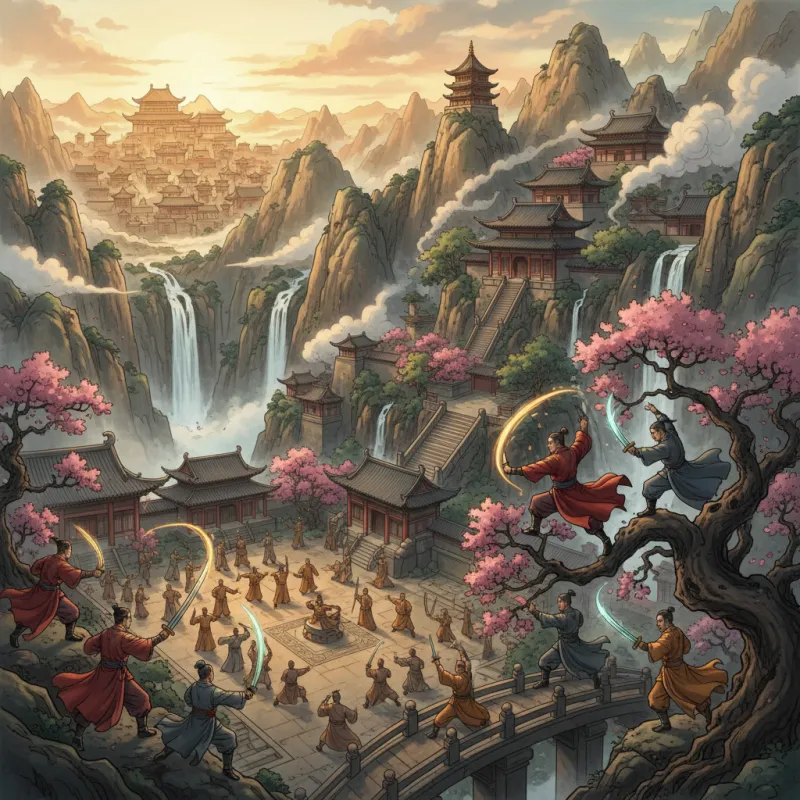
The abbot's staff strikes the stone floor three times. In the Thousand Buddha Hall, a hundred monks drop into horse stance simultaneously, their robes settling like falling leaves. Outside, pilgrims climb the stone steps of Song Mountain, seeking blessings. Inside, disciples perfect strikes that could shatter bone. This is Shaolin Temple (少林寺 Shàolín Sì) — not just a monastery, but the gravitational center of Chinese martial arts, the institution that turned Buddhist compassion into the most feared fighting system in the jianghu.
The Paradox at the Heart of Shaolin
Here's what makes Shaolin endlessly fascinating: it's a Buddhist monastery whose monks have mastered the art of violence. Buddhism teaches non-harm, yet Shaolin monks are the most formidable fighters in wuxia fiction. This contradiction isn't a flaw in the narrative — it's the entire point. The tension between spiritual cultivation and martial prowess creates the philosophical depth that elevates Shaolin above mere fighting schools.
In Jin Yong's Demi-Gods and Semi-Devils (天龙八部), the Shaolin abbot Xuanci embodies this paradox perfectly. He's a man of profound Buddhist learning who has also mastered the temple's most lethal techniques. When his past sins catch up with him, the novel asks: can martial skill coexist with spiritual purity? Or does the very act of perfecting violence corrupt the soul, no matter how righteous the intention?
The answer Shaolin offers is wǔdé (武德) — martial virtue. Violence is permissible only when wielded with compassion, only to protect the innocent, only when all other options have failed. It's a razor's edge to walk, and in the best wuxia novels, Shaolin monks are constantly struggling to maintain that balance.
The 72 Arts and the Mythology of Mastery
"All martial arts under heaven originate from Shaolin" (天下武功出少林 Tiānxià wǔgōng chū Shàolín). This saying is historically dubious but narratively essential. In wuxia fiction, Shaolin isn't just one martial arts school among many — it's the source code from which all other styles derive.
The temple's legendary 72 Arts (七十二艺 Qīshí'èr Yì) represent the pinnacle of martial achievement. These aren't just fighting techniques; they're superhuman abilities that blur the line between skill and magic. Iron Head Skill lets monks shatter stone with their skulls. Iron Shirt makes the body impervious to blades. Finger Zen allows a monk to kill with a single touch to a pressure point.
In Gu Long's novels, Shaolin's martial arts are treated with almost religious reverence. When a character masters even one of the 72 Arts, they're immediately elevated to the top tier of jianghu fighters. But Gu Long also subverts this: his protagonists often defeat Shaolin monks through cunning, speed, or unorthodox techniques, suggesting that rigid tradition can be a weakness as much as a strength.
The most famous Shaolin technique in fiction is probably the Yijin Jing (易筋经 Yìjīn Jīng) — the Muscle-Tendon Change Classic. This isn't just a martial arts manual; it's a method of internal transformation that rebuilds the body from the inside out. In Demi-Gods and Semi-Devils, the Yijin Jing is so powerful that it can cure poison, heal internal injuries, and grant superhuman strength. It's less a fighting style and more a path to transcendence.
Shaolin's Role in the Jianghu Hierarchy
In wuxia fiction, Shaolin occupies a unique position: it's simultaneously part of the jianghu and above it. The temple participates in martial arts conferences, sends disciples to investigate disturbances, and occasionally takes sides in conflicts. But it also maintains a studied neutrality, refusing to be drawn into petty sect rivalries.
This gives Shaolin enormous soft power. When the temple speaks, everyone listens. When Shaolin declares someone a heretic or a threat to the martial world, that person becomes an instant pariah. The temple's approval legitimizes; its disapproval destroys.
Jin Yong understood this dynamic perfectly. In The Heaven Sword and Dragon Saber (倚天屠龙记), the six major orthodox sects — including Shaolin — unite to besiege Bright Peak and destroy the Ming Cult. Shaolin's participation is what makes the siege legitimate in the eyes of the jianghu. Without Shaolin's moral authority, it would just be a gang war. With Shaolin involved, it becomes a righteous crusade.
But Jin Yong also shows the danger of this power. Shaolin's moral certainty can become moral blindness. The temple is so convinced of its righteousness that it fails to see its own hypocrisy — condemning the Ming Cult for violence while leading an army to slaughter them. The protagonist Zhang Wuji eventually forces Shaolin to confront this contradiction, and the temple's reputation never fully recovers.
The Shaolin Monk as Character Archetype
Shaolin monks in wuxia fiction fall into several distinct archetypes, each exploring different aspects of the martial-spiritual tension.
The Righteous Abbot: Wise, powerful, and morally unimpeachable. These characters represent Shaolin at its best — martial skill in service of Buddhist compassion. Xuanci from Demi-Gods and Semi-Devils starts as this archetype before his tragic fall.
The Prodigy: A young monk of exceptional talent who struggles with the restrictions of monastic life. These characters often leave Shaolin to experience the jianghu firsthand, returning with a deeper understanding of both martial arts and Buddhism. Xuzhu from Demi-Gods and Semi-Devils is the quintessential example — a bumbling monk who accidentally becomes one of the most powerful martial artists in the world.
The Fallen Monk: A Shaolin disciple who abandons Buddhist principles for power, revenge, or worldly desires. These characters are often the most dangerous antagonists because they combine Shaolin's martial prowess with none of its moral restraint. Jiumozhi from Demi-Gods and Semi-Devils is a brilliant example — a Tibetan monk who masters Shaolin techniques through theft and obsession, becoming a cautionary tale about the corruption of martial arts divorced from spiritual cultivation.
The Warrior Monk: Older disciples who serve as Shaolin's enforcers in the jianghu. These characters have made peace with the paradox of Buddhist violence, accepting that sometimes compassion requires a firm hand. They're often the most pragmatic and least idealistic Shaolin characters.
Shaolin vs. Wudang: The Great Dichotomy
You can't discuss Shaolin without mentioning its eternal rival: Wudang. In wuxia fiction, these two sects represent opposing philosophies of martial arts and life itself.
Shaolin is external, hard, Buddhist, and communal. Its martial arts emphasize physical conditioning, powerful strikes, and rigid forms. Shaolin monks train together, eat together, pray together — the individual is subsumed into the collective.
Wudang is internal, soft, Daoist, and individualistic. Its martial arts emphasize qi cultivation, flowing movements, and adaptability. Wudang practitioners are often solitary wanderers, seeking enlightenment through personal experience rather than institutional discipline.
This dichotomy structures countless wuxia plots. In The Heaven Sword and Dragon Saber, the rivalry between Shaolin and Wudang drives much of the political intrigue. In Crouching Tiger, Hidden Dragon, the contrast between rigid Shaolin discipline and fluid Wudang philosophy creates the film's central tension.
But the best wuxia stories don't treat this as a simple binary. Jin Yong's novels often suggest that the highest martial arts transcend the Shaolin-Wudang divide, incorporating both external and internal cultivation. The ultimate martial artist isn't purely Shaolin or purely Wudang — they synthesize both approaches into something greater.
The Temple as Narrative Device
Beyond its role as a sect, Shaolin Temple functions as a crucial narrative device in wuxia fiction. It's a place where protagonists go to train, to seek refuge, to find ancient manuals, or to prove themselves against the best fighters in the world.
The temple's Sutra Library (藏经阁 Cángjīng Gé) is a particularly important location. In countless wuxia novels, this is where the most powerful martial arts manuals are hidden, often in plain sight among Buddhist scriptures. The message is clear: true martial arts mastery requires not just physical training but intellectual and spiritual cultivation. You can't just punch your way to enlightenment.
Shaolin also serves as a measuring stick for power levels. When a character can defeat a Shaolin monk, readers know they're formidable. When they can defeat a Shaolin elder, they're top-tier. When they can challenge the abbot himself, they're among the greatest martial artists alive.
This creates a useful narrative shorthand. Instead of lengthy exposition about a character's abilities, the author can simply show them sparring with Shaolin monks. The outcome tells readers everything they need to know.
The Modern Shaolin: Tourism and Transformation
The real Shaolin Temple today is a strange hybrid of monastery, martial arts school, and tourist attraction. Monks perform kung fu demonstrations for crowds of visitors. The temple has been rebuilt and expanded multiple times, most recently with significant government funding. There's even a Shaolin brand, with affiliated schools around the world.
This commercialization troubles some purists, who see it as a betrayal of Shaolin's spiritual mission. But there's another way to look at it: Shaolin has always adapted to survive. The temple has been destroyed and rebuilt multiple times over its 1,500-year history. It has served emperors and resisted them, trained soldiers and sheltered refugees, preserved ancient knowledge and innovated new techniques.
In wuxia fiction, Shaolin's adaptability is often portrayed as wisdom rather than compromise. The temple endures because it knows when to fight and when to bend, when to speak and when to remain silent. This flexibility, paradoxically, is what allows Shaolin to maintain its rigid principles across centuries of upheaval.
Why Shaolin Endures in Fiction
Shaolin Temple persists in wuxia fiction because it embodies contradictions that make for compelling storytelling: violence and compassion, tradition and innovation, individual achievement and collective discipline, worldly power and spiritual transcendence.
The temple is simultaneously the establishment and the ideal, the institution that must be respected and the authority that must be questioned. It's powerful enough to be worth challenging but principled enough to be worth defending. It represents both the best and worst of organized martial arts — the wisdom of accumulated tradition and the blindness of institutional certainty.
When Jin Yong writes about Shaolin, he's not just describing a martial arts sect. He's exploring questions about power, morality, tradition, and change that resonate far beyond the jianghu. How do we balance strength with compassion? When is violence justified? Can institutions maintain their principles while adapting to new circumstances? What is the relationship between individual excellence and collective good?
These questions don't have easy answers, which is why Shaolin remains endlessly fascinating. The temple on Song Mountain, with its warrior monks and hidden manuals and ancient traditions, continues to captivate readers not because it provides answers but because it asks the right questions.
In the end, perhaps that's the real reason "all martial arts under heaven originate from Shaolin." Not because the temple invented every technique, but because it established the framework within which martial arts could become more than just fighting — a path to wisdom, a test of character, a way of engaging with the deepest questions of human existence. That's a legacy worth preserving, whether in fiction or reality.
Related Reading
- Exploring Chinese Martial Arts Fiction and Jianghu Culture in Kung Fu Novels
- Wudang Mountain: The Daoist Heart of Internal Martial Arts
- The Beggar Sect: The Largest and Most Unlikely Martial Arts Organization
- Sects and Clans in Wuxia: The Organizations That Rule the Martial World
- The Beggars Sect: How a Gang of Homeless People Became the Largest Organization in the Martial World
- Chinese Internet Ghost Stories: The Creepypasta of the East
- Poison and Medicine in Wuxia: Two Sides of the Same Coin
- The Wuxia Training Montage: How Heroes Are Made
Explore Chinese Culture
- Explore Jin Yong's martial arts novels
- Explore cultivation fiction and immortal heroes
- Explore the real history behind wuxia