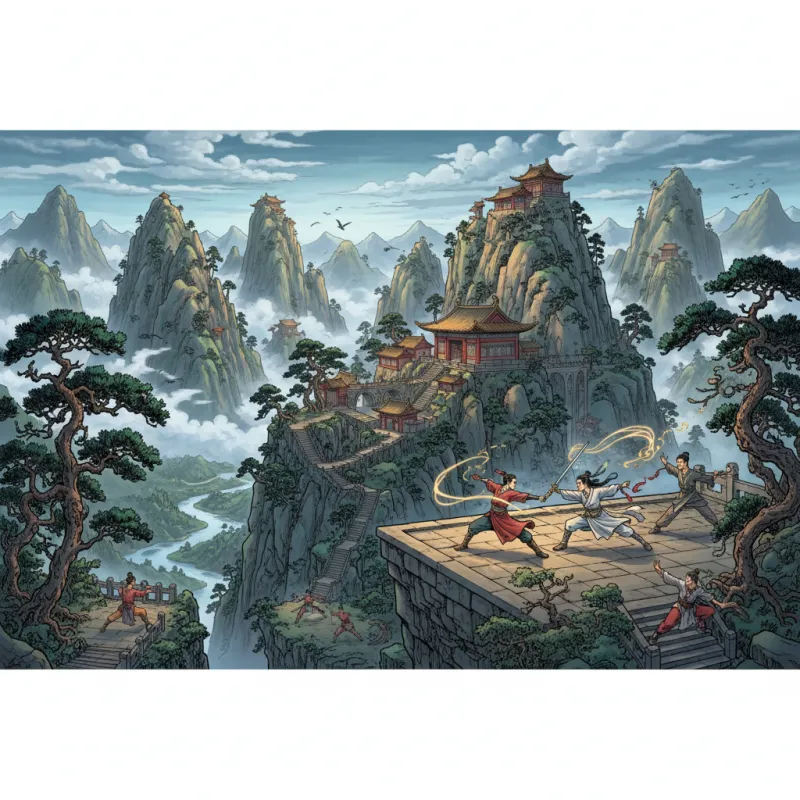
The old Daoist sits motionless on the cliff edge, his sword resting across his knees, watching clouds drift through the valley below. A young challenger approaches, fists clenched, ready to prove his Shaolin training superior. The Daoist doesn't stand. He doesn't even open his eyes. When the young man strikes, the old master simply shifts his weight — barely perceptible — and the attacker tumbles past him, carried by his own momentum into a snowbank. This is Wudang Mountain (武当山 Wǔdāng Shān), where the greatest martial power looks like doing nothing at all.
The Mountain That Moves Like Water
Wudang Mountain isn't just a location in wuxia fiction — it's a philosophy made geography. Perched in Hubei Province, this cluster of seventy-two peaks has been the heart of Daoist martial cultivation since the Song Dynasty, though its legendary status exploded during the Ming Dynasty when the Yongle Emperor poured imperial resources into building the temple complex that still stands today. The real mountain is breathtaking: ancient halls clinging to impossible slopes, stone steps climbing through clouds, the Golden Hall gleaming at the summit like a promise of immortation.
But in wuxia novels, Wudang becomes something more — the eternal counterweight to Shaolin Temple. Where Shaolin represents Buddhist external martial arts (外家拳 wàijiā quán), Wudang embodies Daoist internal martial arts (内家拳 nèijiā quán). This isn't just a technical distinction about whether you punch hard or redirect force. It's a fundamental difference in worldview. Shaolin asks: how can I make my body stronger? Wudang asks: how can I align myself with forces already in motion?
The fictional Wudang appears in nearly every major wuxia work, but Jin Yong's portrayal in The Heaven Sword and Dragon Saber (倚天屠龙记 Yǐtiān Túlóng Jì) set the template everyone else follows. His Wudang is perpetually wrapped in mist, its disciples moving through forms that look more like meditation than combat, its leader Zhang Sanfeng so attuned to the Dao that he seems to exist slightly outside normal time. When Jin Yong's Wudang masters fight, they don't overpower opponents — they make violence look clumsy and exhausting by comparison.
Zhang Sanfeng: The Founder Who Might Have Existed
Every great sect needs an origin story, and Wudang's centers on Zhang Sanfeng (张三丰 Zhāng Sānfēng), possibly the most famous martial artist who may or may not have been real. Historical records are frustratingly vague: there was definitely a Daoist priest named Zhang Sanfeng who lived on Wudang Mountain, probably during the late Song or early Yuan Dynasty, and he definitely had something to do with internal martial arts. Beyond that, facts dissolve into legend.
The wuxia version of Zhang Sanfeng is far more interesting than any historical figure could be. In Jin Yong's novels, he's a former Shaolin monk who left the temple after witnessing a snake and crane fighting, realizing that true martial power comes from yielding rather than resisting. He climbed Wudang Mountain, achieved enlightenment, and created Taijiquan (太极拳 Tàijí Quán) — the supreme internal martial art that turns an opponent's strength against them. By the time we meet him in The Heaven Sword and Dragon Saber, he's over a hundred years old, still spry, and capable of defeating entire armies without breaking a sweat.
What makes Zhang Sanfeng compelling in fiction isn't his power — plenty of wuxia characters are absurdly powerful. It's his temperament. He's playful, curious, more interested in understanding the Dao than dominating others. When his disciple Zhang Cuishan falls in love with a woman from the "evil" Heavenly Eagle Cult, Zhang Sanfeng doesn't condemn him. When the orthodox martial world demands Zhang Cuishan's head, Zhang Sanfeng protects him. He represents Wudang's core principle: the Dao flows through everything, and rigid moral categories are just another form of resistance to natural order.
Other authors have played with Zhang Sanfeng's legend differently. In Liang Yusheng's works, he's more austere, a true ascetic who views martial arts as a path to spiritual cultivation rather than worldly power. In Gu Long's universe, Zhang Sanfeng barely appears — Gu Long preferred to focus on younger, more conflicted characters rather than ancient masters. But even when Zhang Sanfeng isn't present, his shadow looms over every Wudang disciple, every practitioner of internal arts, every character who chooses to redirect rather than resist.
The Seven Heroes of Wudang
Zhang Sanfeng's seven disciples — the Wudang Seven Heroes (武当七侠 Wǔdāng Qī Xiá) — represent different facets of Daoist martial philosophy. Jin Yong's version in The Heaven Sword and Dragon Saber remains definitive: Song Yuanqiao (宋远桥 Sòng Yuǎnqiáo), the eldest and most responsible; Yu Lianzhou (俞莲舟 Yú Liánzhōu), the most technically skilled; Yu Daiyan (俞岱岩 Yú Dàiyán), crippled by enemies but still formidable; Zhang Songxi (张松溪 Zhāng Sōngxī), the strategist; Zhang Cuishan (张翠山 Zhāng Cuìshān), the romantic who marries outside the orthodox world; Yin Liting (殷梨亭 Yīn Lítíng), the youngest and most impulsive; and Mo Shenggu (莫声谷 Mò Shēnggǔ), who dies young defending Wudang's honor.
What's brilliant about Jin Yong's Seven Heroes is that they're not interchangeable kung fu monks. Each has distinct personality, distinct flaws, distinct relationship to Wudang's principles. Zhang Cuishan's love for Yin Susu — a woman the orthodox martial world considers evil — creates the central tragedy of The Heaven Sword and Dragon Saber. When the martial world demands he betray either his wife or his sect, he chooses a third option: suicide. It's a devastating moment that reveals both the strength and limitation of Wudang's philosophy. Zhang Sanfeng taught his disciples to flow with the Dao, but what happens when the Dao itself seems contradictory?
Yu Daiyan's story is equally compelling. Crippled by the villainous Crane-Pen Scholar, he spends years unable to walk or practice martial arts. But because he's a Wudang disciple, he doesn't despair — he turns inward, cultivating his internal energy until he can circulate qi through his meridians without moving. When he finally recovers, he's actually stronger than before his injury. This is pure Daoist philosophy: the obstacle becomes the path.
Internal vs. External: What It Actually Means
The distinction between internal (内家 nèijiā) and external (外家 wàijiā) martial arts is central to Wudang's identity, but it's often misunderstood. It's not that Shaolin monks don't cultivate internal energy or that Wudang disciples don't train their bodies. The difference is emphasis and approach.
External martial arts, associated with Shaolin Temple, prioritize physical conditioning and direct application of force. You punch a wooden post ten thousand times until your fist becomes iron. You practice forms until muscle memory takes over. You build strength, speed, endurance. The body is a weapon to be forged.
Internal martial arts, associated with Wudang, prioritize qi cultivation and understanding of natural principles. You stand in meditation postures until you can feel energy flowing through your meridians. You practice forms slowly, paying attention to how weight shifts, how breath coordinates with movement, how minimal effort can produce maximum effect. The body is a channel for forces larger than itself.
In wuxia fiction, this distinction becomes exaggerated for dramatic effect. Shaolin monks can shatter stone with their fists; Wudang disciples can deflect attacks with a touch. Shaolin techniques are named after aggressive animals — Tiger Claw, Dragon Fist, Eagle Talon. Wudang techniques are named after natural phenomena — Cloud Hands, Wave Hands Like Clouds, Parting the Wild Horse's Mane. Shaolin masters look like warriors; Wudang masters look like scholars who happen to know kung fu.
The most famous Wudang internal art is Taijiquan (太极拳 Tàijí Quán), often translated as "Supreme Ultimate Fist." In real life, Taiji is practiced by millions as a health exercise — slow, flowing movements that look more like dance than combat. In wuxia fiction, Taiji is devastatingly effective: a master can use an opponent's force against them, turning a powerful strike into the attacker's own defeat. Jin Yong's Zhang Sanfeng demonstrates this perfectly when he defeats a Shaolin master by simply stepping aside at the right moment, letting the monk's own momentum carry him into a wall.
But Wudang's arsenal extends beyond Taiji. There's Wudang Sword (武当剑 Wǔdāng Jiàn), emphasizing fluid, circular movements that make the blade seem to float rather than cut. There's Pure Yang Limitless Skill (纯阳无极功 Chúnyáng Wújí Gōng), an internal energy cultivation method that makes practitioners nearly immune to poison and disease. There's Ladder to Heaven (梯云纵 Tī Yún Zōng), a lightness skill that allows Wudang disciples to leap incredible distances and walk on water.
Wudang's Place in the Jianghu Hierarchy
In the political landscape of wuxia fiction, Wudang occupies a unique position. It's universally respected — even villains acknowledge Wudang's legitimacy — but it's not as politically active as Shaolin. Where Shaolin often involves itself in imperial politics and martial world disputes, Wudang tends toward non-interference. This isn't weakness; it's strategic positioning.
Wudang's neutrality makes it a natural mediator. When the orthodox sects gather to condemn some perceived evil, Wudang representatives often argue for restraint, for understanding context, for not rushing to judgment. This sometimes frustrates more aggressive sects like Kunlun or Emei, who view Wudang's caution as moral cowardice. But Wudang's long view usually proves correct — the "villain" often has legitimate grievances, and the orthodox sects' rush to violence creates more problems than it solves.
This dynamic plays out brilliantly in The Heaven Sword and Dragon Saber when the martial world besieges Wudang Mountain, demanding Zhang Cuishan's head for his association with the Heavenly Eagle Cult. Zhang Sanfeng refuses to hand over his disciple, but he also refuses to slaughter the besiegers. Instead, he tries to reason with them, to explain that Zhang Cuishan has done nothing wrong, that their moral certainty is misplaced. It doesn't work — Zhang Cuishan kills himself to end the siege — but Zhang Sanfeng's attempt at peaceful resolution is quintessentially Wudang.
Wudang's relationship with unorthodox sects is also more nuanced than Shaolin's. While Shaolin draws hard lines between orthodox and heterodox, Wudang acknowledges that the Dao flows through everyone. This doesn't mean Wudang tolerates genuine evil — Zhang Sanfeng has no patience for cruelty or exploitation — but it means Wudang doesn't automatically condemn someone for practicing "demonic" martial arts or belonging to an unorthodox sect.
The Aesthetic of Wudang
What makes Wudang compelling in wuxia fiction isn't just its martial philosophy — it's the aesthetic. Wudang is mist and mountain peaks, ancient pine trees and stone pavilions, the sound of a guqin drifting through morning fog. Wudang disciples wear simple Daoist robes, carry swords rather than staffs, move with unhurried grace. When a Wudang master fights, it should look effortless, almost accidental, as if the opponent defeated themselves and the master just happened to be standing in the right place.
This aesthetic extends to Wudang's internal culture. Where Shaolin is communal — monks eating together, training together, praying together — Wudang is more individualistic. Disciples have their own cultivation paths, their own insights into the Dao. Zhang Sanfeng doesn't impose a rigid training regimen; he observes each disciple's nature and guides them accordingly. Song Yuanqiao becomes a leader because that's his nature. Zhang Cuishan becomes a romantic because that's his nature. The Dao accommodates all paths.
The best wuxia adaptations understand this aesthetic. The 2003 television version of The Heaven Sword and Dragon Saber nails Wudang's visual language: every scene on the mountain is suffused with soft light, characters speak quietly, violence is brief and decisive rather than prolonged. The 2019 version is less successful — it makes Wudang look too much like a standard martial arts school, losing the sense of otherworldly tranquility that defines the sect.
Why Wudang Endures
Wudang Mountain persists in wuxia fiction because it represents something readers crave: the possibility that wisdom and power don't require aggression. In a genre filled with violence, Wudang offers an alternative — not pacifism, but strategic non-violence. Not weakness, but strength so complete it doesn't need to prove itself.
Zhang Sanfeng remains one of wuxia's most beloved characters not because he's the strongest fighter (though he probably is) but because he's the wisest. He understands that the martial world's obsession with ranking, with determining who's strongest, is itself a form of delusion. The Dao doesn't rank. Water doesn't compete with stone — it simply flows around obstacles until the stone wears away.
This philosophy resonates beyond martial arts fiction. In a world that constantly demands we prove ourselves, assert ourselves, compete and dominate, Wudang whispers: what if you didn't? What if you observed instead of acted, redirected instead of resisted, cultivated understanding instead of accumulating power? It's a seductive vision, and it's why readers keep returning to that misty mountain, hoping to glimpse what the old Daoist sees when he sits motionless on the cliff edge, watching clouds drift through the valley below.
Related Reading
- The Beggar Sect: The Largest and Most Unlikely Martial Arts Organization
- Sects and Clans in Wuxia: The Organizations That Rule the Martial World
- The Beggars Sect: How a Gang of Homeless People Became the Largest Organization in the Martial World
- Shaolin Temple: The Birthplace of Chinese Martial Arts
- Exploring Chinese Martial Arts Fiction and Jianghu Culture in Kung Fu Novels
- Huang Rong: The Smartest Heroine in Chinese Fiction
- Wuxia Training Montages: How Heroes Are Made
- Poison and Medicine in Wuxia: Two Sides of the Same Coin
Explore Chinese Culture
- Explore Jin Yong's martial arts novels
- Explore cultivation fiction and immortal heroes
- Explore the real history behind wuxia