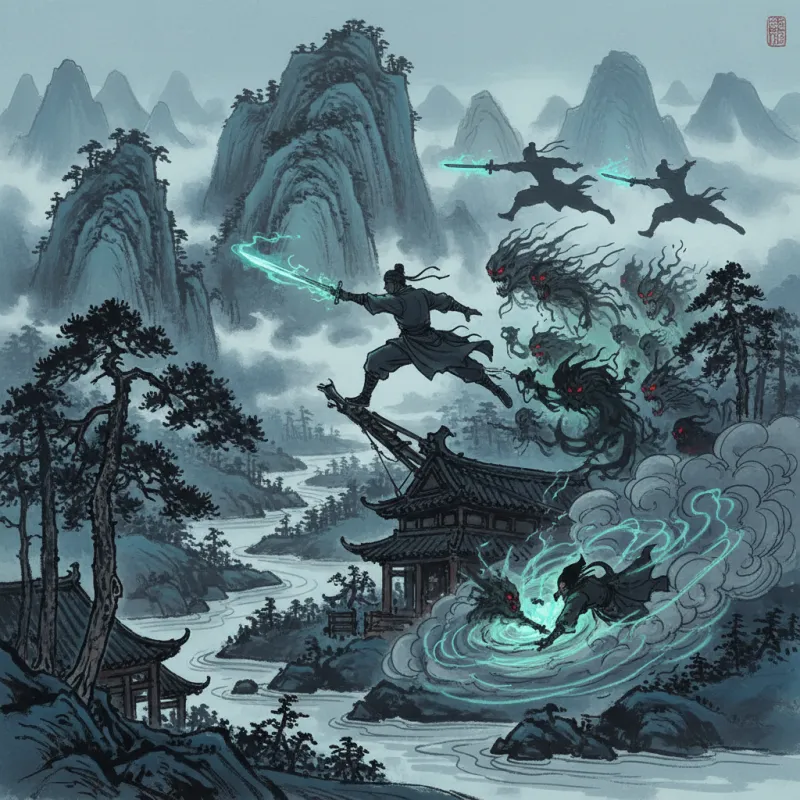
The cursor blinks at 3:47 AM. You're scrolling through Tianya Forum when you see it: a thread titled "My roommate died three days ago, but he's still logging into QQ." Forty-seven pages of replies. The original poster hasn't been online since page twelve. You know you should close the browser. You keep reading.
The Digital Haunting Grounds
Chinese internet horror didn't emerge from a vacuum — it evolved from centuries of ghost literature, transplanted into the fluorescent glow of internet cafes and the blue light of smartphone screens. While Western creepypasta communities were inventing Slenderman and Jeff the Killer in the mid-2000s, Chinese netizens were already years deep into their own tradition of digital terror on platforms like Tianya Forum (天涯论坛 Tiānyá Lùntán), Baidu Tieba (百度贴吧), and Mop.com (猫扑网 Māopū Wǎng). The difference? Chinese internet horror rarely invents its monsters. It doesn't need to. The country's folklore already contains enough nightmare fuel to power a thousand sleepless nights.
The genius of Chinese creepypasta lies in its parasitic relationship with belief. When an American reads about Slenderman, they know it's fiction. When a Chinese reader encounters a story about ghost pressing (鬼压床 guǐ yā chuáng) — the phenomenon of sleep paralysis attributed to a ghost sitting on your chest — they're reading about something their grandmother warned them about, something that might have happened to their cousin last summer. The story doesn't ask you to suspend disbelief. It asks you to remember what you already fear.
The Classics That Launched a Thousand Nightmares
Every tradition has its foundational texts. For Chinese internet horror, several stories achieved legendary status in the early 2000s, spreading across forums like digital contagion. "The Apartment on the 13th Floor" (十三号楼 Shísān Hào Lóu) became infamous for its slow-burn dread — a university student notices his building has no 13th floor button, then discovers the floor exists anyway, accessible only by walking up the stairs. What he finds there depends on which version you read, but all endings share one trait: they make you count the floors in your own building.
Then there's "The Last Bus" (末班车 Mòbān Chē), a story so effective it spawned dozens of regional variations. The core remains consistent: a late-night bus route, passengers who board but never disembark, a driver who won't make eye contact in the rearview mirror. The story taps into urban China's rapid modernization — the alienation of city life, the anonymity of public transit, the unsettling feeling that you're surrounded by people but utterly alone. It's Chinese ghost lore adapted for the subway generation.
"Pen Fairy" (笔仙 Bǐxiān) deserves special mention because it crossed the boundary from story to practice. This Ouija-board-adjacent ritual involves two people holding a pen over paper, summoning a spirit to answer questions. The internet didn't invent Pen Fairy — the game existed in schoolyards for decades — but forums turned it into a participatory horror experience. Users posted their "real" experiences, complete with the questions they asked and the terrifying answers they received. Some threads included photos of the paper, showing handwriting that supposedly wasn't theirs. The line between fiction and claimed reality blurred until it disappeared entirely.
The Architecture of Digital Dread
Chinese internet horror stories follow certain structural patterns that distinguish them from Western creepypasta. They're often framed as personal testimony (亲身经历 qīnshēn jīnglì), posted by users claiming these events happened to them or someone they know. The writing style mimics casual forum posts — typos included, timestamps preserved, follow-up comments from the original poster responding to skeptics. This documentary aesthetic creates a false sense of authenticity that polished prose can't match.
The stories also exploit China's specific cultural pressure points. Many revolve around gaokao (高考) — the brutal university entrance exam that determines your entire future. Ghost stories set during gaokao season tap into collective anxiety: the student who studies so hard they die at their desk, still taking the exam as a ghost; the haunted exam hall where one seat always remains empty; the answer key written in blood. These aren't just scary stories. They're anxiety dreams given narrative form.
Another common thread involves filial piety (孝 xiào) gone wrong. Stories about children who neglect their parents' graves, only to be haunted by increasingly aggressive supernatural phenomena. Or the inverse: parents who love their children so much that death can't stop them from checking in, their ghostly visits growing more disturbing with each appearance. These stories work because they weaponize cultural values, turning virtue into a source of horror.
The Multimedia Evolution
As Chinese internet infrastructure evolved, so did its horror stories. Early text-based tales gave way to multimedia experiences. Flash animations like "Red and Blue" (红蓝 Hóng Lán) — a seemingly innocent children's game that ends in psychological terror — spread through QQ groups and early social media. These weren't just stories anymore; they were interactive experiences designed to make you complicit in your own fear.
The rise of short video platforms like Douyin (抖音, the Chinese version of TikTok) created new formats for horror. Sixty-second ghost stories, often filmed in the first-person perspective, blur the line between found footage and social media post. The algorithm ensures that once you watch one, you'll see dozens more. The horror becomes inescapable, woven into your feed between cooking videos and dance challenges.
WeChat (微信 Wēixìn) introduced another dimension: the horror story that comes to you. Chain messages claiming that forwarding the message will prevent a ghost from appearing in your room tonight. Voice messages that supposedly contain the sound of a ghost's breathing. Group chats where one member is dead but still reading messages, their profile picture slowly changing over days. The platform designed to keep you connected becomes a vector for digital haunting.
The Folklore Foundation
What separates Chinese internet horror from its Western counterparts is its deep roots in established supernatural taxonomy. Western creepypasta often invents new monsters. Chinese stories draw from a vast catalog of existing entities, each with specific rules and behaviors understood by the audience. The hungry ghost (饿鬼 èguǐ) who died unsatisfied and now seeks to drag others into death. The water ghost (水鬼 shuǐguǐ) who drowns victims to take their place and be reborn. The fox spirit (狐狸精 húlijīng) who seduces men to steal their life force.
This shared vocabulary means Chinese horror writers can achieve terror through implication. Mention that someone saw a woman in a red dress standing at a crossroads at midnight, and Chinese readers immediately understand the danger — red is the color of ghost brides, crossroads are liminal spaces where the boundary between worlds grows thin, midnight is when yin energy peaks. The story doesn't need to explain. The culture already did.
The influence of Strange Tales from a Chinese Studio (聊斋志异 Liáozhāi Zhìyì) — Pu Songling's 18th-century collection of supernatural tales — remains palpable in modern internet horror. Pu's stories often featured scholars encountering beautiful ghost women, relationships that began with romance and ended in revelation. Contemporary versions update the setting to university campuses and online dating apps, but the structure remains: attraction, intimacy, the slow realization that something is wrong, the terrible truth. The fox spirit archetype translates seamlessly to catfishing narratives with supernatural twists.
The Censorship Dance
Chinese internet horror exists in a peculiar relationship with censorship. Officially, the government discourages "feudal superstition" (封建迷信 fēngjiàn míxìn) — the promotion of supernatural beliefs. In practice, ghost stories occupy a gray zone. They're fiction, entertainment, not genuine advocacy for supernatural belief. Usually. The ambiguity means horror writers have developed a sophisticated understanding of where the line sits and how to dance along it without crossing over.
This constraint has arguably made Chinese internet horror more creative. When you can't rely on explicit gore or graphic violence — content that attracts moderator attention — you develop subtler techniques. Psychological horror. Implication. The terror of what's not shown. Stories end just before the reveal, letting readers' imaginations complete the horror. The censorship that might have killed the genre instead refined it into something more insidious.
The Export Problem
Chinese internet horror remains largely unknown outside Chinese-language communities, despite its sophistication and cultural richness. Translation is part of the problem — these stories are deeply embedded in cultural context that doesn't survive the journey to English. The fear of ghost pressing means nothing if you don't know the folklore. References to specific Chinese supernatural entities lose their impact when the audience has never heard of them.
But there's also a structural issue. Chinese internet horror is often serialized, unfolding across dozens or hundreds of forum posts, with the original poster responding to reader questions and adding details based on community feedback. It's collaborative storytelling that doesn't fit Western publishing models. The stories aren't designed to be read as standalone texts. They're meant to be experienced as evolving narratives within a community that shares the cultural framework to understand them.
The Eternal Return
The most unsettling aspect of Chinese internet horror might be its cyclical nature. Stories that terrified readers on Tianya Forum in 2005 resurface on Zhihu (知乎) in 2023, slightly modified, claimed as new experiences by different users. The same ghost stories repeat across platforms and years, each generation of internet users discovering them anew and believing they're the first to encounter these digital hauntings.
Perhaps that's fitting. Chinese ghost lore has always been about repetition — the hungry ghost who can never be satisfied, the wronged spirit who can't move on, the curse that passes from person to person. Internet horror simply accelerated the cycle, turning what once took generations into something that repeats every few years. The medium changes. The ghosts remain. And somewhere, right now, someone is reading a forum post at 3:47 AM, knowing they should close the browser, unable to stop scrolling.
Related Reading
- Unraveling the Mystique of Wuxia: Horror Elements in Chinese Martial Arts Fiction
- The Best Chinese Horror Films: A Genre Guide
- Chinese Horror Novels That Will Keep You Up at Night
- Sworn Brotherhood in Wuxia: The Sacred Ritual of Jiéyì
- The Complete Guide to Jianghu Heroes in Wuxia Fiction
- Martial Arts Systems in Wuxia: Internal vs External, Orthodox vs Unorthodox
Explore Chinese Culture
- Explore Jin Yong's martial arts novels
- Explore cultivation fiction and immortal heroes
- Explore the real history behind wuxia