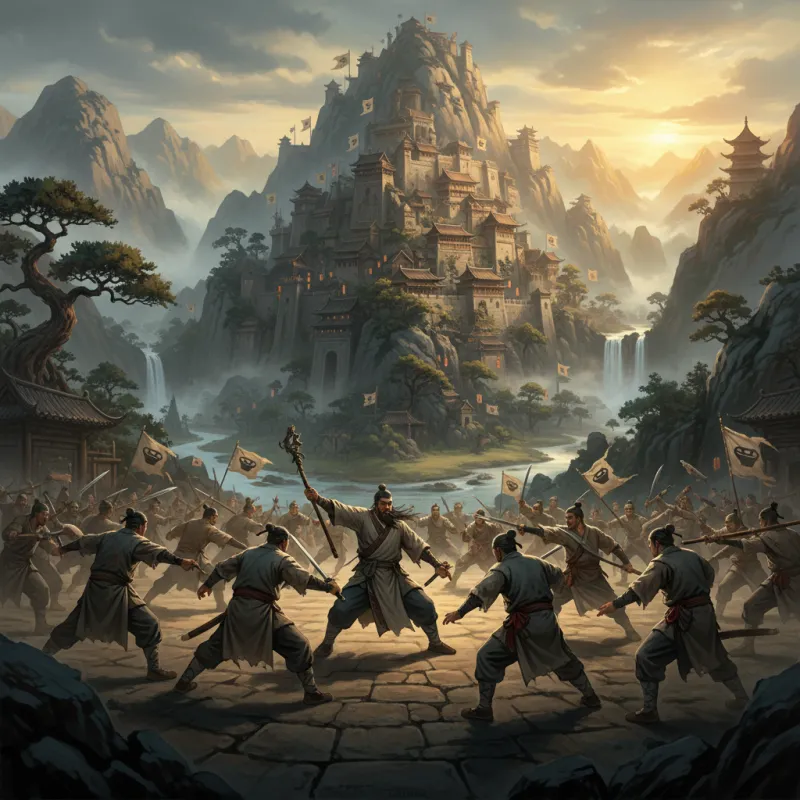
They say the emperor has eyes and ears everywhere. But even the Son of Heaven can't match the intelligence network of a gang of beggars. While imperial spies must hide their identities and work in shadows, the Beggars Sect (丐帮 Gàibāng) operates in plain sight — because nobody bothers to look at a beggar twice. This paradox of visibility and invisibility has made them the largest and most influential organization in the jianghu (江湖 jiānghú, the martial world) for over eight centuries.
The Power of Being Overlooked
Walk through any city in a wuxia novel and you'll find them: ragged figures huddled at temple gates, sleeping in alleyways, rattling bowls outside teahouses. They're part of the scenery, as unremarkable as the cobblestones beneath your feet. A wealthy merchant discusses his shipping routes within earshot. A corrupt official complains about the magistrate who won't take bribes. A martial artist brags about the secret manual he stole from Shaolin Temple. None of them lower their voices, because who pays attention to beggars?
This is the Beggars Sect's greatest weapon: social invisibility. In Jin Yong's The Legend of the Condor Heroes (射雕英雄传 Shèdiāo Yīngxióng Zhuàn), we see this principle in action when Hong Qigong (洪七公), the sect's leader, casually mentions knowing about a conspiracy that's been discussed only in private chambers. How? His disciples were there — sleeping against the wall, begging for scraps, completely ignored by the conspirators.
The sect doesn't just gather intelligence passively. With members numbering in the tens of thousands across every province, they form a communication network that would make modern intelligence agencies envious. A beggar in Guangzhou can relay a message to the sect leader in Luoyang within days, passed from bowl to bowl, from street corner to street corner. No carrier pigeons needed, no written evidence, just whispered words between people society has trained itself not to see.
From Street Gangs to Martial Brotherhood
The Beggars Sect's origins trace back to the Song Dynasty (960-1279 CE), though the exact founding date varies depending on which wuxia author you ask. What's consistent across most depictions is that the sect began as a mutual protection society — actual beggars banding together for survival in a society that viewed them as less than human.
The genius of the sect's structure is how it transformed poverty from a weakness into an organizational principle. The sect uses a ranking system based on the number of bags (袋 dài) a member carries, from one to nine. New disciples start with one bag and earn additional bags through martial achievement, service to the sect, or acts of righteousness. The sect leader traditionally carries nine bags, though in Jin Yong's novels, Hong Qigong famously carries only eight, having demoted himself after accidentally killing a good person while drunk.
This bag system serves multiple purposes. It's a visible hierarchy that any sect member can recognize at a glance, yet it means nothing to outsiders — just another beggar with some ragged pouches. It also reinforces the sect's core identity: no matter how skilled you become, you remain a beggar. Even nine-bag elders still beg for their meals, still sleep rough when traveling. This isn't just tradition; it's operational security. The moment a Beggars Sect member starts living comfortably, they lose their invisibility.
The Dog-Beating Staff and Other Traditions
Every major sect has its signature martial arts, and the Beggars Sect is no exception. Their most famous technique is the Dog-Beating Staff Method (打狗棒法 Dǎgǒu Bàngfǎ), a staff technique passed down exclusively to the sect leader. The name itself is deliberately crude — who would suspect that a "dog-beating" technique could be one of the most sophisticated staff methods in the martial world?
Jin Yong describes the Dog-Beating Staff Method as having thirty-six moves, each one adaptable to countless variations. The technique emphasizes agility over strength, using the staff's reach to control distance while maintaining unpredictable angles of attack. In The Legend of the Condor Heroes, Hong Qigong uses it to fight Ouyang Feng (欧阳锋), one of the Five Greats, to a standstill — no small feat considering Ouyang Feng's mastery of the Toad Stance kung fu.
The sect's other signature skill is the Eighteen Dragon-Subduing Palms (降龙十八掌 Xiánglóng Shíbā Zhǎng), though this technique isn't exclusive to sect leaders. These palm strikes are the opposite of the staff method — pure, overwhelming force channeled through internal energy. Guo Jing (郭靖), though not a Beggars Sect member, learns this technique from Hong Qigong and uses it to become one of the greatest heroes in wuxia literature. The contrast between the two techniques reflects the sect's philosophy: adapt to any situation, whether it requires finesse or raw power.
But the sect's real martial advantage isn't any specific technique — it's their numbers. While elite sects like Wudang or Shaolin might have a few dozen masters, the Beggars Sect can mobilize thousands of disciples. They might not all be top-tier martial artists, but when you're facing a hundred beggars who know basic staff work and aren't afraid to die, even a master has to think twice.
The Righteous Beggar: Hong Qigong and Sect Philosophy
Hong Qigong remains the most iconic Beggars Sect leader in wuxia fiction, and for good reason. Jin Yong created in him a character who embodies everything the sect represents: martial excellence, moral integrity, and an absolute refusal to take himself seriously. He's one of the Five Greats — the five most powerful martial artists of his generation — yet he spends his time begging for food and teaching kung fu to a naive kid from Mongolia.
What makes Hong Qigong fascinating is how he represents the sect's core philosophy: righteousness (义 yì) matters more than status. He could live in luxury, could demand respect from the martial world, could leverage his position for political power. Instead, he wanders around eating good food, helping people in trouble, and occasionally beating up villains with a bamboo staff. When Guo Jing asks why he remains a beggar despite his abilities, Hong Qigong's answer is simple: "I like it."
This attitude isn't just personal eccentricity — it's sect doctrine. The Beggars Sect has always positioned itself as the champion of common people, the organization that steps in when corrupt officials oppress the weak or bandits terrorize villages. They're not interested in political power or martial world dominance. They want to eat their next meal and make sure the world doesn't become completely unbearable for people like them.
This philosophy creates an interesting dynamic in wuxia novels. The Beggars Sect is simultaneously the most powerful organization in the jianghu and the least ambitious. They could probably overthrow dynasties if they wanted to, but they're more concerned with whether the local magistrate is taking bribes or if bandits are harassing travelers on the northern road. It's power wielded with restraint, which makes them more trustworthy than any other major faction.
Internal Politics and the Succession Crisis
Of course, any organization with tens of thousands of members will have internal politics, and the Beggars Sect is no exception. The sect's size is both its strength and its weakness — coordinating that many people, maintaining discipline, and ensuring loyalty becomes increasingly difficult as the organization grows.
Succession is a recurring problem. In The Heaven Sword and Dragon Saber (倚天屠龙记 Yǐtiān Túlóng Jì), set during the Yuan Dynasty, we see the sect in decline, its leadership corrupted and its members divided. The sect leader has been manipulated by external forces, and the organization that once stood for righteousness has become a tool of oppression. It takes the intervention of Zhang Wuji (张无忌), the novel's protagonist, to restore the sect to its proper path.
This storyline reflects a deeper truth about the Beggars Sect: their strength depends entirely on the character of their leadership. Unlike sects with rigid hierarchies and written rules, the Beggars Sect operates on personal loyalty and shared values. When the leader embodies those values — like Hong Qigong — the sect flourishes. When the leader is weak or corrupt, the entire organization suffers.
The sect also faces the constant challenge of maintaining its identity while operating in a changing world. As dynasties rise and fall, as cities grow and social structures shift, what does it mean to be a beggar? In some wuxia novels set in later periods, we see the sect struggling with modernization, with members who want to abandon the begging lifestyle while maintaining the organization's intelligence network and martial traditions. Can the Beggars Sect exist without actual beggars? It's a question that goes to the heart of what the organization represents.
The Intelligence Network That Never Sleeps
Let's return to what makes the Beggars Sect truly formidable: information. In an era before telecommunications, before newspapers, before any form of mass media, the sect created a real-time intelligence network spanning the entire country. This isn't just impressive — it's historically unprecedented.
The system works through a combination of human observation and structured communication. Every beggar is trained to notice and remember specific types of information: troop movements, merchant caravans, unusual travelers, overheard conversations. This information flows upward through the bag hierarchy, with senior members filtering and analyzing reports before passing critical intelligence to the sect leader.
What makes this network so effective is its redundancy. If one beggar misses something, ten others might catch it. If one communication line is compromised, dozens of alternative routes exist. And because beggars are everywhere — at city gates, in marketplaces, outside government offices, along every major road — there are very few blind spots.
In Demi-Gods and Semi-Devils (天龙八部 Tiānlóng Bābù), Jin Yong shows us the sect's intelligence network at its peak. The sect leader knows about political conspiracies in the imperial court, secret martial arts manuals being transported across provinces, and assassination plots being planned in distant cities. This information allows the sect to intervene in jianghu affairs with perfect timing, appearing exactly when and where they're needed most.
The intelligence network also serves a defensive purpose. Any organization as large and influential as the Beggars Sect will have enemies, and those enemies will inevitably try to infiltrate or attack. But how do you infiltrate an organization where every member knows every other member by sight, where strangers are immediately noticed, and where information about threats spreads faster than the threats themselves? The sect's structure makes it remarkably resistant to external manipulation.
Why the Beggars Sect Endures
In the end, the Beggars Sect's longevity comes down to a simple principle: they fill a need that no other organization can fill. The martial world needs an intelligence network. Common people need protectors who understand their struggles. The jianghu needs an organization powerful enough to check the ambitions of other sects but humble enough not to seek dominance itself.
The sect endures because it never forgets what it is. While other organizations grow wealthy and corrupt, while martial arts schools become obsessed with prestige and status, the Beggars Sect remains a gang of homeless people who happen to know kung fu. This isn't a limitation — it's their superpower. They can't be bought because they own nothing. They can't be intimidated because they've already lost everything. They can't be corrupted by power because they've chosen to remain powerless.
There's something deeply appealing about this fantasy: that the lowest members of society might secretly be the most powerful, that poverty might be a choice rather than a curse, that righteousness matters more than status. It's probably not realistic — real poverty is grinding and dehumanizing, not romantic or empowering. But in the world of wuxia, where martial arts can let you fly and internal energy can heal wounds, why shouldn't beggars be heroes?
The Beggars Sect represents wuxia fiction at its most subversive: taking society's outcasts and making them the moral center of the story. Every time a ragged beggar reveals themselves as a martial arts master, every time Hong Qigong defeats a villain with his dog-beating staff, the genre reminds us that worth isn't determined by wealth or status. Sometimes the most powerful person in the room is the one everyone else has trained themselves not to see.
Related Reading
- Shaolin Temple: The Birthplace of Chinese Martial Arts
- Wudang Mountain: The Daoist Heart of Internal Martial Arts
- Exploring Chinese Martial Arts Fiction and Jianghu Culture in Kung Fu Novels
- Sects and Clans in Wuxia: The Organizations That Rule the Martial World
- The Fusang Tree: Where the Suns Rise and the World Begins
- Animal Spirits and the Path to Becoming Yaoguai
- Internal Energy (Neigong): The Hidden Power Behind Every Martial Art
Explore Chinese Culture
- Explore Jin Yong's martial arts novels
- Explore cultivation fiction and immortal heroes
- Explore the real history behind wuxia