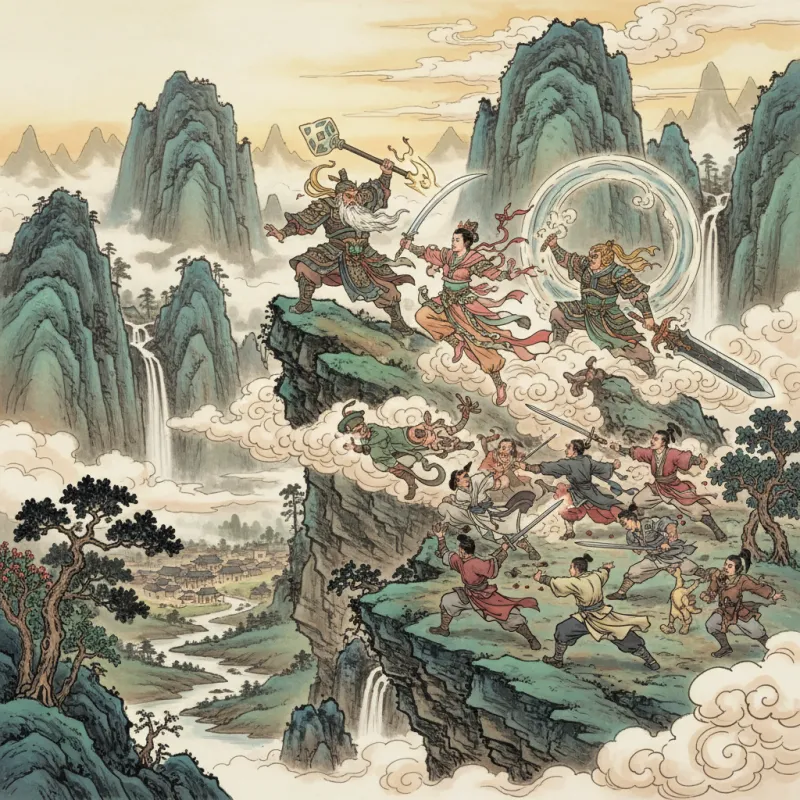
The old Daoist master once told me: "If you want to understand the gods, climb a mountain at dawn." I thought he was being poetic. He wasn't. Mountains in Chinese cosmology aren't just geological formations — they're divine bureaucrats with official titles, territorial jurisdictions, and direct reporting lines to the Jade Emperor himself. The mountain gods (山神 shānshén) operate the most extensive administrative network in the Daoist pantheon, and their hierarchy mirrors the imperial government so precisely that you could file a celestial complaint form if you knew the right peak to climb.
The Five Sacred Peaks: Heaven's Regional Governors
At the apex of mountain deity power sit the Five Great Mountains (五岳 Wǔyuè), and their authority has nothing to do with altitude. Mount Everest doesn't make the list. These peaks earned their status through centuries of imperial sacrifice, philosophical significance, and their strategic positions defining China's spiritual borders.
Mount Tai (泰山 Tài Shān) in Shandong province rules the East and holds the title of foremost among the five. Emperors climbed its 7,000 steps to perform the Feng and Shan sacrifices (封禅 fēngshàn) — rituals so sacred that only 72 emperors in all of Chinese history dared attempt them. The God of Mount Tai (泰山神 Tàishān Shén) doesn't just govern a mountain; he controls the Department of Life and Death. Souls report to his jurisdiction before moving on to the Ten Courts of Hell. In Journey to the West, even Sun Wukong shows him grudging respect.
Mount Hua (华山 Huà Shān) guards the West with cliffs so sheer that the plank walk along its face has killed more pilgrims than any demon ever could. The Western Peak God (西岳大帝 Xīyuè Dàdì) oversees metal element energies and autumn transformations. Wuxia novels love Mount Hua — it's home to the Huashan Sect in The Smiling, Proud Wanderer, where Yue Buqun's obsession with the Evil-Resisting Sword Manual plays out against cliffs that have witnessed actual Daoist immortals achieving transcendence.
Mount Heng (衡山 Héng Shān) in Hunan represents the South, governing fire energies and summer growth. Don't confuse it with the Northern Mount Heng (恒山 Héng Shān) in Shanxi — same pronunciation, different character, entirely separate deity. The Southern Peak God (南岳大帝 Nányuè Dàdì) has jurisdiction over longevity and is particularly popular with those seeking extended lifespans. The mountain hosts 72 peaks and 18 streams, each with its own minor deity reporting upward through the bureaucratic chain.
Mount Song (嵩山 Sōng Shān) occupies the center in Henan province, home to the Shaolin Temple and the Central Peak God (中岳大帝 Zhōngyuè Dàdì). This deity balances the energies of the other four directions and governs earth element transformations. The mountain's position at China's geographical heart gives its god unique mediating authority — he's essentially the celestial prime minister of mountain affairs.
Mount Heng (恒山 Héng Shān) of the North in Shanxi controls water energies and winter stillness. The Northern Peak God (北岳大帝 Běiyuè Dàdì) has the coldest temperament of the five and the strictest standards for spiritual cultivation. The Hanging Temple (悬空寺 Xuánkōng Sì) clings to its cliffs, a Buddhist-Daoist hybrid that acknowledges the mountain god's authority regardless of sectarian boundaries.
The Bureaucratic Cascade: From Peaks to Foothills
Below the Five Great Mountains, the hierarchy fragments into thousands of regional and local mountain gods, each governing their specific peak with titles granted by imperial decree or earned through centuries of local worship. This isn't metaphor — actual emperors issued official appointments to mountain gods, complete with seals and ceremonial robes (delivered through ritual burning, naturally).
Provincial Mountain Gods (省级山神 shěngjí shānshén) govern major peaks within each province. Mount Emei (峨眉山 Éméi Shān) in Sichuan, Mount Wutai (五台山 Wǔtái Shān) in Shanxi, and Mount Jiuhua (九华山 Jiǔhuá Shān) in Anhui all have gods with ministerial-level authority. These deities coordinate with the City God network to manage the spiritual affairs of their regions, handling everything from rainfall distribution to the suppression of mountain demons.
County-Level Mountain Gods (县级山神 xiànjí shānshén) manage smaller peaks and hills. Every county seat in traditional China had at least one significant hill with a temple to its resident deity. These gods are the middle managers of the celestial bureaucracy — they handle local disputes, protect travelers, and report unusual spiritual activity up the chain of command. In Strange Tales from a Chinese Studio, Pu Songling frequently features these county-level mountain gods as characters who are powerful enough to be helpful but bureaucratic enough to require proper ritual etiquette.
Village Mountain Spirits (村级山灵 cūnjí shānlíng) occupy the bottom tier. These are the gods of specific hills, large rocks, or ancient trees that villagers worship for protection and good harvests. They might not have official titles from the Jade Emperor, but they have something more important: direct relationships with the humans who live at their feet. A village mountain spirit knows every family, remembers every promise, and expects regular offerings at festival times.
The Mountain God's Actual Job Description
What does a mountain god do all day? The answer is surprisingly specific, drawn from centuries of temple inscriptions, ritual manuals, and folk tales.
Territory Management: Mountain gods maintain the spiritual integrity of their domain. This includes suppressing demons and malevolent spirits, regulating the behavior of lesser nature spirits (tree spirits, rock spirits, animal spirits), and ensuring that the mountain's qi (气 qì) flows properly. When a mountain's energy becomes stagnant or corrupted, disasters follow — landslides, droughts, plagues of insects.
Weather Coordination: Mountain gods work with Dragon Kings to manage local weather patterns. They don't control weather directly, but they can petition higher authorities for rain during droughts or request that storms be diverted around vulnerable villages. The bureaucratic paperwork for weather modification is apparently extensive, requiring multiple celestial seals and approvals.
Soul Escort Services: Many mountain gods serve as psychopomps, guiding newly deceased souls to their proper destinations. This is especially true for people who die on the mountain itself — hunters, pilgrims, hermits. The mountain god ensures these souls don't become lost ghosts haunting the peaks.
Cultivation Site Supervision: Mountains are prime real estate for Daoist and Buddhist cultivation. Mountain gods regulate who gets to establish hermitages, meditation caves, and temples on their peaks. They're generally supportive of genuine spiritual seekers but hostile to charlatans and those who would exploit the mountain's energy for selfish purposes. In wuxia fiction, this often manifests as mysterious "tests" that martial artists must pass before accessing secret manuals hidden in mountain caves.
The Tiger General: Every Mountain God's Enforcer
Here's a detail that most casual readers miss: nearly every mountain god has a Tiger General (虎将军 Hǔ Jiāngjūn) as their primary enforcer. These aren't metaphorical tigers — they're actual tiger spirits who have cultivated enough spiritual power to take human form and serve in the celestial bureaucracy.
The Tiger General handles the violent work that mountain gods prefer to delegate. When demons need to be expelled, when bandits threaten pilgrims, when a corrupt local official needs a supernatural warning — the Tiger General handles it. Temple iconography typically shows them as fierce warriors with tiger-striped armor and a distinctly feline cast to their features.
In Investiture of the Gods, several Tiger Generals appear as characters with their own personalities and combat styles. They're loyal, fierce, and absolutely terrifying when roused to anger. The relationship between mountain god and Tiger General mirrors the relationship between a magistrate and his chief constable — one handles administration, the other handles enforcement.
When Mountain Gods Fail: Demotion and Replacement
The celestial bureaucracy doesn't tolerate incompetence. Mountain gods who fail in their duties face demotion, reassignment, or outright replacement. Historical records document cases where emperors, responding to natural disasters or local petitions, officially stripped mountain gods of their titles and appointed new deities to take their place.
The Tang Dynasty emperor Xuanzong famously demoted several mountain gods after a series of earthquakes and landslides. The ritual involved burning the demotion decree at the mountain's main temple, symbolically stripping the deity of authority. New gods were appointed through elaborate ceremonies, and — according to local accounts — the disasters stopped.
This system reveals something crucial about Chinese religious pragmatism: gods are judged by results. A mountain god who allows bandits to flourish, who fails to prevent landslides, or who ignores the prayers of local people will lose their position. The divine bureaucracy operates on performance metrics just like any human government.
The Mountain God in Wuxia Fiction
Wuxia novels treat mountain gods with fascinating ambiguity. They're rarely main characters, but they're always present as background authority figures who set boundaries on what martial artists can and cannot do.
In Demi-Gods and Semi-Devils, the various sects establish their headquarters on sacred mountains with the implicit permission of the resident deities. The mountain gods don't interfere in martial arts disputes, but they absolutely will intervene if someone tries to damage the mountain itself or disturb its spiritual ecology. This creates an interesting dynamic where even the most powerful martial artists must show respect to forces that operate on a different level of reality.
The Heaven Sword and Dragon Saber features Mount Wudang (武当山 Wǔdāng Shān) extensively, and while the mountain god never appears directly, Zhang Sanfeng's ability to establish the Wudang Sect there implies he received divine approval. The mountain's protection of the sect during times of crisis suggests ongoing cooperation between human martial artists and celestial authorities.
Visiting a Mountain God: Practical Etiquette
If you ever find yourself at a Chinese mountain temple (and you should — they're architecturally stunning), here's how to show proper respect:
Approach the temple with clean hands and a clear mind. Mountain gods appreciate sincerity over elaborate ritual. Offer incense — three sticks is standard. State your name, where you're from, and why you're visiting. Be specific. "Please protect me during my hike" works better than vague requests for "blessings."
Don't make promises you can't keep. Mountain gods have long memories and take vows seriously. If you promise to return with an offering after a successful journey, you'd better return. The consequences of breaking promises to mountain gods range from persistent bad luck to actual supernatural intervention.
Leave the mountain cleaner than you found it. Mountain gods are territorial and protective of their domains. Littering is not just environmentally irresponsible — it's spiritually offensive. Many hikers report strange misfortunes after disrespecting mountain spaces, and while skeptics dismiss these as coincidence, locals know better.
The Living Tradition
The worship of mountain gods isn't ancient history — it's ongoing practice. Modern Chinese hikers still stop at mountain temples to burn incense before attempting difficult climbs. Rural communities continue to hold festivals honoring their local mountain deities. Even in urban areas, people maintain small shrines to mountain gods if they live near hills or elevated areas.
This persistence reveals something important: the mountain gods fulfill a genuine human need to relate to landscape as something more than scenery. They transform geography into relationship, turning mountains from obstacles into protectors. In an era of environmental crisis, perhaps the old Daoist insight that mountains are divine beings deserving respect and proper treatment isn't superstition — it's wisdom we forgot at our peril.
The mountain gods are still there, still watching, still maintaining their ancient bureaucratic order. Whether you believe in them or not, they believe in their duty. And that, perhaps, is what matters most.
Related Reading
- Celestial Masters and Heavenly Generals: Daoism's Divine Warriors
- The Three Pure Ones: Supreme Deities of Daoism
- Pangu and the Cosmic Egg: The Chinese Creation Myth
- The Poison Arts: Wuxia Fiction's Most Feared Discipline
- Classic vs. New Wuxia: How the Genre Evolved
Explore Chinese Culture
- Explore Jin Yong's martial arts novels
- Explore cultivation fiction and immortal heroes
- Explore the real history behind wuxia