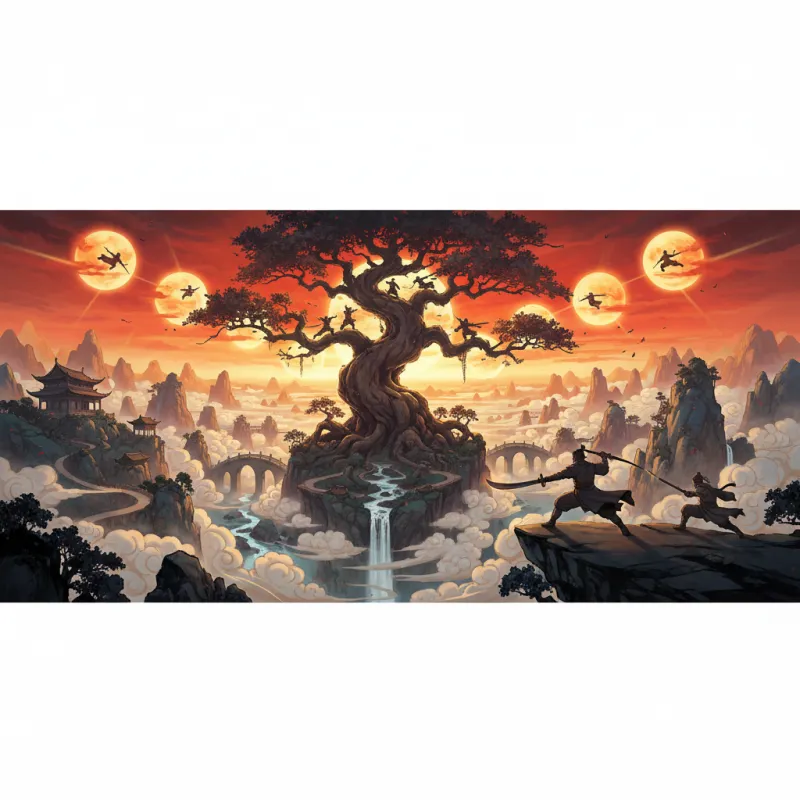
Ten suns once scorched the earth at the same time. The rivers boiled, crops withered to ash, and humanity cowered in caves while the world burned. This wasn't divine punishment or cosmic accident—it was a scheduling problem. The ten solar brothers, bored with their daily rotation, decided to take their joyride together. Only the archer Houyi's (后羿 Hòuyì) arrows brought nine of them down, leaving the lone survivor to make his solitary journey across the sky. But where did these celestial troublemakers come from? The answer lies in a tree so massive it bridges ocean and heaven, so ancient it predates the concept of time itself: the Fusang Tree (扶桑 Fúsāng).
The Cosmic Mulberry at the Edge of Dawn
The Shanhaijing (山海经 Shānhǎi Jīng), that strange catalog of mountains, seas, and impossibilities compiled during the Warring States period, places the Fusang in the Tanggu Valley (汤谷 Tānggǔ)—literally "Hot Water Valley"—somewhere in the eastern ocean where the world begins. The text describes it with the same casual precision it uses for three-headed tigers and countries where people have holes through their chests: "In the hot water there is the Fusang tree. The ten suns bathe there. It is north of the Black Tooth nation. In the water stands a great tree. Nine suns rest on its lower branches and one sun rests on its upper branch."
This isn't metaphor. In the cosmology of ancient China, the Fusang was as real as Mount Tai, as necessary as the Yellow River. It was infrastructure—the cosmic garage where solar vehicles parked between shifts. The tree itself was said to be a species of mulberry, though calling it a mulberry is like calling the ocean a puddle. Some texts claim it reached three thousand li into the sky. Others say two identical trees grew intertwined, their trunks supporting each other—hence the name Fusang, "supporting mulberry."
The bathing detail matters. The suns didn't just perch on the Fusang; they ritually cleansed themselves in the boiling waters of Tanggu before ascending. This daily ablution transformed them from dormant embers into blazing celestial bodies capable of their journey across the sky. The water never cooled, perpetually heated by the presence of ten solar entities. Imagine the steam rising from that valley, the light refracting through the mist, the sound of divine fire meeting primordial ocean.
The Geography of Myth and the Myth of Geography
Here's where it gets interesting. The Fusang wasn't just mythological set dressing—it became entangled with actual geography and political ambition. By the Han Dynasty, "Fusang" had become a name for a mysterious land far to the east, possibly Japan, possibly the Korean peninsula, possibly somewhere that never existed. The Book of Liang (梁书 Liángshū) contains an account by a Buddhist monk named Huishen (慧深 Huìshēn) who claimed to have visited a country called Fusang in 499 CE, located twenty thousand li east of China. He described it as a land of mild climate, abundant resources, and people who knew neither iron weapons nor warfare.
Was this Japan? The Americas? Pure fabrication? Scholars have argued for centuries. What matters for our purposes is how the mythical tree became a geographical concept, how the cosmic became cartographic. In wuxia fiction, this slippage between myth and map creates narrative possibility. The Fusang exists in that productive ambiguity where a martial artist might seek the legendary tree itself or journey to the earthly land that bears its name, never quite sure which they'll find.
This mirrors the function of other mythical locations in the genre—places like Kunlun Mountain: The Axis of Heaven and Home of Immortals or the Peach Blossom Spring, which exist simultaneously as spiritual destinations and physical places. The journey to Fusang becomes a test of worthiness, a threshold between the mundane jianghu and something stranger.
The Solar Bureaucracy and Its Discontents
Let's return to those ten suns. They weren't random celestial objects but brothers, sons of the goddess Xihe (羲和 Xīhé), who served as their charioteer. Each day, one sun would ride with his mother across the sky from east to west while his nine siblings rested on the Fusang. It was a perfect system, orderly and eternal—until it wasn't.
The story of the ten suns' rebellion appears in multiple sources, but the Huainanzi (淮南子 Huáinánzǐ) gives us the fullest account. The brothers grew tired of their solitary shifts. Why should only one of them enjoy the journey while the others languished on the tree? So they all rose together, and the world nearly ended. The heat was so intense that forests ignited spontaneously, stones melted, and the five grains turned to cinders. Humanity faced extinction.
Enter Houyi, the divine archer, who shot down nine of the ten suns with his magic bow. Some versions say he was commanded by the emperor Yao; others that he acted on his own initiative. Either way, he saved the world but earned the eternal enmity of Xihe, who cursed him for killing her sons. The surviving sun, chastened and alone, has made his solitary journey ever since.
This myth resonates through wuxia fiction in the figure of the archer-hero, the lone warrior whose skill with the bow transcends the merely martial to touch the cosmic. Characters like Guo Jing in Jin Yong's Legend of the Condor Heroes, who learns the "Eighteen Dragon-Subduing Palms" but whose archery skills prove equally crucial, echo Houyi's legacy. The bow in wuxia isn't just a weapon—it's a tool for imposing order on chaos, for bringing down the unreachable.
The Tree in Daoist Alchemy and Immortal Cultivation
For Daoist practitioners and the immortal cultivators of xianxia fiction, the Fusang represents something more than mythology. It's a symbol of the axis mundi, the cosmic pillar connecting earth and heaven. In internal alchemy (内丹 nèidān), the practitioner's body becomes a microcosm of the universe, and the spine becomes their personal Fusang—the channel through which celestial yang energy descends and earthly yin energy ascends.
The ten suns resting on the tree correspond to the ten stages of spiritual refinement, the progressive illuminations of consciousness as the practitioner advances toward immortality. The daily rising of the sun mirrors the circulation of qi through the meridians, the small heavenly circuit (小周天 xiǎo zhōutiān) that forms the foundation of internal cultivation. To "reach the Fusang" in this context means to achieve the highest level of spiritual attainment, to become one with the cosmic order.
This alchemical interpretation explains why so many wuxia and xianxia novels feature quests to the eastern ocean, searches for legendary trees, or cultivation techniques named after solar phenomena. The protagonist isn't just seeking power—they're attempting to replicate the cosmic structure within themselves, to become their own Fusang tree supporting their own internal suns.
The Fusang in Modern Wuxia: From Myth to Narrative Device
Contemporary wuxia writers have used the Fusang in fascinatingly varied ways. Some treat it as a literal location, a secret realm accessible only to those who've reached a certain level of martial cultivation. Others use it metaphorically, as a symbol of ultimate achievement or forbidden knowledge. Still others ignore it entirely, which is itself a choice—an acknowledgment that not every ancient myth needs to be incorporated into every story.
What's interesting is how the Fusang's function as a boundary marker—the eastern edge of the known world—makes it narratively useful for stories about exploration and transcendence. When a character sets out for the Fusang, they're not just traveling east; they're moving toward the origin point of light itself, toward the place where each day begins. It's a journey that's simultaneously geographical and spiritual, external and internal.
This dual nature connects the Fusang to other liminal spaces in wuxia fiction, places like The Ruins of Loulan: Desert Mysteries and Lost Kingdoms where the boundaries between history and legend blur. These locations serve as testing grounds where martial artists confront not just external enemies but the limits of their own understanding.
The Tree That Holds Up the Sky
The Fusang endures in Chinese cultural imagination because it solves a fundamental narrative problem: how do you explain the daily miracle of sunrise? Modern science gives us orbital mechanics and stellar fusion, but the ancient answer was more satisfying—a tree so vast it could cradle suns, a goddess who drove her children across the sky, a cosmic order maintained through ritual and routine until the day it wasn't.
For wuxia writers and readers, the Fusang offers something equally valuable: a reminder that the jianghu exists within a larger cosmos, that martial arts are ultimately about aligning oneself with fundamental forces, that the greatest warriors are those who understand their place in the pattern. The tree where morning starts is also the tree that holds up the sky, and every sunrise is proof that the cosmic order, however briefly disrupted by ten rebellious suns, continues to function.
The next time you read about a martial artist seeking enlightenment in the east, or a cultivation technique named after the sun, or a legendary tree that grants immortality, remember the Fusang. Remember that in the beginning, there was a tree, and on that tree rested ten suns, and from that tree came every dawn the world has ever known. Some myths are too useful to die, too beautiful to forget, too true in their own way to be dismissed as mere stories.
Related Reading
- The Four Seas and the Shape of the Ancient Chinese World
- Exploring Chinese Martial Arts Fiction and the Mythical Jianghu Culture
- Penglai Island: The Legendary Isle of Immortals
- Kunlun Mountain: The Paradise at the Center of the World
- The Heavenly Sword and Dragon Saber: Twin Weapons of Destiny
- Legend of the Condor Heroes: A Complete Reading Guide
- The Poison Arts: Wuxia Fiction's Most Feared Discipline
Explore Chinese Culture
- Explore Jin Yong's martial arts novels
- Explore cultivation fiction and immortal heroes
- Explore the real history behind wuxia