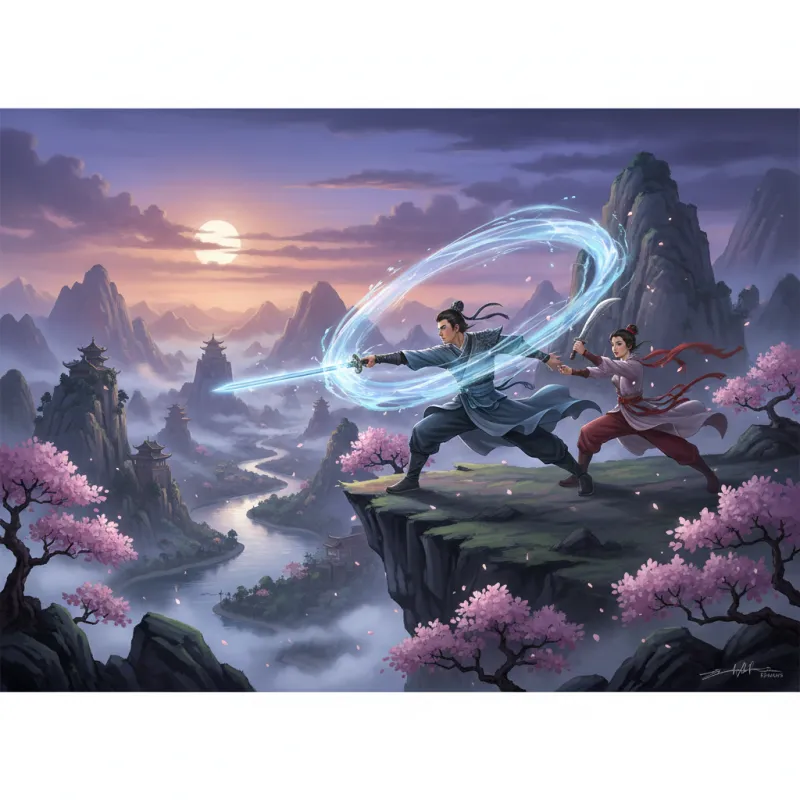
A master stands perfectly still while his student throws a full-force punch at his chest. The fist connects — and the student flies backward, crashing into the wall behind him. The master hasn't moved an inch. No visible technique, no obvious counter. Just... something. That "something" is what wuxia novels call neigong (内功 nèigōng), and it's the reason why the old man sweeping the temple courtyard might be the most dangerous person in the building.
The word breaks down cleanly: 内 (nèi) means "internal" and 功 (gōng) means "skill" or "work." Put them together and you get "internal skill" — the cultivation of qi (气 qì), that vital energy Chinese medicine and martial philosophy treat as the foundation of all physical power. But here's what the novels rarely get right: neigong isn't magic. It's a specific, systematic approach to training that takes decades to develop and looks nothing like the instant power-ups in Demi-Gods and Semi-Devils.
The Three Pillars of Real Neigong Practice
Authentic neigong training rests on three interconnected practices: breathing regulation (调息 tiáoxī), mental focus (调心 tiáoxīn), and body alignment (调身 tiáoshēn). Miss any one of these and you're just doing regular exercise with your eyes closed.
The breathing component is where most people start and where most people quit. We're not talking about taking deep breaths before a presentation. Neigong breathing patterns — like reverse abdominal breathing (逆腹式呼吸 nì fùshì hūxī) — require you to expand your lower abdomen on the exhale and contract it on the inhale, the exact opposite of natural breathing. Try it right now. Feels wrong, doesn't it? That's because you're fighting decades of autonomic programming. Masters of taijiquan (太极拳 tàijíquán) spend years making this reversal feel natural, coordinating it with every movement until breath and motion become inseparable.
Mental focus in neigong isn't meditation in the Buddhist sense. You're not trying to empty your mind or achieve enlightenment. You're directing attention to specific points in your body — the lower dantian (下丹田 xià dāntián) located roughly three finger-widths below your navel, or the middle dantian at your solar plexus, or the upper dantian between your eyebrows. The goal is to "sink the qi" (气沉丹田 qì chén dāntián), concentrating your vital energy in your body's center of gravity. In The Legend of the Condor Heroes, when Guo Jing finally grasps the essence of the Nine Yin Manual's internal cultivation methods, Jin Yong describes exactly this process — though he speeds up what should take years into a few dramatic chapters.
Body alignment is the piece that separates neigong from simple meditation. Your spine must be straight but not rigid, your shoulders relaxed but not collapsed, your tailbone tucked but not forced. Practitioners of xingyiquan (形意拳 xíngyìquán) call this "standing like a pine tree" (站如松 zhàn rú sōng) — rooted below, reaching above, flexible throughout. Get the alignment wrong and your qi circulation gets blocked at the joints. Get it right and energy flows through your body like water through an open channel.
Why Internal Beats External (Eventually)
Chinese martial arts traditionally divide into internal styles (内家拳 nèijiāquán) and external styles (外家拳 wàijiāquán). The external schools — Shaolin kung fu being the most famous — emphasize muscular strength, speed, and conditioning. Punch a thousand times, kick a thousand times, hit the wooden dummy until your shins turn to iron. It works. A twenty-year-old Shaolin monk will absolutely destroy most opponents through sheer physical superiority.
But here's the problem: that same monk at sixty? His knees are shot, his joints ache, and that explosive speed is gone. Meanwhile, the taijiquan practitioner who spent those same forty years cultivating neigong is just entering his prime. Chen Fake (陈发科 Chén Fākē), the legendary Chen-style taiji master, was reportedly at his most formidable in his sixties and seventies, when most fighters have long since retired.
The internal arts approach power differently. Instead of building bigger muscles, you're training your body to use the strength it already has more efficiently. Instead of tensing up to generate force, you relax completely and let your structure do the work. It sounds paradoxical because it is paradoxical — until you feel it work. That's why neigong takes so long to develop. You're not just learning new techniques; you're rewiring your nervous system's fundamental understanding of how force generation works.
The Dantian: Your Body's Power Plant
Every discussion of neigong eventually circles back to the dantian (丹田 dāntián), literally "elixir field." While Chinese medicine recognizes three dantian points, martial neigong focuses primarily on the lower dantian, that spot below your navel that serves as your body's energetic center of gravity.
Here's what actually happens when you "cultivate the dantian" — stripped of mystical language. Through specific breathing patterns and mental focus, you're training your body to engage your deep core muscles (transversus abdominis, pelvic floor, multifidus) in coordination with your diaphragm. This creates internal pressure that stabilizes your spine and allows force to transfer efficiently from your legs through your torso to your arms. Biomechanics researchers call this "intra-abdominal pressure." Neigong practitioners have been training it for centuries without needing the scientific terminology.
The sensation of "qi sinking to the dantian" that novels describe constantly? That's real. It feels like a warm, heavy ball settling in your lower abdomen. But it's not magic energy — it's your proprioceptive awareness of your deep core engagement combined with increased blood flow to the area from focused breathing. The effect is the same either way: your center of gravity drops, your balance improves, and your power generation becomes more efficient.
In baguazhang (八卦掌 bāguàzhǎng), practitioners walk in circles for hours specifically to develop this dantian awareness. The constant turning and weight shifting forces you to maintain your center while your periphery moves. Do it long enough and your dantian becomes your body's gyroscope, automatically adjusting to maintain balance and structure no matter what position you're in.
Small Circulation and Grand Circulation
Advanced neigong practice involves circulating qi through specific pathways in your body. The Small Heavenly Circuit (小周天 xiǎo zhōutiān) runs up your spine and down the front of your torso, connecting the Governing Vessel (督脉 dūmài) and Conception Vessel (任脉 rènmài) — two of the eight extraordinary meridians in Chinese medicine. The Grand Circulation (大周天 dà zhōutiān) extends this flow through your arms and legs.
Wuxia novels love this stuff. Characters "break through" to new levels by completing their Small Circulation or achieving Grand Circulation, usually while sitting in meditation during a life-or-death crisis. Duan Yu in Demi-Gods and Semi-Devils accidentally achieves circulation while trapped in a cave, and suddenly he's got decades of internal power. It's dramatic, but it's nonsense.
Real circulation practice is painfully gradual. You sit in meditation, focus on your lower dantian, and try to sense — then guide — the movement of qi up your spine. Most people feel nothing for months. Eventually you might notice warmth, tingling, or a sense of movement. After years, you can consciously direct this sensation through the circuit. The "breakthrough" isn't a sudden explosion of power; it's the moment when the pathway becomes clear enough that circulation happens naturally, without forced concentration.
Does this actually do anything? The honest answer is: probably, but not what the novels claim. Studies on qigong practitioners show measurable changes in blood flow, nervous system activity, and even brain wave patterns during circulation practice. You're not channeling mystical energy, but you are training a sophisticated form of mind-body coordination that has real physiological effects. Whether you call it qi circulation or "voluntary control of autonomic nervous system functions" is mostly a matter of cultural framing.
Why Most People Never Get There
Here's the uncomfortable truth about neigong: most people who start training never develop real internal skill. Not because they're not talented, but because they quit too early or train incorrectly.
The typical progression goes like this: You start training, you learn the forms, you practice the breathing. For the first year, maybe two, you feel like you're making progress. Then you hit the plateau. Nothing seems to change. Your teacher keeps saying "relax more" and "sink your qi" but you have no idea what that actually means in practice. The movements feel the same as they did six months ago. Meanwhile, your friend who started boxing is obviously getting better every week — faster, stronger, more skilled.
This is where most people quit. They switch to a different style, or they decide internal arts are bullshit, or they just stop training. The ones who stay are either incredibly stubborn or have a teacher good enough to guide them through the dead zone.
Because here's the thing: neigong development isn't linear. You can train correctly for three years and feel like you've accomplished nothing, then suddenly something clicks and your power doubles in a month. Chen Xiaowang (陈小旺 Chén Xiǎowàng), another Chen-style taiji master, describes it as "ten years to get through the door" — meaning a decade of training before you even begin to understand what internal power actually is.
The novels get this exactly backward. In wuxia fiction, heroes gain decades of internal power in days through lucky encounters, magical pills, or energy transfers from dying masters. Real neigong is the opposite: you put in decades of work for gains that are invisible to outsiders and sometimes barely perceptible to yourself. It's the least dramatic, most unglamorous path to martial skill imaginable. Which is probably why it works.
The Modern Neigong Problem
Walk into most taiji classes today and you'll find people doing slow-motion movements with no understanding of the internal principles behind them. The forms look right, but the substance is missing. This isn't entirely the students' fault — many teachers don't understand neigong themselves, having learned only the external shell of the art.
Real neigong transmission requires hands-on correction and years of close teacher-student relationship. You can't learn it from books or videos because the crucial adjustments are too subtle to see. Your teacher needs to touch your body, feel where you're tense, and guide you toward the correct internal state. This kind of teaching doesn't scale well to modern commercial martial arts schools with fifty students per class.
The result is a generation of practitioners who know the choreography but lack the substance. They can perform beautiful forms but can't apply the techniques under pressure because they never developed the internal structure that makes the techniques work. It's like learning to play piano by memorizing finger positions without ever understanding music theory or developing a sense of rhythm.
Some schools are trying to preserve authentic neigong transmission. The Chen Village in Henan Province still produces legitimate internal arts masters. Certain lineages of baguazhang and xingyiquan maintain rigorous training standards. But they're increasingly rare, islands of traditional practice in a sea of commercialized martial arts.
What Neigong Actually Gives You
So after all this training, what do you actually get? Not the ability to shoot energy blasts or fight fifty opponents simultaneously. But you do get something valuable: a body that moves with unusual efficiency, generates power from relaxation rather than tension, and maintains its capabilities well into old age.
You develop what internal arts practitioners call "whole-body power" (整劲 zhěngjìn) — the ability to coordinate your entire structure into a single unified force. When you push someone, they don't feel your arm strength; they feel like they've been hit by your whole body at once. This is the real "internal power" behind those demonstrations where a small master effortlessly throws a larger opponent.
You also gain a kind of body awareness that most people never develop. You can feel tension patterns before they become pain, adjust your structure to prevent injury, and maintain balance in situations that would topple others. These aren't supernatural abilities — they're the natural result of decades spent paying close attention to your body's internal state.
And perhaps most importantly, you develop a practice that deepens with age rather than declining. While external martial artists peak in their twenties and thirties, internal practitioners often don't hit their stride until their fifties or sixties. It's a long game, but it's one of the few games where time is on your side.
The novels will keep depicting neigong as instant power and magical energy. That's fine — it makes for better stories. But the real practice is stranger and more interesting than the fiction. It's the art of spending decades learning to do less, to relax more, to let your body's natural structure do what it's designed to do. Not as dramatic as breaking through to the next level of cultivation, but a lot more useful in the long run.
For more on how internal power manifests in actual combat, see Qi Circulation Techniques. And if you're curious about the philosophical foundations underlying these practices, check out Daoist Influence on Martial Arts.
Related Reading
- The Poison Arts: Wuxia Fiction's Most Feared Discipline
- The Wuxia Training Montage: How Heroes Are Made
- Wuxia Training Montages: How Heroes Are Made
- How Wuxia Heroes Train: From Waterfall Meditation to Iron Palm
- Exploring Chinese Martial Arts Fiction: Training and Tradition in Wuxia Novels
- The Allure of Wuxia: Exploring Chinese Martial Arts Fiction and Jianghu Culture
- The Origins of Wuxia: From Sima Qian to Jin Yong
- The Three Pure Ones: Supreme Deities of Daoism
Explore Chinese Culture
- Explore Jin Yong's martial arts novels
- Explore cultivation fiction and immortal heroes
- Explore the real history behind wuxia