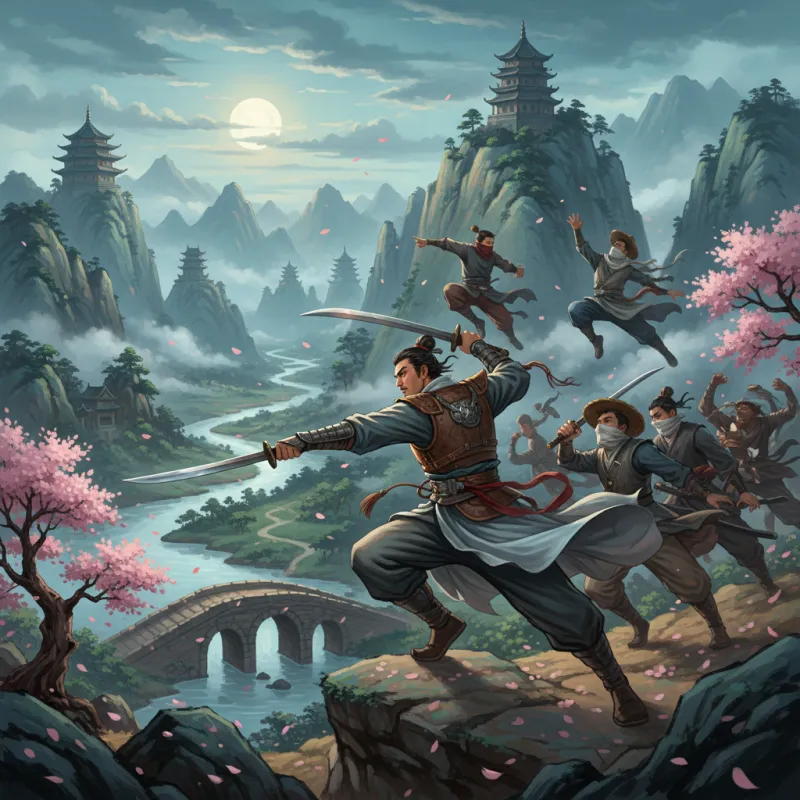
A man named Jing Ke walked into the throne room of the King of Qin in 227 BCE carrying a dagger hidden inside a rolled map. He was there to commit regicide. He failed—and the king he tried to kill became China's first emperor. But Jing Ke wasn't a rebel general or a political rival. He was a youxia (游侠 yóuxiá), a "wandering knight," and his assassination attempt was recorded in official histories as an act of righteous valor. That's how seriously ancient China took these figures: even when they tried to murder the emperor, historians wrote about them with grudging respect.
The youxia were real. They carried real swords, killed real people, and operated outside the law in ways that made Confucian officials deeply uncomfortable. They're also the reason wuxia fiction exists at all. Every wandering swordsman in Jin Yong's novels, every righteous outlaw in Gu Long's stories, every martial artist who puts personal loyalty above imperial law—they're all descendants of these historical knights-errant who refused to bow to authority.
The Historical Record: Sima Qian's Uncomfortable Admiration
The most detailed accounts of youxia come from Sima Qian (司马迁), the grand historian of the Han Dynasty, who wrote about them around 94 BCE in his Records of the Grand Historian (史记 Shǐjì). He dedicated two entire chapters to these figures: "Biographies of Assassins" (刺客列传) and "Biographies of Wandering Knights" (游侠列传). This wasn't casual interest—Sima Qian was documenting people who fundamentally challenged the social order he was supposed to uphold.
What's fascinating is that Sima Qian clearly admired them. He wrote that youxia "do not boast of their abilities, and are ashamed to vaunt their virtues." They kept their promises even unto death. They avenged wrongs for people who couldn't seek justice through official channels. In a society built on rigid hierarchy and Confucian propriety, the youxia operated on a completely different moral code: personal loyalty, keeping one's word, and yi (义)—righteousness or justice—above all else.
The government hated this. The youxia represented everything Confucianism opposed: they were mobile when society demanded stability, they were loyal to individuals rather than the state, and they resolved disputes with violence rather than through proper legal channels. Several emperors tried to suppress them. The Han Dynasty even passed laws specifically targeting youxia, forcing them to relocate or face execution. It didn't work. The youxia tradition persisted for centuries.
Who Were They Really?
The historical youxia weren't a unified group. They ranged from educated men of minor nobility to street toughs and professional killers. What united them was their rejection of conventional paths to success—the civil service examinations, merchant trade, farming—in favor of a life built around martial skill, personal honor, and the bonds of jianghu (江湖), that "rivers and lakes" world that existed outside official society.
Some were essentially bodyguards and enforcers for wealthy families. Others were genuine idealists who intervened in local disputes, protected the weak, or avenged wrongs. Many were hired assassins. The line between "righteous knight" and "dangerous criminal" was always blurry, which is exactly why Confucian officials found them so threatening.
Take Guo Xie (郭解), one of the most famous youxia from the Han Dynasty. Sima Qian describes him as short, physically unimpressive, and not particularly skilled in martial arts—but so respected in the jianghu that people across multiple provinces would help him without question. When someone insulted Guo Xie's family, the man was found murdered the next day. Guo Xie claimed he had nothing to do with it; his followers had acted on their own initiative. That's the kind of power a true youxia wielded: not just personal martial skill, but a network of loyalty that operated like an invisible government.
The authorities eventually executed Guo Xie for his influence, not for any specific crime they could prove. His existence was the crime.
The Code They Lived By
The youxia operated according to principles that would become central to wuxia philosophy: yi (义 righteousness), xin (信 trustworthiness), and bao (报 reciprocity—repaying both kindness and enmity). These weren't abstract virtues. They were actionable commitments that could get you killed.
If a youxia promised to help you, he would help you even if it meant his death. If you showed him kindness, he would repay it. If you wronged him or someone under his protection, he would seek revenge—not through lawsuits or official complaints, but with a blade. This code made them simultaneously admirable and terrifying.
The most extreme examples were the assassins. Jing Ke, who tried to kill the King of Qin, did so because the Crown Prince of Yan had shown him hospitality and respect. That was enough. When the assassination failed and Jing Ke was cut down, he reportedly laughed at his own failure—not because he didn't care, but because he'd kept his word and that was what mattered.
Another assassin, Nie Zheng (聂政), killed a high official to repay a debt of gratitude, then committed suicide by mutilating his own face so his family wouldn't be implicated. His sister, hearing about an unidentified assassin's body, traveled to the capital, identified her brother publicly, and died embracing his corpse. Sima Qian recorded this as an example of supreme yi. Modern readers might call it insane. Both interpretations are valid.
From History to Fiction: The Transformation
The youxia tradition never completely died, but it did transform. By the Tang Dynasty (618-907 CE), you start seeing chuanqi (传奇) tales—short stories about swordsmen with supernatural abilities. The historical youxia who relied on networks and daggers became the fictional wuxia who could leap over walls and fight twenty men at once.
This transformation makes sense. Real youxia were dangerous and destabilizing. Fictional wuxia could embody the same values—personal loyalty, righteousness, freedom from authority—without actually threatening the social order. You could read about them, admire them, even fantasize about being them, all while remaining a law-abiding subject of the empire.
The Ming and Qing dynasties produced novels like Water Margin (水浒传 Shuǐhǔ Zhuàn), which featured 108 outlaws who were essentially youxia writ large: martial artists who rejected corrupt authority and formed their own brotherhood. The novel was officially banned multiple times because the government understood exactly what it was celebrating.
Modern wuxia fiction, from Jin Yong to Gu Long to contemporary web novels, continues this tradition. The difference is that now the youxia have qinggong (轻功 lightness skill) and internal energy cultivation. They can fight for three days straight and deflect arrows with their sleeves. But the core remains the same: they're outsiders who live by a personal code, who value loyalty over law, who would rather die than break their word.
Why the Government Was Right to Be Afraid
Here's the uncomfortable truth: the youxia were genuinely destabilizing. A society where people resolve disputes through private violence rather than legal channels is a society in chaos. A society where personal loyalty trumps loyalty to the state is a society that can't be governed effectively. The Confucian officials who tried to suppress the youxia weren't just being authoritarian—they were trying to maintain basic social order.
But the youxia persisted because they fulfilled needs the official system couldn't or wouldn't address. When local magistrates were corrupt, when the legal system favored the wealthy, when ordinary people had no recourse against injustice—that's when the youxia mattered. They were a pressure valve for social frustration, a parallel system of justice that operated in the gaps of official power.
This is why wuxia fiction remains popular. We still live in societies where official justice is imperfect, where the powerful exploit the weak, where doing the right thing sometimes means breaking the rules. The fantasy of the wandering swordsman who can simply cut through all that complexity with a blade and a clear moral code—that fantasy is eternal.
The Legacy in Modern Wuxia
When you read Jin Yong's The Legend of the Condor Heroes and see Guo Jing struggling between personal loyalty and national duty, you're watching the youxia code collide with Confucian values. When you read Gu Long's The Eleventh Son and encounter Xiao Shiyi Lang, a wandering swordsman with no family and no home who lives entirely by his personal code—that's the youxia tradition in its purest form.
Even the structure of wuxia stories reflects youxia values. The protagonist is almost always an outsider. They form bonds based on personal loyalty rather than family or official position. They intervene in conflicts not because it's their job but because it's the right thing to do. They're willing to die for their principles. These aren't random plot choices—they're the historical DNA of the youxia expressing itself through fiction.
The jianghu itself, that martial world that exists parallel to official society, is the fictional descendant of the real networks that youxia like Guo Xie commanded. In wuxia novels, the jianghu has its own rules, its own hierarchies, its own systems of justice that operate independently of imperial law. That's not fantasy—that's historical memory transformed into narrative structure.
Understanding the youxia doesn't just give you historical context for wuxia fiction. It reveals why these stories matter, why they've persisted for centuries, why they still resonate. They're not just adventure tales about people with swords. They're stories about the eternal tension between individual conscience and social order, between personal loyalty and institutional authority, between the law as written and justice as felt.
The youxia lost in history—the government eventually won, as governments usually do. But they won in fiction, and that victory might be more permanent. Every time someone reads a wuxia novel and feels that thrill of identification with the wandering swordsman who answers to no one but their own conscience, the youxia live again.
Related Reading
- Pangu and the Cosmic Egg: The Chinese Creation Myth
- The Real History Behind Wuxia Fiction
- The Real History Behind Wuxia: Knight-Errants of Ancient China
- The Enigmatic World of Jianghu: A Deep Dive into Wuxia Fiction and Kung Fu Novels
- The Origins of Wuxia: From Sima Qian to Jin Yong
- Yi and Qi: The Concepts of Righteousness and Brotherhood in Wuxia
- Exploring Wuxia Fiction: The Art and Culture of Chinese Martial Arts Novels
- Animal Spirits and the Path to Becoming Yaoguai
Explore Chinese Culture
- Explore Jin Yong's martial arts novels
- Explore cultivation fiction and immortal heroes
- Explore the real history behind wuxia