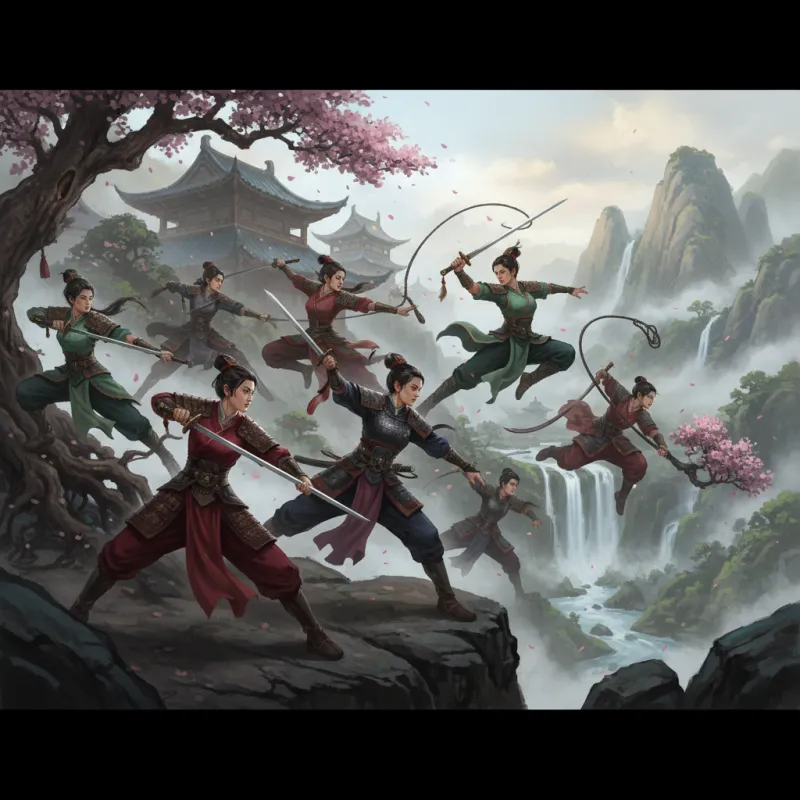
The first time Huang Rong (黄蓉 Huáng Róng) appears in The Legend of the Condor Heroes, she's disguised as a filthy beggar boy, outwitting grown men twice her size. When she finally reveals herself as a woman, it's not to become a love interest—though that happens too—but to demonstrate that she's been the smartest person in every room she's entered, regardless of what anyone assumed about her gender. Jin Yong (金庸 Jīn Yōng) wrote this in 1957, and it remains one of the most subversive character introductions in wuxia literature. Not because Huang Rong is strong—plenty of women in wuxia are strong—but because her intelligence, cunning, and martial prowess exist independent of male validation.
The Meritocracy Myth
The jianghu (江湖 jiānghú, literally "rivers and lakes") sells itself as the ultimate meritocracy. Your sword doesn't care about your gender. Your internal energy cultivation (内功 nèigōng) doesn't check your chromosomes. Qi (气 qì) flows through the same meridians (经络 jīngluò) whether you're male or female. In theory, a woman who trains as hard and as long as a man should be exactly as dangerous.
But wuxia fiction, like the society that produces it, can't quite commit to this premise. The genre has given us some of the most brilliant, capable, fully realized women in Chinese popular literature—characters who could carry entire novels on their own. It has also sidelined, objectified, and sacrificed these same women for male character development with depressing regularity. Both things are true simultaneously, and understanding this contradiction is essential to appreciating what wuxia does well and where it still fails its female characters.
The Archetypes That Trap Them
Wuxia's women tend to fall into recognizable patterns. There's the Sect Leader's Daughter, whose primary narrative function is to be kidnapped or to fall in love with the protagonist (sometimes both). There's the Demonic Seductress, whose sexuality is treated as a weapon more dangerous than her actual martial arts. There's the Tragic Beauty, who dies to motivate the hero's revenge arc. And there's the Masculine Woman, who rejects femininity entirely and is often punished by the narrative for doing so.
These archetypes aren't inherently bad—archetypes exist in all genre fiction. The problem is when they become the only options available. When Ren Yingying (任盈盈 Rèn Yíngyíng) in The Smiling, Proud Wanderer spends the first half of the novel as a mysterious, powerful figure only to become primarily defined by her love for Linghu Chong in the second half, it's frustrating precisely because Jin Yong showed us what she could be.
The Ones Who Break Through
Yet some characters transcend these limitations entirely. Xiao Longnu (小龙女 Xiǎo Lóngnǚ) from The Return of the Condor Heroes is perhaps the most radical female character Jin Yong ever created. She's emotionally detached, sexually inexperienced but not innocent, and her martial arts—the Ancient Tomb Sect's techniques—are explicitly designed to counter male strength with female advantages. She doesn't become "softer" or "more feminine" as the story progresses; if anything, she becomes more herself.
Gu Long's (古龙 Gǔ Lóng) women operate differently. Characters like Shangguan Feiyan (上官飞燕 Shàngguān Fēiyàn) from The Eleventh Son are written with the same moral complexity as his male protagonists. They're allowed to be selfish, calculating, and survival-oriented without the narrative punishing them for it. Gu Long's jianghu is darker and more cynical than Jin Yong's, but paradoxically, his women often have more agency within it.
Then there's Liang Yusheng's (梁羽生 Liáng Yǔshēng) approach, which tends toward historical realism. His female characters like Lian Nishang (练霓裳 Liàn Níshang) from The White-Haired Maiden are products of specific historical moments—the Ming-Qing transition, the fall of dynasties, the chaos of regime change. Their martial prowess is contextualized within larger political struggles, making them feel less like fantasy figures and more like women who might have actually existed.
The Problem of Romance
Here's the uncomfortable truth: wuxia struggles to imagine what a powerful woman does with her life besides fall in love. Even the most capable female characters—women who lead sects, command armies, master forbidden techniques—tend to have their arcs culminate in romantic resolution. Their power becomes something they wield for their beloved rather than for themselves.
This isn't universal. Zhou Zhiruo (周芷若 Zhōu Zhǐruò) from The Heaven Sword and Dragon Saber is fascinating precisely because her arc is about power, not love. She wants to lead Emei Sect (峨嵋派 Éméi Pài), and she's willing to betray, manipulate, and kill to achieve that goal. The tragedy isn't that she loses Zhang Wuji's love—it's that the narrative treats her ambition as a corruption rather than a legitimate desire. A male character with identical motivations would be complex and morally gray; Zhou Zhiruo is often read as a villain.
The romance problem extends to how female characters relate to each other. Too often, women in wuxia are isolated—the only female disciple, the only woman in the group, the only one who matters. When multiple women appear, they're frequently positioned as rivals for male attention rather than as potential allies or friends. The exceptions, like the complex relationship between Yue Lingshan (岳灵珊 Yuè Língshān) and Ning Zhongze (宁中则 Níng Zhōngzé) in The Smiling, Proud Wanderer, are notable precisely because they're rare.
Modern Revisions and Adaptations
Contemporary wuxia, particularly in web novel form, is actively interrogating these patterns. Female authors are writing women who pursue martial arts for reasons beyond love or revenge—for curiosity, for ambition, for the simple joy of mastery. Characters are allowed to be powerful and feminine, or powerful and masculine, or powerful and neither, without the narrative treating these as contradictions.
Television and film adaptations have also pushed boundaries. The 2019 adaptation of The Legend of Condor Heroes gave Huang Rong more agency and screen time for her schemes. The Sword of Legends series created original female characters who exist outside the love-interest framework entirely. These changes aren't always improvements—sometimes they overcorrect, creating women who are powerful but bland—but they represent a genuine attempt to expand what wuxia women can be.
The influence of Western fantasy and feminist discourse is visible here, for better and worse. Some modern wuxia women feel like they're checking boxes—she's strong, she's independent, she doesn't need a man—without the depth that makes characters like Xiao Longnu or Ren Yingying compelling. The best contemporary female characters, like those in Priest's (Priest) novels, combine traditional wuxia elements with modern sensibilities in ways that feel organic rather than forced.
What the Genre Owes Its Women
Wuxia has always been about outsiders—people who reject conventional society for the freedom of the jianghu. Women, by definition, are outsiders in a patriarchal system. They should be the genre's natural protagonists, not its supporting cast. The fact that they so rarely are reveals the limits of wuxia's imagination.
But those limits are being tested. Every time a reader picks up a wuxia novel hoping for a female character who's more than a love interest, every time a writer creates a woman whose arc doesn't end in marriage or death, every time an adaptation gives a female character her own subplot independent of the male lead—the genre inches closer to fulfilling its own premise. The jianghu is supposed to be a meritocracy of violence. It's time the stories set there started acting like it.
The women warriors of wuxia deserve better than to be brilliant in service of someone else's story. They deserve to be brilliant in their own right, pursuing their own goals, making their own mistakes, achieving their own victories. Some already are. The question is whether the genre will catch up to its best characters, or continue to treat them as exceptions rather than the rule they should be. For readers interested in how these dynamics play out in specific contexts, exploring the role of female sect leaders or women's martial arts styles offers deeper insight into how gender shapes power in the jianghu.
Related Reading
- Romance in Wuxia: Love, Duty, and the Tragedy Between
- Hua Mulan and Beyond: Real Women Warriors of China
- Female Martial Artists in Wuxia Fiction
- Hua Mulan and the Wuxia Tradition of Women Warriors
- Women Warriors in Chinese Martial Arts Fiction: Empowering Jianghu Heroines
- Sleeve Arrows and Mechanical Weapons in Wuxia Fiction
- Chinese Internet Ghost Stories: The Creepypasta of the East
- Internal Energy (Neigong): The Hidden Power Behind Every Martial Art
Explore Chinese Culture
- Explore Jin Yong's martial arts novels
- Explore cultivation fiction and immortal heroes
- Explore the real history behind wuxia