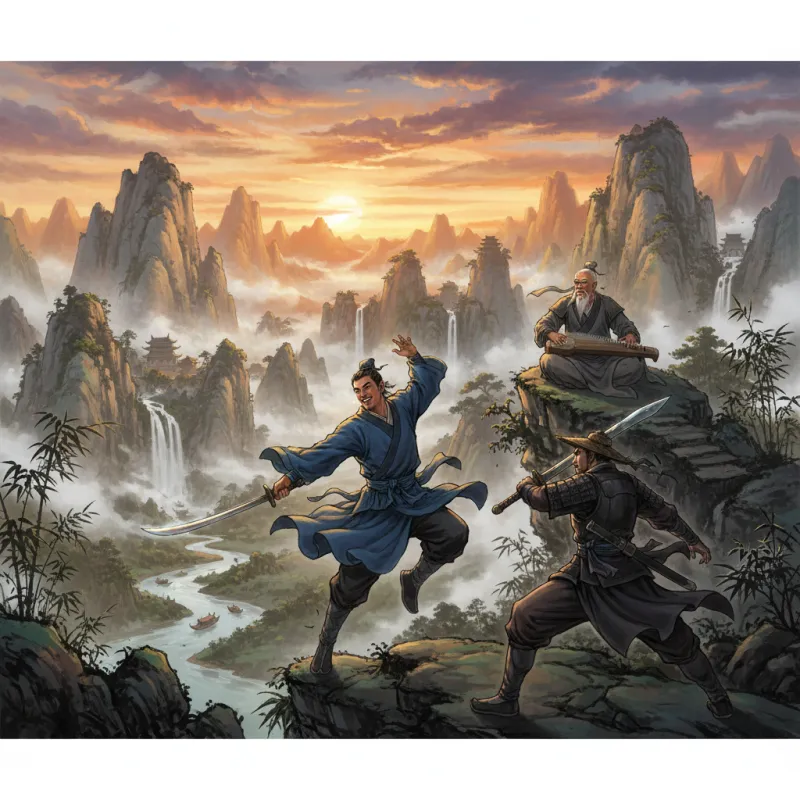
Linghu Chong stands drunk on a mountaintop, his sword forgotten at his side, playing a haunting melody on his guqin while the martial world below tears itself apart over power and orthodoxy. This image—a master swordsman who'd rather make music than war—captures everything Jin Yong wanted to say about freedom in his 1967 masterpiece The Smiling Proud Wanderer (笑傲江湖, Xiào Ào Jiāng Hú). While other wuxia novels celebrate loyalty to one's sect or devotion to righteous causes, this one dares to ask: what if the real hero is the one who walks away from it all?
The Unconventional Hero Who Refuses to Play by the Rules
Linghu Chong isn't your typical wuxia protagonist. He doesn't seek revenge for murdered parents, harbor ambitions to lead the martial world, or obsess over becoming the greatest fighter. Expelled from the orthodox Huashan Sect (华山派, Huáshān Pài) due to misunderstandings and political machinations, he could have spent the novel proving his innocence or seeking reinstatement. Instead, he befriends outcasts, drinks with demons of the unorthodox path (魔教, Mó Jiào), and learns the Dugu Nine Swords (独孤九剑, Dúgū Jiǔ Jiàn)—a technique that has no fixed forms, only principles of adaptation. Even his martial arts philosophy mirrors his life: no rigid stances, just pure response to the moment.
What makes Linghu Chong revolutionary is his refusal to choose sides in the endless orthodox versus unorthodox conflict that dominates jianghu politics. When Ren Woxing, leader of the Sun Moon Holy Cult, offers him power and position, he declines. When his own sect demands blind obedience, he questions. This wasn't just character development—Jin Yong was writing during China's Cultural Revolution, and readers understood the subtext about conformity versus individual conscience.
Freedom's Price in a World Obsessed with Control
The novel's Chinese title literally translates to "Laughing Proudly in the Jianghu," but that laughter comes at tremendous cost. Every major faction in the story—from the Five Mountains Sword Sects Alliance (五岳剑派, Wǔyuè Jiàn Pài) to the Sun Moon Holy Cult—operates on the same principle: accumulate power, eliminate rivals, control others. Yue Buqun, Linghu Chong's master, presents himself as the epitome of Confucian virtue while secretly practicing the evil Sunflower Manual (葵花宝典, Kuíhuā Bǎodiǎn) and plotting to dominate the martial world. The so-called righteous sects prove just as ruthless as the demonic ones they condemn.
Linghu Chong's freedom isn't passive withdrawal—it's active resistance against this entire system. When he learns the Absorbing Star Technique (吸星大法, Xīxīng Dàfǎ), a powerful but dangerous skill that absorbs others' internal energy, he faces a choice that defines the novel's philosophy. The technique offers immense power but risks consuming his identity, turning him into another power-hungry martial artist. His struggle with this internal conflict mirrors the broader question: can you remain free while wielding the tools of oppression?
The Music That Transcends Martial Arts
One of Jin Yong's most brilliant narrative choices was making music central to Linghu Chong's character. The piece "Laughing in the Wilderness" (笑傲江湖之曲, Xiào Ào Jiāng Hú Zhī Qǔ), composed by two masters from opposing factions who became friends, represents everything the martial world has forgotten. When Linghu Chong plays it with the unorthodox musician Qu Yang and the orthodox Liu Zhengfeng, their harmony transcends sectarian boundaries. The martial world's response? They try to kill Liu Zhengfeng for fraternizing with the enemy.
This subplot devastates because it shows how systems of control crush not just rebellion but simple human connection. Liu Zhengfeng attempts to retire from jianghu, wanting only to play music with his friend, but the orthodox sects won't allow it. You're either with us or against us—neutrality is betrayal. The scene where Liu's family is slaughtered while Linghu Chong watches helplessly remains one of wuxia fiction's most brutal moments, not because of graphic violence but because of its message: the price of freedom is watching others pay for their attempts at it.
Love Without Possession
Linghu Chong's relationship with Ren Yingying, daughter of the Sun Moon Holy Cult's leader, further explores freedom's dimensions. Unlike typical wuxia romances built on misunderstandings and jealousy, their love develops through mutual respect for each other's autonomy. Yingying, despite her position and power, never tries to control or change Linghu Chong. She understands that loving him means accepting his nature—including his lingering feelings for his junior martial sister Yue Lingshan.
The contrast with Yue Lingshan's marriage to Lin Pingzhi is stark. Lin, obsessed with restoring his family's reputation and mastering the Evil-Resisting Sword Manual (辟邪剑谱, Bìxié Jiàn Pǔ), becomes increasingly controlling and paranoid. His relationship with Lingshan deteriorates into mutual destruction because it's built on possession rather than freedom. Jin Yong suggests that authentic love, like authentic freedom, requires letting go—of expectations, of control, of the need to shape others into what we want them to be.
The Sword Style That Has No Style
The Dugu Nine Swords technique that Linghu Chong masters from the eccentric Feng Qingyang represents Jin Yong's martial arts philosophy at its purest. Unlike other legendary techniques in wuxia that require decades of rigid practice or self-mutilation (looking at you, Sunflower Manual), the Dugu Nine Swords has no fixed moves. It's entirely reactive, finding the flaws in any opponent's technique and exploiting them. You can't practice it by rote—you must understand principles and adapt in the moment.
This mirrors Daoist concepts of wu wei (无为)—effortless action that flows with circumstances rather than forcing outcomes. While other martial artists in the novel accumulate techniques like collectors hoarding treasures, Linghu Chong strips away everything unnecessary. The more he learns, the less he relies on. It's the opposite of the power-accumulation mindset that drives characters like Yue Buqun and Zuo Lengchan to their doom. For readers interested in how martial arts philosophy intersects with character development, The Condor Heroes trilogy offers fascinating comparisons in Jin Yong's evolving thought.
Why This Novel Still Matters
The Smiling Proud Wanderer endures because its central question remains urgent: how do you maintain individual freedom in systems designed to eliminate it? Jin Yong wasn't just writing about Ming Dynasty martial artists—he was exploring timeless tensions between conformity and authenticity, between institutional power and personal conscience. The novel suggests that true freedom isn't about having no constraints but about choosing which constraints you accept and which you resist.
What makes Linghu Chong heroic isn't his martial arts prowess—plenty of characters in the novel could defeat him. It's his refusal to compromise his essential nature despite overwhelming pressure. He loses his sect, his reputation, nearly his life, yet never becomes what others demand. In a genre often criticized for glorifying violence and rigid hierarchies, Jin Yong created a protagonist who questions the entire foundation of jianghu society.
The Legacy of Laughing Proudly
Modern readers sometimes find Linghu Chong frustrating—he's passive when he should act, loyal to people who betray him, seemingly naive about political realities. But that's precisely the point. Jin Yong asks whether maintaining your humanity in an inhumane system is weakness or the highest form of strength. The novel's ending, with Linghu Chong and Yingying retiring from jianghu to live simply, isn't defeat—it's the ultimate assertion of freedom. They choose their own values over the martial world's endless power struggles.
For those exploring Jin Yong's broader themes about individual versus society, The Deer and the Cauldron takes these ideas even further with a protagonist who's far more morally ambiguous. But The Smiling Proud Wanderer remains the purest expression of Jin Yong's belief that freedom—real freedom—means having the courage to laugh proudly while the world demands you bow.
Related Reading
- Legend of the Condor Heroes: A Complete Reading Guide
- Wuxia Web Novels: The Online Revolution in Martial Arts Fiction
- Gu Long vs. Jin Yong: Two Masters, Two Visions of Wuxia
- The Allure of Wuxia: Exploring Chinese Martial Arts Fiction and Jianghu Culture
- Classic vs. New Wuxia: How the Genre Evolved
- The Best Chinese Horror Films: A Genre Guide
- The Hetu and Luoshu: Magical Diagrams from the Rivers
- The Dao of the Sword: Martial Arts as Philosophy in Wuxia
Explore Chinese Culture
- Explore Jin Yong's martial arts novels
- Explore cultivation fiction and immortal heroes
- Explore the real history behind wuxia