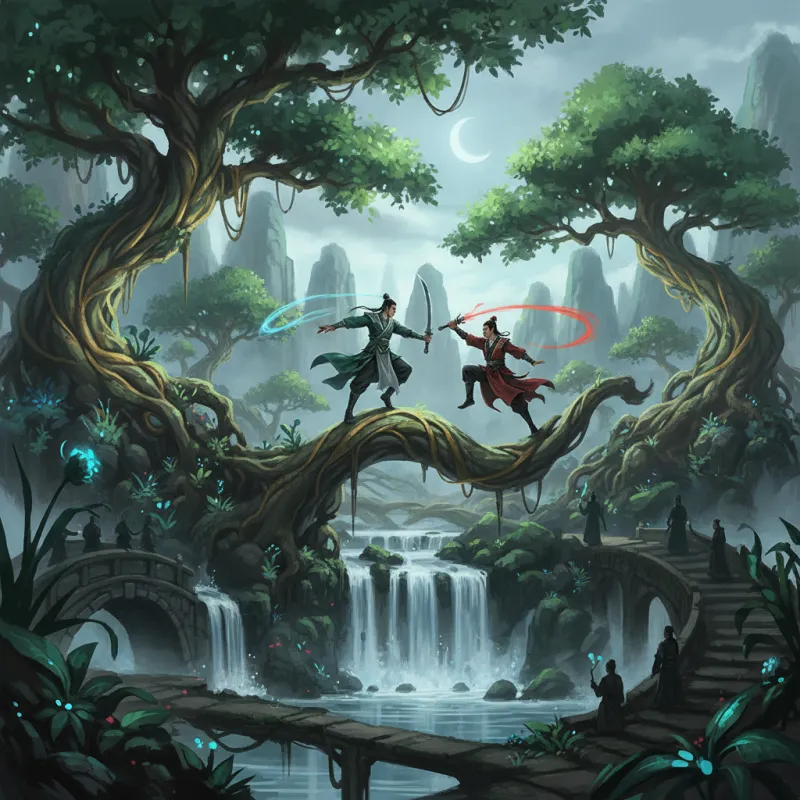
The pharmacist who compiled the plant sections of the Shanhaijing (山海经 Shānhǎi Jīng, "Classic of Mountains and Seas") must have been either a genius or completely unhinged. Possibly both. While everyone fixates on the text's parade of bizarre creatures — the nine-tailed foxes and human-faced birds — the botanical entries are where things get truly wild. We're talking about trees that grow jade fruit, grasses that resurrect the dead, and flowers that render you invisible. This isn't herbalism. This is cosmic horticulture on an unimaginable scale.
The World Trees: Architecture of the Cosmos
Forget your garden-variety sacred trees. The Shanhaijing describes botanical megastructures that literally hold the universe together, serving as highways between heaven, earth, and the underworld.
The Fusang Tree (扶桑 Fúsāng) dominates the eastern ocean, its trunk so massive that two people with outstretched arms couldn't encircle it. According to the text, ten suns roost in its branches like celestial chickens, taking turns to illuminate the world. The tree's roots sit submerged in boiling water — a detail that suggests the ancients understood geothermal activity, or at least knew that the cosmic plumbing required serious heat management. When the archer Houyi shot down nine of those suns during the legendary drought, he fundamentally altered the Fusang's ecosystem. One wonders if the tree ever recovered from losing 90% of its solar tenants.
In the west stands the Ruomu Tree (若木 Ruòmù), the Fusang's counterpart where the sun rests after its daily journey. The text describes it as having purple stems and black flowers — a color scheme that screams "underworld adjacent." This is where daylight goes to die, botanically speaking.
But the most important is the Jianmu (建木 Jiànmù), the Construction Tree, which grows at the exact center of the world. This is the cosmic elevator, the axis mundi that allows gods, spirits, and the occasional ambitious shaman to travel between realms. The Zhuangzi mentions that the legendary Yellow Emperor used it to ascend to heaven. Later, the tyrant Gun supposedly chopped it down to prevent divine interference in human affairs — an act of botanical vandalism with cosmic consequences. Imagine cutting down the only bridge between dimensions because you didn't want the gods checking your homework.
The Immortality Pharmacy
The Shanhaijing catalogs dozens of plants that grant longevity or outright immortality, each with its own peculiar properties and side effects.
The text mentions a grass on Mount Buzhou (不周山 Bùzhōu Shān) that makes you immune to hunger. Eat it once, and you never need food again. This sounds convenient until you realize it would completely destroy the social fabric of human civilization, which revolves largely around shared meals. The ancient Chinese understood that immortality without community is just eternal loneliness with better health metrics.
On Mount Kunlun (昆仑山 Kūnlún Shān), the axis of the world and home of the Queen Mother of the West, grows the legendary Peach of Immortality (蟠桃 Pántáo). These aren't your farmer's market peaches. They ripen once every three thousand years, and a single fruit grants eternal life. The Queen Mother hosts elaborate banquets when they're ready, inviting only the most distinguished immortals. Getting on that guest list is harder than getting into an Ivy League school, and the consequences of party-crashing are significantly more severe. The Journey to the West features Sun Wukong raiding this orchard in what might be literature's most consequential act of fruit theft.
More accessible but equally potent is the Lingzhi (灵芝 Língzhī), the "spirit mushroom" that appears throughout the text. Unlike the three-thousand-year peaches, Lingzhi grows in various mountains and can be harvested by mortals willing to brave the guardian creatures. The catch? The most potent specimens grow in the most dangerous locations, guarded by divine beasts that view mushroom hunters as convenient snacks. Risk-reward ratios in the Shanhaijing are never subtle.
The Resurrection Plants
Some plants in the Shanhaijing don't just extend life — they reverse death entirely, which raises uncomfortable questions about the natural order.
The text describes a grass on Mount Duguang that can bring the dead back to life. Just place it on a corpse, and the deceased returns to the living. No elaborate rituals, no monkey's paw consequences mentioned — just straightforward necromancy through botany. The text treats this as casually as describing a plant that cures headaches, which suggests either the compilers had a very different relationship with death, or they understood something about consciousness and biology that we've forgotten.
There's also the Buxiu Grass (不朽草 Bùxiǔ Cǎo, "Never-Rot Grass") that prevents decay. Apply it to a body, and decomposition simply stops. This has obvious applications for preservation, but the text hints at deeper uses. Some scholars argue this grass was essential for certain Daoist practices involving the transformation of the physical body into an immortal vessel. You can't achieve physical immortality if your body keeps trying to return to the earth.
The Transformation Flora
The strangest category might be plants that fundamentally alter your nature or appearance, blurring the line between human and other.
Several mountains host flowers that grant invisibility when worn. The text doesn't specify duration or side effects, but one imagines there were incidents. Invisibility in Chinese folklore is rarely consequence-free — it tends to reveal truths about human nature that are better left hidden, or attract the attention of spirits who can see through such tricks.
More disturbing are plants that change your species. The Shanhaijing mentions a tree whose fruit transforms humans into fish, and another whose leaves turn you into a bird. These aren't metaphors. The text presents them as straightforward biological facts, as if species boundaries were just suggestions that the right plant could override. Modern readers might see this as fantasy, but it reflects a worldview where the categories we use to organize reality were far more fluid than we assume.
The Jade and Metal Trees
Not all magical plants in the Shanhaijing are organic in the conventional sense. Some blur the boundary between botanical and mineral.
Multiple mountains feature trees that grow jade instead of fruit, or have leaves made of precious metals. Mount Zhongshan hosts a tree with jade branches and pearl flowers. These aren't trees that produce jade — they ARE jade, somehow alive and growing despite being made of stone. The text offers no explanation for how mineral trees photosynthesize or reproduce, which is probably for the best. Some mysteries don't benefit from scrutiny.
These jade trees connect to broader Chinese beliefs about the relationship between organic and inorganic matter. In traditional Chinese thought, minerals weren't dead matter but slow-living substances with their own qi (气 qì, vital energy). A jade tree isn't a contradiction — it's just a very patient form of life. This perspective makes the Shanhaijing's botanical catalog more coherent: if everything contains vital energy, then the distinction between plant, animal, and mineral becomes a matter of degree rather than kind.
The Practical Impossibilities
What makes the Shanhaijing's plants fascinating isn't just their magical properties but their specificity. The text doesn't just say "there are healing plants" — it catalogs exactly which mountain, which valley, which specific location hosts each species. It provides details about appearance, growing conditions, and effects with the precision of a field guide.
This precision creates a strange tension. The plants are clearly impossible by any conventional understanding of biology, yet they're described with the matter-of-fact tone of a botanical survey. The compilers weren't writing fantasy — they were documenting what they believed to be real geography and real flora, however extraordinary. Whether they actually believed in resurrection grass or were encoding other knowledge in botanical metaphors remains debated.
Some scholars argue the plants represent alchemical formulas or meditation techniques, with "eating the immortality peach" being code for specific spiritual practices. Others suggest they're garbled accounts of real plants with exaggerated properties, the ancient equivalent of supplement marketing. The most interesting interpretation might be that they represent a different epistemology entirely — a way of understanding the natural world where symbolic and material properties weren't separate categories.
The Lost Gardens
The tragedy of the Shanhaijing's botanical catalog is that we can't verify any of it. The text provides locations, but those mountains have been renamed, eroded, or never existed in physical space to begin with. No one has found the Fusang Tree or harvested resurrection grass, despite centuries of searching.
Yet the plants persist in Chinese culture, appearing in everything from traditional medicine to wuxia novels where heroes quest for immortality herbs. The Shanhaijing created a template for magical botany that influenced two thousand years of literature. When Jin Yong writes about the Ice Silkworm or the Vermillion Fruit in his novels, he's working in a tradition that starts with this ancient text's audacious claim that plants could rewrite the rules of life and death.
The Shanhaijing's plants remind us that the boundary between possible and impossible is culturally constructed. To its compilers, a tree that grows jade was no stranger than a tree that grows apples — both were expressions of the fundamental strangeness of life itself, the mystery of how anything grows at all. We've gained precision in our botany since then, but we've lost something too: the sense of wonder at the sheer improbability of the natural world, magical properties or not.
Related Reading
- Mythical Plants of the Shanhaijing: Trees That Grant Immortality and Flowers That Kill
- Lingzhi: The Mushroom of Immortality from Myth to Medicine
- The Bizarre Plants of the Shanhaijing: Trees That Cure Death and Fruits That Grant Flight
- The Peaches of Immortality: The Most Famous Fruit in Chinese Mythology
- Unraveling the Mystique of Wuxia: A Dive into Jianghu Culture and Kung Fu Novels
- Poison Needles and Flying Daggers: Hidden Weapons in Wuxia Combat
- Wire-Fu: The Art of Flying Swordsmen in Action Cinema
- Real Chinese Martial Arts Schools That Inspired Wuxia Fiction
Explore Chinese Culture
- Explore Jin Yong's martial arts novels
- Explore cultivation fiction and immortal heroes
- Explore the real history behind wuxia