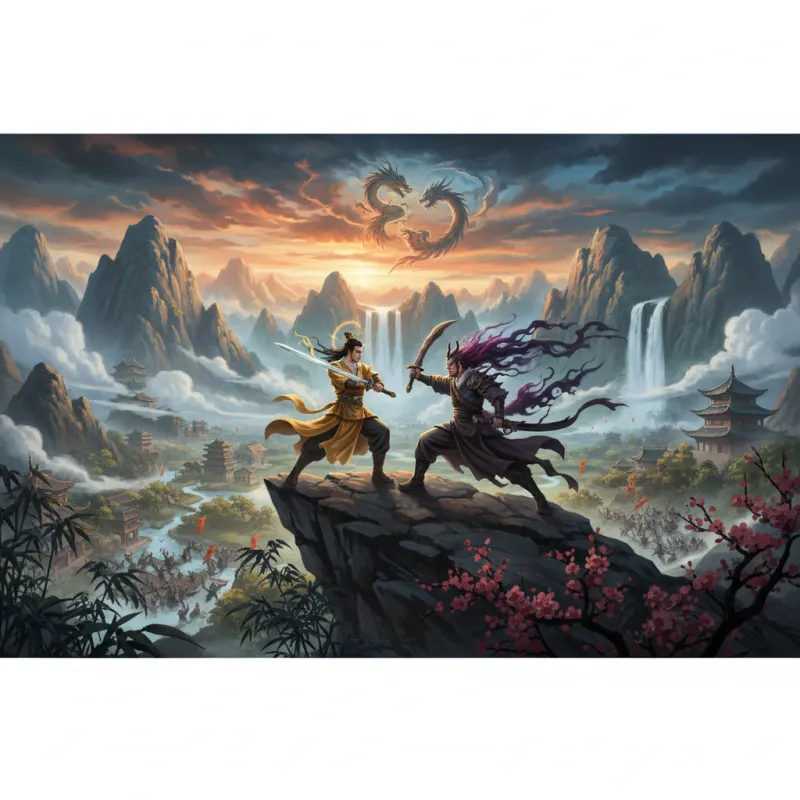
Qiao Feng stands atop Yanmen Pass, the wind whipping his robes as he realizes the truth that will shatter his world: the heroic Khitan-slaying beggar chief is himself Khitan. This moment of devastating self-discovery lies at the heart of Jin Yong's (金庸) masterwork "Demi-Gods and Semi-Devils" (天龙八部, Tiān Lóng Bā Bù), a novel that strips away the comfortable certainties of identity and fate to reveal something far more unsettling—that we are never quite who we think we are.
The Illusion of Fixed Identity
Jin Yong published this sprawling epic between 1963 and 1966, during a period when questions of Chinese identity were particularly fraught. The novel's Chinese title references eight classes of non-human beings from Buddhist cosmology, immediately signaling that its characters exist in states of fundamental incompleteness. Unlike earlier wuxia works where heroes knew their place in the world, "Demi-Gods and Semi-Devils" presents protagonists whose very sense of self becomes the central conflict.
Qiao Feng's (乔峰) journey exemplifies this crisis most dramatically. Raised as Han Chinese, celebrated as the righteous leader of the Beggar Sect (丐帮, Gàibāng), he discovers his birth name is Xiao Feng—a Khitan prince whose existence challenges the neat ethnic boundaries that define the jianghu (江湖, the martial arts world). Jin Yong refuses to resolve this tension cleanly. Qiao Feng doesn't simply "choose" one identity over another; instead, he's forced to inhabit the impossible space between them, belonging fully to neither world. This makes him more psychologically complex than the typical wuxia hero who might dramatically renounce one heritage for another.
Fate as Karmic Entanglement
The Buddhist framework of the title isn't mere decoration—it's the philosophical engine driving the entire narrative. Jin Yong draws heavily from the concept of karma (业, yè) and the cycle of cause and effect to show how past actions create inescapable present consequences. Every character is trapped in webs of causation they didn't spin but cannot escape.
Consider Duan Yu (段誉), the scholarly prince who abhors violence yet possesses devastating martial abilities he never sought. His Six Meridians Divine Sword (六脉神剑, Liù Mài Shén Jiàn) technique works only sporadically, appearing when fate demands rather than when he wills it. This unreliability isn't a plot convenience—it's Jin Yong's statement about human agency. We don't control our talents or when they manifest; we're merely vessels through which larger karmic forces flow.
The novel's treatment of fate differs markedly from earlier wuxia works like The Legend of the Condor Heroes, where destiny felt more like a heroic calling. Here, fate is burden, trap, and tragedy. Characters don't fulfill glorious destinies—they're crushed by them.
The Poison of Desire and Attachment
Xu Zhu (虚竹), the third protagonist, begins as a Shaolin monk whose entire identity rests on Buddhist precepts. Jin Yong systematically strips away every element of this constructed self: his vows of celibacy, his humble status, even his physical appearance. Forced to drink alcohol, sleep with a woman, kill, and eventually become the leader of the Vulture Palace (灵鹫宫, Líng Jiù Gōng), Xu Zhu experiences identity not as discovery but as violent imposition.
What makes Xu Zhu's arc particularly brilliant is that his "liberation" from monastic constraints doesn't bring happiness—it brings confusion and loss. Jin Yong suggests that identity isn't something we find beneath social roles; rather, we are those roles, and their removal leaves only emptiness. This aligns with the Buddhist concept of anatta (无我, wú wǒ)—the doctrine of no-self—but Jin Yong presents it as existential horror rather than spiritual enlightenment.
The novel's treatment of romantic love reinforces this theme. Nearly every romantic relationship in the story is built on misunderstanding, mistaken identity, or impossible attachment. Duan Yu loves Wang Yuyan (王语嫣), who loves Murong Fu (慕容复), who loves only his impossible dream of restoring the Yan kingdom. These aren't merely unrequited loves—they're demonstrations of how desire creates suffering by attaching to illusions.
Ethnic Identity and Historical Trauma
Jin Yong wrote "Demi-Gods and Semi-Devils" during the 1960s, but set it during the Song Dynasty (960-1279), a period of intense conflict between Han Chinese and northern peoples including the Khitan Liao Dynasty. This historical setting allows him to explore ethnic identity with unusual nuance for the genre. The jianghu's anti-Khitan prejudice isn't presented as justified patriotism but as destructive tribalism that destroys its greatest hero.
Qiao Feng's tragedy stems from the jianghu's inability to see beyond ethnic categories. His martial virtue, his righteousness, his years of service—none of it matters once his Khitan blood is revealed. Jin Yong forces readers to confront an uncomfortable question: if we define identity by blood rather than action, what does that say about our moral framework? The novel suggests that ethnic essentialism is itself a form of delusion, another false identity we cling to that causes suffering.
This theme resonates differently than in The Smiling, Proud Wanderer, where sectarian conflict serves as political allegory. Here, the ethnic dimension adds historical weight and moral urgency. Jin Yong isn't just critiquing martial sects—he's interrogating Chinese nationalism itself.
The Futility of Ambition
Murong Fu's obsessive quest to restore his family's fallen kingdom provides the novel's clearest example of how identity based on past glory leads to madness. His entire sense of self rests on being the rightful heir to the Yan throne, a kingdom that fell centuries ago. As his schemes repeatedly fail, he doesn't adapt or find new meaning—he fractures, eventually descending into delusion where he playacts as emperor to an audience of none.
Jin Yong presents Murong Fu as both pitiable and contemptible, a man so attached to an inherited identity that he sacrifices everything real—friendship, love, honor—for a fantasy. The novel suggests that identities based on ancestral glory or future restoration are particularly toxic because they deny present reality. Murong Fu cannot be who he is; he can only fail to be who he imagines he should be.
Buddhist Cosmology as Narrative Structure
The title's reference to the eight classes of non-human beings (天龙八部, Tiān Lóng Bā Bù) from Buddhist scripture—devas, nagas, yakshas, gandharvas, asuras, garudas, kinnaras, and mahoragas—isn't just thematic flavoring. Jin Yong structures his entire cast as beings trapped in various realms of existence, each suffering according to their nature. The "demi-gods" (asuras) are powerful but perpetually at war; the "semi-devils" (nagas) are wise but bound to suffering.
This cosmological framework means that no character can transcend their fundamental nature through willpower alone. Qiao Feng's tragedy is that of an asura—powerful, righteous, but doomed to conflict. Duan Yu embodies the gandharva—artistic, romantic, but ineffectual. Xu Zhu represents the human realm, capable of enlightenment but constantly pulled by desire. By mapping characters onto Buddhist cosmology, Jin Yong suggests that identity isn't chosen but assigned by karmic forces beyond individual control.
The Impossibility of Heroism
Traditional wuxia celebrates the xiake (侠客)—the righteous martial hero who rights wrongs and upholds justice. "Demi-Gods and Semi-Devils" systematically deconstructs this ideal. Qiao Feng tries to be the perfect xiake and is destroyed by it. His righteousness becomes the weapon used against him; his strength cannot solve problems rooted in prejudice and misunderstanding. The novel asks: what good is martial prowess in a world where the real enemies are ignorance, attachment, and the illusions we mistake for identity?
Jin Yong's answer seems to be that heroism itself is another false identity, another role we play that ultimately brings suffering. The novel's most heroic act—Qiao Feng's suicide at Yanmen Pass—isn't a triumph but an admission of defeat. He cannot reconcile his dual identity, cannot stop the war between Song and Liao, cannot make the jianghu see beyond ethnic hatred. His death changes nothing except to remove himself from an impossible situation.
This bleakness distinguishes "Demi-Gods and Semi-Devils" from Jin Yong's other works and from the wuxia genre generally. There's no restoration of order, no clear victory of good over evil, no sense that the protagonists' suffering served a greater purpose. Instead, we're left with the Buddhist truth the title promised: all beings, whether gods or humans or demons, are trapped in samsara, the cycle of suffering, until they relinquish their attachment to identity itself.
Related Reading
- The Smiling Proud Wanderer: A Story About Freedom
- Classic vs. New Wuxia: How the Genre Evolved
- The Best Wuxia Novels for English Readers
- 12 Best Wuxia Novels for Beginners: Where to Start Reading
- Legend of the Condor Heroes: A Complete Reading Guide
- Crouching Tiger, Hidden Dragon: How One Film Changed Everything
- The Knight-Errant (游侠): Real Warriors Who Inspired Wuxia
- Celestial Masters and Heavenly Generals: Daoism's Divine Warriors
Explore Chinese Culture
- Explore Jin Yong's martial arts novels
- Explore cultivation fiction and immortal heroes
- Explore the real history behind wuxia