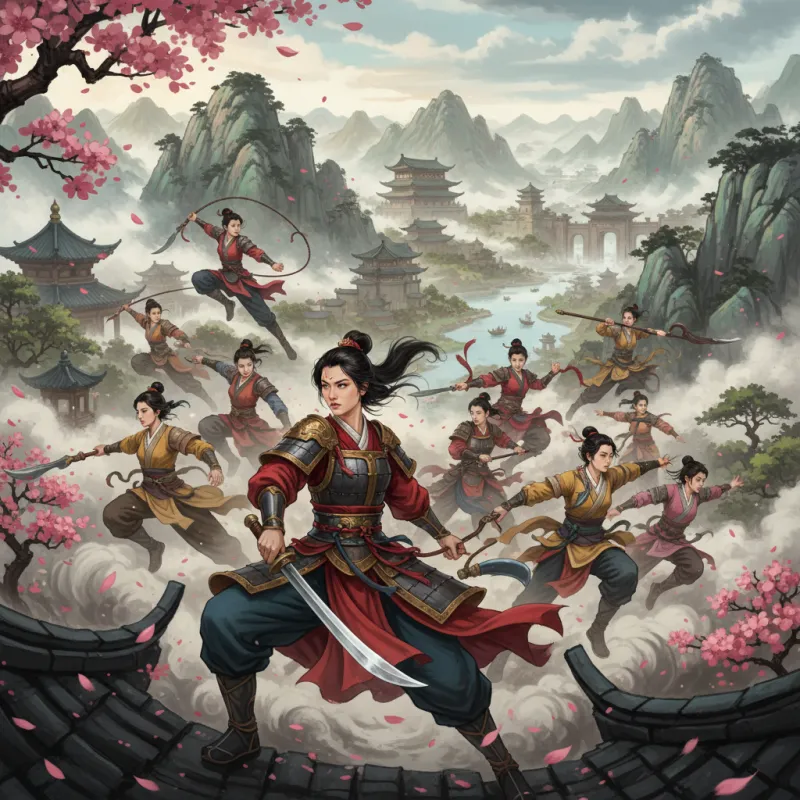
The weaving loom falls silent. A young woman stands, walks to the door, and hears nothing but her own sighs. Not because she's lovesick — the Ballad of Mulan (木兰辞 Mùlán Cí) makes that clear in its opening lines. She's thinking about war, about her aging father's name on the conscription lists, about the choice nobody else in her household can make.
This moment, preserved in a folk poem from the Northern Wei Dynasty (386-534 CE), doesn't describe a martial arts prodigy. Hua Mulan (花木兰 Huā Mùlán) doesn't cultivate qi (气 qì) or master the eighteen weapons. She makes a decision, buys a horse, and rides north. Twelve years later, she comes home, puts on her old clothes, and her comrades realize they've been fighting alongside a woman the entire time.
That's it. That's the story that created the template for every female warrior in wuxia fiction.
What the Ballad Actually Says
The Ballad of Mulan is shockingly spare. No training montages. No mystical masters. No revenge plot. Mulan hears the Khan's call for troops, sees her father's name, notes he has no grown son, and decides. The poem spends more lines on her shopping trip — buying horses in different markets — than on her combat prowess.
When she returns, the Son of Heaven offers her a government position. She declines. She wants to go home. The poem's most famous lines come at the end: "The he-hare's feet go hop and skip, the she-hare's eyes are muddled and fuddled. Two hares running side by side close to the ground, how can they tell if I am he or she?"
This isn't a story about a woman proving she can fight as well as a man. It's about someone who did what needed doing, then went back to her life. The gender reveal isn't triumphant — it's matter-of-fact. Her fellow soldiers are surprised, but the poem doesn't dwell on it. The real point is the question: does it matter?
How Wuxia Transformed Her
By the time wuxia fiction hit its stride in the 20th century, Mulan had been transformed. Not in every version, but in the cultural DNA she passed down. The woman warrior in wuxia novels doesn't just fight competently — she often surpasses men. She doesn't just survive in male spaces — she dominates them. And crucially, she usually has martial arts skills that put her in a different category entirely from ordinary soldiers.
Take Huang Rong (黄蓉 Huáng Róng) from Jin Yong's Legend of the Condor Heroes (射雕英雄传 Shèdiāo Yīngxióng Zhuàn). She's brilliant, beautiful, and deadly with her Dog-Beating Staff technique (打狗棒法 Dǎgǒu Bàngfǎ). Or Ren Yingying (任盈盈 Rèn Yíngyíng) from The Smiling, Proud Wanderer (笑傲江湖 Xiào'ào Jiānghú), who commands the Sun Moon Holy Cult's forces with strategic genius. These women aren't disguising themselves to serve in an army. They're operating openly in the jianghu (江湖 jiānghú), that lawless world of martial artists, and they're forces to be reckoned with.
The transformation makes sense. Wuxia is fantasy. It takes the kernel of "women can fight" and asks: what if they could really fight? What if they had access to the same secret techniques, the same legendary masters, the same cultivation methods as men? The answer, in novel after novel, is that they'd be just as formidable — sometimes more so.
The Sect Structure Changes Everything
Here's what Mulan didn't have: a sect. In wuxia fiction, sects (门派 ménpài) are the great equalizer. A woman trained in Emei Sect (峨眉派 Éméi Pài) techniques isn't asking permission to fight. She's not disguising herself. She's a recognized martial artist with a lineage, a style, and a reputation. The sect gives her legitimacy that Mulan had to steal by wearing her father's armor.
This matters because it shifts the narrative. Mulan's story is about transgression — crossing a boundary she wasn't supposed to cross. The wuxia woman warrior's story is often about inheritance. She learned from her master, same as the men did. She earned her place in the jianghu through skill, not deception. When Guo Xiang (郭襄 Guō Xiāng) founded Emei Sect in Jin Yong's novels, she created an institution that would train women warriors for generations. That's a different kind of legacy than Mulan's solitary choice.
The role of women in martial arts sects deserves its own examination, but the key point is this: sects made the woman warrior a category, not an exception. Once you have multiple women training together, passing down techniques, you're not talking about individual heroism anymore. You're talking about a tradition.
The Romance Problem
Mulan goes home and puts on makeup. The ballad ends there, with no mention of marriage or romance. Wuxia fiction rarely shows such restraint.
Nearly every major female martial artist in wuxia ends up in a romance plot. Sometimes it's central to the story, like Xiaolongnü (小龙女 Xiǎolóngnǚ) and Yang Guo in The Return of the Condor Heroes (神雕侠侣 Shéndiāo Xiálǚ). Sometimes it's secondary, but still present. Even the most formidable women warriors — the ones who could defeat dozens of opponents, who command sects or lead armies — get paired off.
This isn't necessarily a flaw. Romance is part of human experience, and wuxia novels are sprawling epics that cover years or decades of their characters' lives. But it does represent a shift from Mulan's story, where her gender is revealed and then... nothing. No marriage proposal from a fellow soldier. No romantic subplot. She goes home, and the poem ends.
The question is whether the romance plots enhance or diminish these characters. When Huang Rong's brilliance is shown through how she helps Guo Jing, is that partnership or subordination? When Ren Yingying gives up leadership of the Sun Moon Holy Cult for Linghu Chong, is that love or loss? The answers vary by reader, by novel, by character. But the pattern is clear: wuxia took Mulan's solitary return home and asked, "But what about love?"
What Mulan Actually Gave Wuxia
Strip away the romance plots, the sect politics, the mystical martial arts, and here's what remains from Mulan's story: competence without permission.
She didn't ask if women could be soldiers. She became one. She didn't petition for the right to fight. She fought. And when it was over, she didn't demand recognition or reward. She went home. The Ballad of Mulan is radical not because it argues for women's equality, but because it simply shows a woman doing what needs doing and doing it well.
This is the DNA that runs through wuxia's women warriors, even when everything else has changed. They don't typically ask permission. They don't justify their presence in the jianghu. They're there because they're skilled, because they've trained, because they've earned their place through the same trials as the men. The legendary women fighters of wuxia fiction inherit this assumption: that competence is its own justification.
Jin Yong, the most influential wuxia novelist of the 20th century, filled his novels with women who could fight, strategize, lead, and survive in a brutal world. He didn't write origin stories explaining how women gained the right to learn martial arts. They just did. That's Mulan's legacy — not the disguise, not the deception, but the fundamental assumption that women can do this.
The Modern Disconnect
Here's the uncomfortable truth: modern adaptations of Mulan often miss the point entirely. They add romance with a fellow soldier. They give her a phoenix spirit guide or magical powers. They make her journey about self-discovery or finding her true identity. The 2020 Disney live-action film gave her qi powers that she had to hide, turning her story into a metaphor for... something. Authenticity? Being yourself?
The original ballad is simpler and stranger. Mulan doesn't discover her true self. She does a job, does it well, and goes home. Her gender is incidental to her competence. The poem's genius is that it doesn't make a big deal out of this. It just presents it as fact.
Wuxia fiction, for all its fantasy elements, often gets closer to this spirit than modern "realistic" adaptations. When a woman in a Jin Yong novel demonstrates superior martial arts, nobody stops the plot to marvel at it. It's just part of the world. The jianghu has women warriors because of course it does. They're skilled because they trained. They're respected because they're dangerous. It's not a statement — it's just how things are.
Why It Still Matters
We're seventeen centuries past the Northern Wei Dynasty. Mulan, if she existed, is long dust. But her story persists because it asks a question that every generation has to answer: what happens when someone steps outside their assigned role and simply performs?
Wuxia fiction answered by building a world where women warriors aren't anomalies. They're part of the landscape. They have their own techniques, their own sects, their own legends. They're not all disguised as men. They're not all asking permission. They're just there, fighting alongside or against the male heroes, with their own goals and their own stories.
That's not historical accuracy — women in imperial China faced severe restrictions. But it's mythic truth, the kind that shapes how we imagine possibility. Mulan rode to war without asking. Wuxia's women warriors inherited that audacity and built an entire tradition on it. They took her solitary choice and made it a world where such choices are simply part of the landscape.
The weaving loom falls silent. But the story it wove keeps going, thread by thread, through every woman warrior who picks up a sword and doesn't bother explaining why she has the right to hold it.
Related Reading
- Women Warriors in Wuxia: Beyond the Love Interest
- Female Martial Artists in Wuxia Fiction
- Women Warriors in Chinese Martial Arts Fiction: Empowering Jianghu Heroines
- Romance in Wuxia: Love, Duty, and the Tragedy Between
- Hua Mulan and Beyond: Real Women Warriors of China
- The Tang Clan: Masters of Hidden Weapons and Poison
- Wudang Mountain: The Daoist Heart of Internal Martial Arts
- The Three Pure Ones: Supreme Deities of Daoism
Explore Chinese Culture
- Explore Jin Yong's martial arts novels
- Explore cultivation fiction and immortal heroes
- Explore the real history behind wuxia