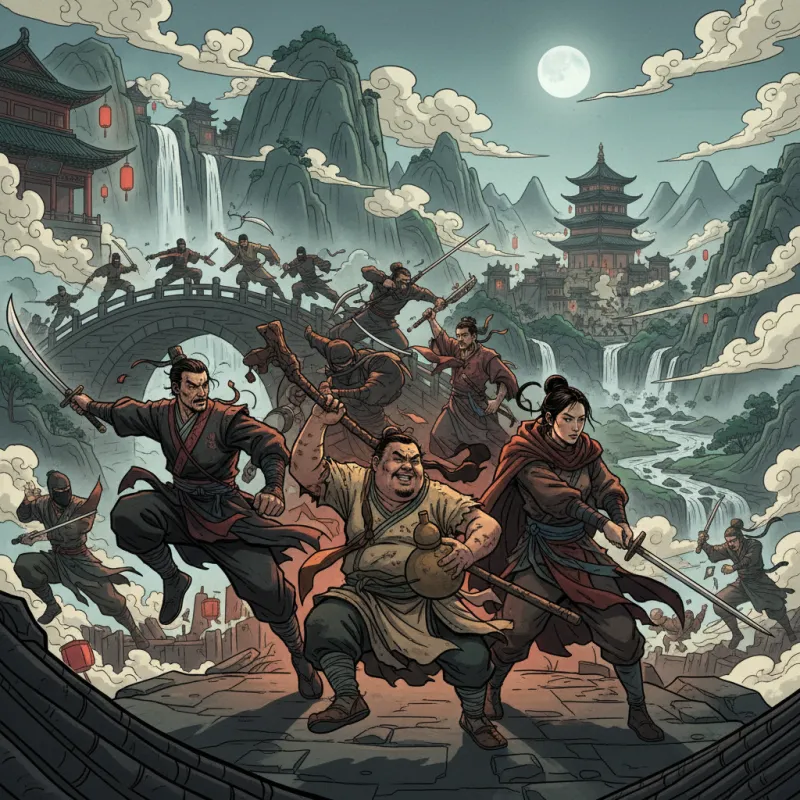
The beggar reeked of wine, his tattered robes stained with yesterday's dinner and this morning's hangover. When the bandits surrounded the village, the elders didn't even bother asking him for help. Yet when the dust settled and eight bodies lay cooling in the dirt, it was this drunk—this nobody—who stood swaying in the town square, wine gourd still dangling from his belt. The villagers never learned his name. He was gone by sunrise, stumbling toward the next tavern, the next fight, the next reason to forget whatever demons chased him.
This is the anti-hero of wuxia (武俠 wǔxiá), and he's far more interesting than the righteous champions we're supposed to admire.
Why Perfect Heroes Are Perfectly Boring
Let's be honest: Guo Jing is exhausting. The protagonist of Jin Yong's Legend of the Condor Heroes (射鵰英雄傳 Shèdiāo Yīngxióng Zhuàn) is loyal, honest, hardworking, and about as morally complex as a fortune cookie. He's the jianghu (江湖 jiānghú) equivalent of eating plain rice for every meal—nutritious, sure, but where's the flavor?
The anti-hero, by contrast, is the Sichuan hotpot of wuxia fiction. Complicated. Messy. Sometimes you're not sure if you're enjoying it or suffering through it, but you can't stop coming back for more.
Jin Yong understood this better than anyone. For every Guo Jing, he gave us a Yang Guo—the orphaned, resentful protagonist of Return of the Condor Heroes who falls in love with his teacher and doesn't care what society thinks. For every Linghu Chong's initial righteousness in Smiling, Proud Wanderer (笑傲江湖 Xiào'ào Jiānghú), we get his gradual disillusionment with orthodox sects and his friendship with literal demons of the martial arts world.
These characters matter because they ask uncomfortable questions: What if the orthodox sects are just as corrupt as the heterodox ones? What if loyalty to a master means betraying your conscience? What if the greatest swordsman in the jianghu is also an alcoholic disaster who can barely remember why he's fighting?
The Drunk Master: When Wine Becomes Wisdom
The drunken martial artist is wuxia's most enduring anti-hero archetype, and it's not just because fight choreographers love the unpredictable movements of Drunken Fist (醉拳 zuìquán). The drunk represents something deeper: the rejection of Confucian self-control in favor of Daoist spontaneity.
Take Linghu Chong from Smiling, Proud Wanderer. After his expulsion from the Huashan Sect (華山派 Huàshān Pài), he doesn't become a brooding avenger. He becomes a wine-soaked wanderer who'd rather drink with outcasts than reclaim his honor. His friendship with the "heretical" musicians of the Heng-Shan Sect and his refusal to play political games make him more heroic than any amount of righteous posturing could.
Or consider Qiao Feng from Demi-Gods and Semi-Devils (天龍八部 Tiānlóng Bābù)—though not primarily a drunk, his tragic arc involves drowning his identity crisis in wine after discovering his Khitan heritage. The alcohol doesn't make him weaker; it makes him human. His drunken rampage through the Juxian Manor, where he fights dozens of martial artists while morally devastated, remains one of Jin Yong's most powerful scenes.
The drunk master archetype tells us that sometimes the only sane response to an insane world is to stop pretending you have it together. In a jianghu obsessed with face (面子 miànzi) and reputation, the drunk who doesn't care what anyone thinks becomes paradoxically free to do what's actually right.
The Reluctant Champion: Heroism as Inconvenience
Some anti-heroes don't reject heroism—they're just really annoyed by it.
Wei Xiaobao from Jin Yong's The Deer and the Cauldron (鹿鼎記 Lùdǐng Jì) is the ultimate reluctant champion. He's a con artist, a womanizer, a shameless liar who can't do martial arts to save his life (literally—he survives through luck and deception). He stumbles into the Qing court, befriends the Kangxi Emperor, infiltrates the Heaven and Earth Society (天地會 Tiāndìhuì), and somehow ends up at the center of every major political event of his era.
Wei Xiaobao never wanted to be a hero. He wanted money, women, and an easy life. Yet his very lack of ideological commitment makes him more effective than the true believers around him. He can see through the hypocrisy of both the Qing court and the anti-Qing rebels because he's not invested in either side's mythology. His "heroism" is accidental, self-serving, and completely authentic.
This archetype resonates because it's honest about human motivation. Most people don't wake up thinking, "Today I shall uphold righteousness!" They wake up thinking about breakfast, rent, and whether that attractive person at the teahouse noticed them. The reluctant champion admits that heroism is often inconvenient, dangerous, and unrewarding—and does it anyway, usually while complaining.
The Rogue with a Code: Selective Morality
Then there's the anti-hero who has principles—just not the ones society approves of.
Tian Boguang, the "Lone Traveler of a Thousand Miles" (獨行千里 dúxíng qiānlǐ) from Smiling, Proud Wanderer, is a rapist and a scoundrel. Yet he keeps his word, respects martial prowess, and has a strange sense of honor within his depravity. Jin Yong doesn't redeem him—after Yilin the nun shows him compassion, he becomes a monk and castrates himself in penance—but he's written with enough complexity that readers remember him decades later.
Or consider Ouyang Feng, the "Western Venom" (西毒 Xīdú) from Legend of the Condor Heroes. He's selfish, cruel, and willing to murder for profit. But his twisted love for his sister-in-law, his grudging respect for worthy opponents, and his eventual madness (where he forgets who he is and becomes almost innocent) make him tragic rather than simply evil. His final appearance in Return of the Condor Heroes, where he dies alone in the desert after a philosophical conversation with the protagonist, is heartbreaking.
These rogues matter because they complicate the jianghu's moral landscape. The orthodox sects love to draw clear lines between righteous (正 zhèng) and evil (邪 xié), but the most memorable characters live in the gray areas. They remind us that having a code—even a twisted one—is different from having no principles at all. The demonic sect members who keep their promises are sometimes more honorable than the orthodox heroes who betray their friends for political gain.
The Cynic Who Cares: Disillusionment as Clarity
The cynical anti-hero has seen through the jianghu's pretensions and decided the whole system is rotten. Yet somehow, they still care.
Li Xunhuan from Gu Long's Sentimental Swordsman, Ruthless Sword (多情劍客無情劍 Duōqíng Jiànkè Wúqíng Jiàn) is the quintessential example. He's a brilliant martial artist who gave up his family inheritance and the woman he loved to his sworn brother, then spent years drinking and carving wooden figurines. He's dying of tuberculosis, coughing blood between fights, and he's so disillusioned with human nature that he barely speaks.
Yet when it matters, Li Xunhuan's "Little Li Flying Dagger" (小李飛刀 Xiǎo Lǐ Fēidāo) never misses. He saves people he doesn't particularly like because it's the right thing to do. He protects the jianghu even though he knows it's full of hypocrites and backstabbers. His cynicism doesn't make him cruel—it makes him clear-eyed about human weakness while still choosing compassion.
Gu Long specialized in these disillusioned heroes. His protagonists drink too much, trust too little, and see through every pretty lie the jianghu tells itself. Yet they fight anyway, not because they believe in the system, but because individual people are worth saving. It's a more mature heroism than the bright-eyed idealism of traditional wuxia protagonists—the heroism of someone who knows how bad things are and chooses to care regardless.
Why Anti-Heroes Endure
The anti-hero's lasting appeal isn't just about being edgy or subversive. It's about emotional honesty.
Traditional wuxia heroes embody Confucian ideals: filial piety, loyalty, righteousness, self-cultivation. These are admirable values, but they're also exhausting to maintain. The anti-hero admits what we all know: that people are complicated, that doing the right thing often sucks, that sometimes you want to tell your shifu (師父 shīfu) to shove his teachings and just live your life.
The anti-hero makes heroism accessible. You don't need to be morally perfect to make a difference. You can be a drunk, a cynic, a screw-up who's made terrible choices—and still, in the moment that counts, do something brave. Maybe even something good.
Jin Yong's later novels increasingly featured anti-heroes because he understood that moral complexity makes for better stories. Gu Long built his entire career on protagonists who were broken, disillusioned, and barely holding it together. Modern wuxia continues this tradition because readers recognize themselves in these flawed champions more than in the untouchable paragons.
The beggar who saved the village probably didn't think of himself as a hero. He was just a drunk who happened to know how to fight and couldn't stand by while innocent people died. He didn't want gratitude, recognition, or a place in the history books. He wanted another drink and to be left alone with his regrets.
That's the anti-hero's gift to wuxia: the reminder that heroism isn't about being perfect. It's about being present when it matters, even if you're a mess. Especially if you're a mess. Because the jianghu doesn't need more saints—it needs people willing to fight despite their flaws, their doubts, their hangovers.
And that's a hero worth reading about.
Related Reading
- Women Warriors of Wuxia: Breaking Boundaries in the Martial World
- Huang Rong: The Smartest Heroine in Chinese Fiction
- The Heroes of Wuxia: What Makes a Xia Different from a Fighter
- Tragic Heroes of Wuxia: When Honor Leads to Destruction
- ** Unraveling the Legends of Jianghu: The Cultural Allure of Wuxia Heroes
- Exploring the Cultural Depth of Wuxia: The Art of Chinese Martial Arts Fiction
- Best Wuxia TV Dramas: A Streaming Guide for International Viewers
- Chinese Mythology in Hollywood: From Mulan to Shang-Chi
Explore Chinese Culture
- Explore Jin Yong's martial arts novels
- Explore cultivation fiction and immortal heroes
- Explore the real history behind wuxia