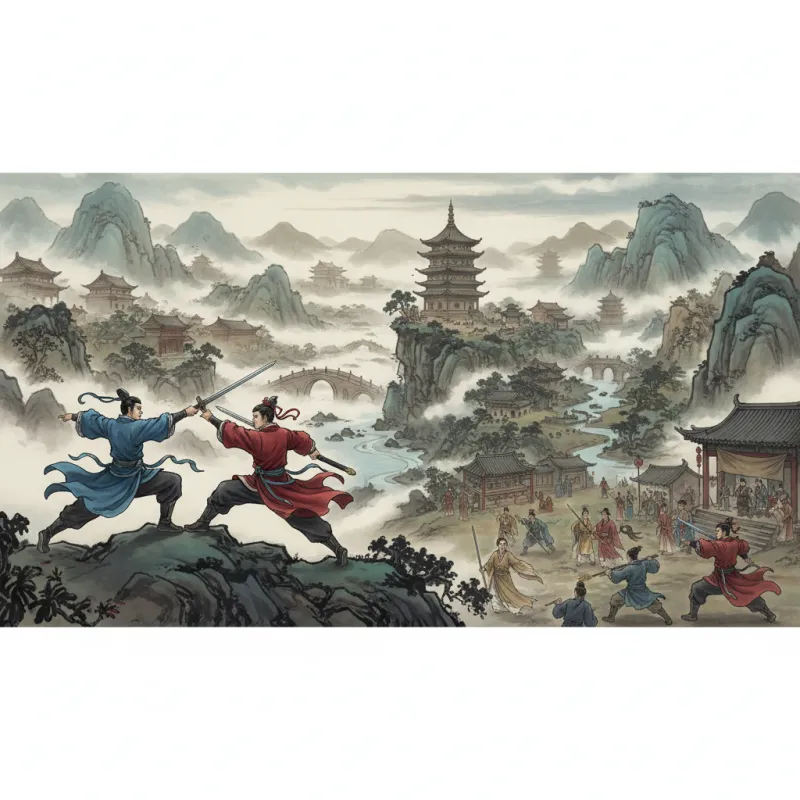
A swordsman named Jing Ke (荆轲, Jīng Kē) walked into the Qin palace in 227 BCE with a dagger hidden inside a rolled map. His mission: assassinate the king who would soon become China's first emperor. He failed, but his attempt became legendary—not because he succeeded, but because he embodied something the Chinese have celebrated for over two millennia: the youxia (游侠, yóuxiá), the wandering knight-errant who lives by a personal code of honor rather than imperial law. This is where wuxia fiction begins. Not in fantasy, but in blood-soaked historical records.
The Youxia: Real Vigilantes in Ancient China
The historian Sima Qian (司马迁, Sīmǎ Qiān) wasn't writing fiction when he devoted an entire chapter of his Records of the Grand Historian (史记, Shǐjì, completed around 94 BCE) to the youxia. These were actual people—assassins, bodyguards, vigilantes—who operated in the shadows of legitimate authority. Sima Qian described them with a mix of admiration and wariness: "Their words were always sincere and trustworthy, their actions always quick and decisive... they would sacrifice themselves to save others from distress."
The Han dynasty government hated them. Why? Because youxia represented an alternative power structure. When local officials were corrupt or ineffective, people turned to these wandering knights for justice. They settled disputes, protected the weak, and occasionally murdered tyrants. They were heroes to commoners and threats to bureaucrats. The tension between state authority and individual righteousness that drives every wuxia novel? It's not invented. It's a conflict that's been playing out in China since the Warring States period (475-221 BCE).
Consider Zhu Hai (朱亥, Zhū Hài), a butcher-turned-warrior who killed a general with a forty-pound iron hammer to help save the state of Zhao. Or Nie Zheng (聂政, Niè Zhèng), who assassinated a prime minister to avenge his father, then mutilated his own face so his family wouldn't be implicated. These stories appear in historical texts, not novels. The line between history and legend was already blurring two thousand years ago.
When Buddhism Brought Martial Arts to the Monasteries
Here's where things get interesting. Around the 5th century CE, an Indian monk named Bodhidharma (菩提达摩, Pútídámó) allegedly arrived at the Shaolin Temple (少林寺, Shàolín Sì) and found the monks too weak to meditate properly. So he taught them exercises that evolved into martial arts. Is this story true? Probably not in the way it's usually told. But it points to a real historical development: Buddhist monasteries became centers of martial training.
Why would monks need to fight? Because temples owned land, stored wealth, and existed in a world without reliable police protection. Bandits were a constant threat. By the Tang dynasty (618-907 CE), Shaolin monks were famous enough that Emperor Taizong supposedly requested their help in military campaigns. Whether they actually fought in battles is debatable, but the reputation was established. The idea of the warrior monk—disciplined, skilled, bound by religious codes—became a permanent fixture in Chinese culture and later in wuxia literature.
The Buddhist influence did something else crucial: it introduced the concept of martial arts as a spiritual practice, not just a killing technique. This philosophical dimension separates wuxia from simple action stories. When Jin Yong's (金庸, Jīn Yōng) characters debate whether martial arts should be used for personal gain or righteous causes, they're continuing arguments that Buddhist and Daoist martial artists were having a thousand years ago.
The Tang Dynasty: When Swordsmen Became Legends
The Tang dynasty was wuxia's golden age—not in fiction, but in reality. This was when the culture of the jianghu (江湖, jiānghú, literally "rivers and lakes," meaning the martial arts underworld) truly crystallized. Tang China was cosmopolitan, wealthy, and relatively lawless outside major cities. Perfect conditions for wandering martial artists.
The Tang also produced the first proto-wuxia literature: chuanqi (传奇, chuánqí) tales, short stories about extraordinary individuals. "The Curly-Bearded Warrior" tells of a mysterious swordsman who helps establish the Tang dynasty, then sails away to found his own kingdom. "The Kunlun Slave" features an African warrior-slave who performs impossible feats of martial prowess. These stories weren't classified as "wuxia" yet—that term wouldn't be coined until the 20th century—but they established the template: skilled fighters, impossible deeds, a world where personal ability matters more than social status.
The Tang government's relationship with martial culture was complicated. They needed skilled fighters for military campaigns and border defense, but they also feared private martial organizations. Sound familiar? It's the same tension that appears in every wuxia novel where the imperial court tries to control or eliminate martial arts sects. The history of martial arts sects reflects this ongoing power struggle between state authority and independent martial communities.
The Song Dynasty: When Outlaws Became Heroes
If you want to understand wuxia's DNA, read Water Margin (水浒传, Shuǐhǔ Zhuàn), written during the Ming dynasty but set in the Song period (960-1279 CE). It's based on real Song dynasty outlaws who rebelled against corrupt officials. The novel's 108 heroes—bandits, monks, former soldiers, even a few women—gather at Liangshan Marsh and create their own society based on loyalty and righteousness rather than Confucian hierarchy.
Water Margin is technically not wuxia—it's more historical fiction—but it established tropes that every wuxia author would use: the band of martial brothers, the corrupt official as villain, the righteous outlaw, the idea that true honor exists outside government structures. When you read about martial arts sects in modern wuxia, you're reading about Liangshan Marsh's descendants.
The Song dynasty also saw the rise of professional storytellers in urban teahouses, spinning tales of martial heroes to paying audiences. These oral traditions kept the stories alive and evolving. Each storyteller added their own embellishments, their own impossible feats. This is how qinggong (轻功, qīnggōng)—the ability to leap great distances and run across water—entered the tradition. Nobody actually did this, but audiences loved it, so it became "real" in the stories.
The Qing Dynasty: When Martial Arts Went Underground
The Qing dynasty (1644-1912) was ruled by Manchus, not Han Chinese, and the new government was paranoid about Han resistance. They banned martial arts organizations, confiscated weapons, and executed anyone suspected of rebellion. So martial arts went underground. Secret societies flourished—the Triads, the White Lotus, the Heaven and Earth Society—all claiming to preserve Han Chinese culture and martial traditions while plotting to overthrow the Qing.
This is the historical reality behind every wuxia novel's secret martial arts manual and hidden sect. These weren't just literary devices. They reflected actual practices. Martial arts techniques were genuinely passed down in secret, often within families or closed organizations. The paranoia about spies and traitors in wuxia fiction? That came from real Qing-era persecution.
The Qing period also produced The Seven Heroes and Five Gallants (七侠五义, Qīxiá Wǔyì), one of the first novels to focus specifically on martial artists and their adventures. It featured Judge Bao, a historical Song dynasty official, solving crimes with the help of various martial heroes. The novel blended history, detective fiction, and martial arts adventure—a combination that would define wuxia for the next century.
The Republic Era: When Wuxia Became Modern
The real explosion of wuxia fiction happened in early 20th century Shanghai. After the Qing dynasty fell in 1912, censorship loosened, literacy rates rose, and commercial publishing boomed. Newspapers serialized martial arts novels to boost circulation. Writers like Xiang Kairan (向恺然, Xiàng Kǎirán, pen name Pingjiang Buxiaosheng) churned out fantastical tales where martial artists could fly, become invisible, and shoot energy from their palms.
This is when wuxia split from historical reality. Earlier stories had exaggerated real martial arts; these new novels invented entirely new powers. Critics called it "butterfly and duck fiction" (鸳鸯蝴蝶派, yuānyāng húdié pài)—pretty but shallow. They weren't entirely wrong, but they missed the point. These novels were wildly popular because they offered Chinese readers something they desperately needed: heroes who could fight back against foreign imperialism, warlord chaos, and social collapse. If China was weak in reality, at least Chinese heroes could be invincible in fiction.
The Communist victory in 1949 killed wuxia in mainland China. The new government considered it feudal superstition and bourgeois escapism. But the genre survived in Hong Kong and Taiwan, where writers like Jin Yong and Gu Long (古龙, Gǔ Lóng) would transform it into serious literature in the 1950s-70s. They pulled wuxia back toward its historical roots—not by removing the fantasy elements, but by grounding them in philosophical depth and historical context.
What's Real and What's Not
So what's actually historical in wuxia fiction? The youxia tradition is real. Martial arts monasteries existed. Secret societies during the Qing were genuine. The jianghu as a concept—a world parallel to official society where different rules apply—reflects actual historical conditions in imperial China.
What's invented? Pretty much all the specific martial arts techniques you see in novels. Qinggong doesn't exist. You can't shoot energy from your palms. Internal energy (内力, nèilì) as depicted in wuxia is fictional, though it's based on real qigong (气功, qìgōng) practices that are far less dramatic. The elaborate sect hierarchies and ancient martial arts manuals are mostly literary inventions, though they're inspired by real martial arts lineages.
But here's the thing: wuxia fiction isn't trying to be historical documentary. It's mythologizing real historical tensions—between individual and state, between justice and law, between Han and foreign rule, between the powerful and the powerless. The fantasy elements aren't bugs; they're features. They let the stories explore these tensions without being constrained by what actually happened.
When you watch a wuxia hero leap across rooftops to fight corrupt officials, you're watching a fantasy. But you're also watching two thousand years of Chinese history compressed into a single image: the youxia who defied the Han dynasty, the monks who defended Shaolin, the outlaws of Liangshan Marsh, the secret societies of the Qing, all rolled into one impossible, magnificent figure. That's not history. But it's not entirely fiction either. It's something in between—and that's exactly where wuxia has always lived.
Related Reading
- Real Chinese Martial Arts Schools That Inspired Wuxia Fiction
- The Origins of Wuxia: From Sima Qian to Jin Yong
- The Real History Behind Wuxia: Knight-Errants of Ancient China
- The Enigmatic World of Jianghu: A Deep Dive into Wuxia Fiction and Kung Fu Novels
- Pangu and the Cosmic Egg: The Chinese Creation Myth
- Lingzhi: The Mushroom of Immortality from Myth to Medicine
- Internal Energy (Neigong): The Hidden Power Behind Every Martial Art
- Unraveling the Mystique of Wuxia: Horror Elements in Chinese Martial Arts Fiction
Explore Chinese Culture
- Explore Jin Yong's martial arts novels
- Explore cultivation fiction and immortal heroes
- Explore the real history behind wuxia