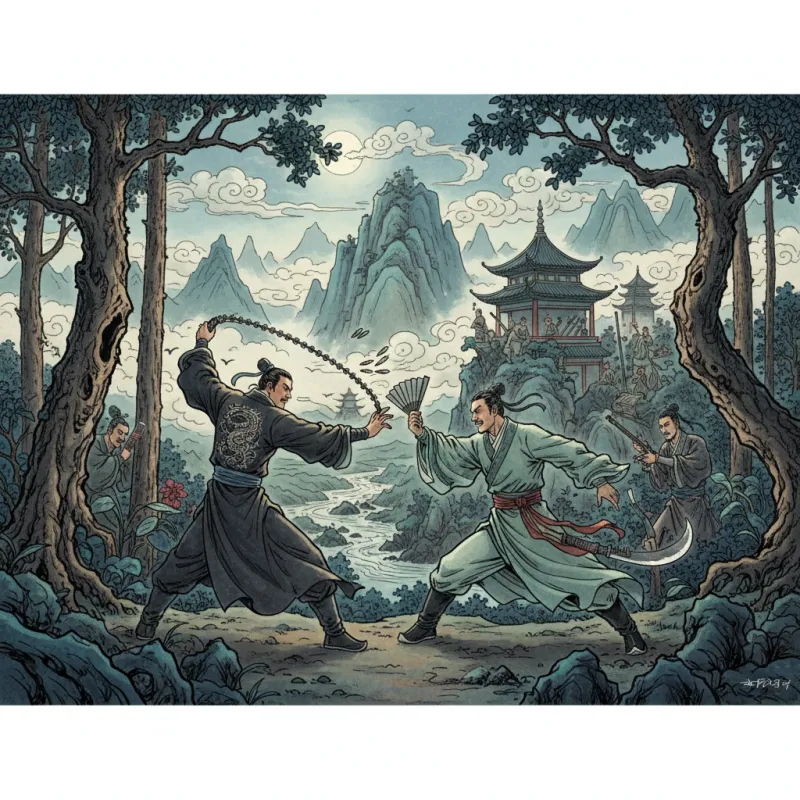
A poisoned needle flies from a sleeve. A throwing knife emerges from a boot heel. A silk rope whips out from beneath a scholar's robe. In the jianghu (江湖, jiānghú) — that lawless world of martial artists and wandering heroes — survival often depends not on the sword at your hip, but on the weapon no one sees coming. While wuxia novels celebrate the elegant swordsman and the righteous staff-wielder, it's the hidden weapons (暗器, ànqì) that reveal the true cunning and moral complexity of jianghu culture.
The Philosophy Behind Concealment
Hidden weapons occupy a fascinating moral gray zone in wuxia literature. Orthodox martial sects like Shaolin and Wudang traditionally viewed them with suspicion — tools of assassins and the dishonorable. Yet even the most righteous heroes carried them. Guo Jing, the famously straightforward protagonist of Jin Yong's The Legend of the Condor Heroes (射雕英雄传), learned to use the "Jade Maiden Heart Sutra" needles despite his preference for direct combat. Why? Because jianghu survival demanded pragmatism over purity.
The Chinese term ànqì literally means "dark weapons" or "secret weapons," and this darkness carries both literal and metaphorical weight. These weapons operated in shadows — hidden in clothing, disguised as everyday objects, or small enough to conceal in a palm. But they also represented the shadow side of martial arts philosophy: the acknowledgment that honor alone won't save you when outnumbered, poisoned, or ambushed at midnight.
The Arsenal of Deception
The variety of hidden weapons in wuxia fiction rivals any modern spy thriller. Gu Long's novels, particularly the Little Li Flying Dagger (小李飞刀) series, elevated throwing weapons to an art form. Li Xunhuan's flying daggers never missed — not because of supernatural power, but through perfect technique and psychological mastery. His weapons were hidden in plain sight, carried openly yet deployed with such speed that opponents died before realizing they'd been attacked.
The Tang Sect (唐门, Tángmén) of Sichuan became wuxia's definitive hidden weapon specialists. In Jin Yong's Demi-Gods and Semi-Devils (天龙八部), Tang Sect disciples wielded an terrifying array: the Rainstorm Pear Blossom Needle (暴雨梨花针, bàoyǔ líhuā zhēn) that fired dozens of poisoned needles simultaneously, the Peacock Plume (孔雀翎, kǒngquè líng) that released a deadly spray of projectiles, and countless poisoned darts, throwing stars, and concealed crossbows. Their reputation was so fearsome that merely announcing "Tang Sect" could end conflicts without bloodshed.
But hidden weapons weren't always exotic. Gu Long's The Eleventh Son features a protagonist whose deadliest weapon is a simple chopstick. Huang Yaoshi in The Legend of the Condor Heroes could kill with flicked pebbles or snapped twigs. This democratization of lethality — the idea that anything becomes dangerous in skilled hands — reflects a deeper jianghu truth: true mastery transcends tools.
Women and the Politics of Hidden Weapons
Female characters in wuxia fiction gravitated toward hidden weapons for reasons both practical and subversive. In a genre where physical strength often determined hierarchy, hidden weapons leveled the battlefield. Poison needles required precision, not muscle. Throwing knives rewarded speed over stamina. These weapons allowed female martial artists to compete with — and often defeat — stronger male opponents.
Consider Huang Rong from Jin Yong's Condor trilogy. Her primary weapons were her intelligence and an arsenal of hidden devices: smoke bombs, poisoned needles, and the ingenious "Hedgehog Chainmail" (软猬甲, ruǎnwèi jiǎ) that turned her clothing into a defensive weapon. She rarely engaged in prolonged sword duels, preferring to outthink and outmaneuver opponents. Her approach embodied a feminine martial philosophy that valued cunning over confrontation.
The Poison Arts in Wuxia tradition particularly attracted female practitioners. The Five Poison Sect (五毒教, Wǔdú Jiào) in various wuxia novels often featured female leaders who commanded respect through their mastery of venoms and antidotes. This wasn't just about combat effectiveness — it represented a form of power that patriarchal martial society couldn't easily dismiss or control.
The Moral Ambiguity of Invisible Violence
What makes hidden weapons so narratively compelling is their moral flexibility. A sword fight happens in the open, witnessed and judged by jianghu society. But a poisoned needle in the dark? That's assassination, not combat. Yet wuxia authors consistently blur this line, forcing readers to question their assumptions about honor and righteousness.
Jin Yong's Wei Xiaobao in The Deer and the Cauldron (鹿鼎记) represents the ultimate hidden weapon philosophy. He possessed minimal martial arts skill but survived through deception, concealed blades, and shameless trickery. Readers loved him precisely because he violated every wuxia convention — he was a scoundrel who won through cunning rather than cultivation. His success challenged the genre's foundational myth that virtue and martial prowess naturally align.
The Assassination Techniques in Jianghu evolved into a sophisticated art precisely because jianghu culture recognized that not all conflicts could be resolved through honorable duels. Sometimes the tyrant was too powerful, the enemy too numerous, or the cause too desperate. Hidden weapons became tools of the pragmatic hero — the one who understood that saving lives sometimes required taking them in ways that wouldn't earn poetic tributes.
The Craft and Cultivation
Creating effective hidden weapons required specialized knowledge that intersected martial arts, metallurgy, toxicology, and engineering. The Tang Sect's multi-generational expertise wasn't just about throwing techniques — it encompassed weapon design, poison formulation, and the mechanical principles behind spring-loaded launchers and concealed triggers.
Gu Long's novels often featured weapon craftsmen as important secondary characters. These artisans occupied a unique jianghu position: respected for their skills but not quite martial artists themselves. The best hidden weapons were custom-made, tailored to the user's fighting style, body type, and preferred tactics. A weapon that worked perfectly for one martial artist might be useless to another.
Training with hidden weapons also differed fundamentally from traditional martial arts. Sword techniques could be practiced openly in courtyards. Hidden weapon mastery required secrecy — not just to maintain tactical advantage, but because many techniques involved poisons or mechanisms that could injure the careless practitioner. The Tang Sect's training grounds were described as deadly labyrinths where students learned through survival rather than instruction.
Hidden Weapons in Modern Adaptations
Contemporary wuxia adaptations — films, television series, and video games — have transformed hidden weapons from subtle tools into spectacular visual effects. Zhang Yimou's Hero (2002) featured CGI-enhanced arrow storms that bore little resemblance to the intimate, precise hidden weapon techniques described in classic novels. While visually stunning, something essential was lost: the psychological tension of not knowing when or where the hidden strike would come.
The best adaptations understand that hidden weapons work through anticipation, not spectacle. The 2001 television series Xiao Shi Yi Lang (萧十一郎) captured this perfectly in scenes where characters' eyes would flick to an opponent's sleeves or hands, calculating distances and trajectories. The weapons themselves appeared only briefly — the drama came from the mental chess game preceding their use.
Video games like Moonlight Blade and Justice Online have gamified hidden weapons into character classes with cooldown timers and damage calculations. This mechanical approach strips away the moral complexity that made hidden weapons interesting in literature. When every player can spam throwing knives without consequence, the weight of choosing invisible violence over open combat disappears.
The Enduring Appeal of Shadows
Hidden weapons persist in wuxia fiction because they represent something fundamental about jianghu culture: the gap between appearance and reality, between reputation and survival, between the martial world's ideals and its brutal truths. Every hero who conceals a needle in their sleeve acknowledges that righteousness alone won't protect the innocent or punish the wicked.
The greatest wuxia authors understood this tension. They created characters who struggled with the decision to use hidden weapons, who felt the moral weight of striking from concealment, who questioned whether winning through deception diminished their victories. These internal conflicts made hidden weapons more than plot devices — they became mirrors reflecting the compromises required to navigate jianghu's treacherous waters.
In the end, hidden weapons reveal what wuxia has always known: that the most dangerous weapon isn't the one you can see, but the one you never suspected was there. Just like the jianghu itself — a world that appears romantic and heroic on the surface, but conceals depths of complexity, danger, and moral ambiguity that only the wise survive. The needle in the sleeve, the poison in the wine, the knife in the smile — these are the true weapons of jianghu, and they've been there all along, waiting in the shadows where honor and necessity meet.
Related Reading
- Throwing Knives, Needles, and Darts: The Hidden Weapon Arsenal
- The Tang Clan: Masters of Hidden Weapons and Poison
- Poison Needles and Flying Daggers: Hidden Weapons in Wuxia Combat
- The Concealed Weapon Arsenal: Every Hidden Weapon in the Jianghu
- Hidden Weapons in Wuxia: The Deadly Art of Surprise
- Wire-Fu: The Art of Flying Swordsmen in Action Cinema
- External vs. Internal Martial Arts: The Great Divide in Wuxia
- The Enigmatic World of Shapeshifters in Wuxia Fiction: Unveiling Jianghu Adventures
Explore Chinese Culture
- Explore Jin Yong's martial arts novels
- Explore cultivation fiction and immortal heroes
- Explore the real history behind wuxia