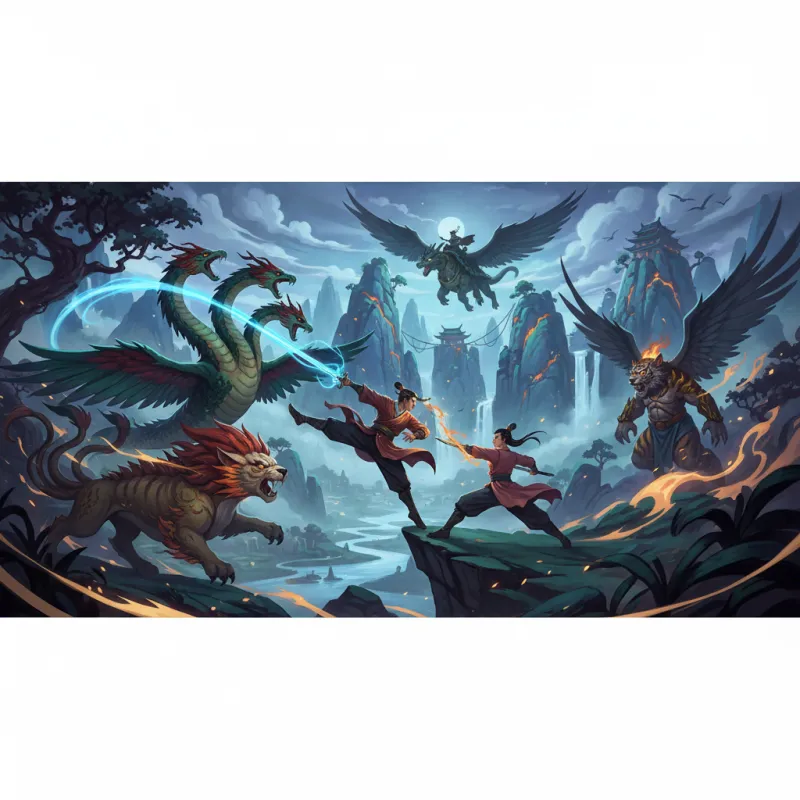
The first time you fight a Bifang (毕方 Bìfāng) in a video game, you might not realize you're facing a creature that terrified ancient Chinese travelers for millennia. This one-legged fire bird, documented in the Shanhaijing (山海经 Shānhǎi Jīng, Classic of Mountains and Seas) around 300 BCE, appears in everything from indie roguelikes to AAA blockbusters. But here's what most players miss: the Shanhaijing wasn't just an ancient bestiary—it was the world's first game design document, complete with creature stats, loot tables, and zone-specific spawns.
The Original Monster Manual
The Shanhaijing reads like a dungeon master's notebook. Each entry follows a rigid format: creature name, physical description, habitat coordinates, special abilities, and effects on humans who encounter it. The Zhuyin (烛阴 Zhúyīn), a thousand-li-long dragon with a human face, doesn't just exist—it controls day and night by opening and closing its eyes. Kill a Lushu (驴鼠 Lǘshǔ) and eat its meat, and you'll become immune to tumors. Wear the hide of a Qiongqi (穷奇 Qióngqí), and you'll gain protection against weapons.
This isn't mythology in the traditional sense. It's a systematic catalog of interactive game elements. The text even organizes creatures by geographical regions—the Classic of Southern Mountains, the Classic of Western Mountains—exactly like modern open-world games divide their maps into biomes with region-specific enemy types. Ancient readers used the Shanhaijing as a survival guide for traversing unknown territories. Modern players use it the same way, except now those territories are rendered in Unreal Engine 5.
Black Myth: Wukong and the Global Awakening
When Black Myth: Wukong (黑神话:悟空 Hēi Shénhuà: Wùkōng) launched in 2024, it shattered every expectation for Chinese mythology games. Game Science's action RPG sold over 10 million copies in three days, proving that Western audiences were hungry for authentic Chinese mythological content. But while the game draws primarily from Journey to the West, its creature design philosophy comes straight from the Shanhaijing playbook.
The game's Yaoguai (妖怪 yāoguài, demons) aren't just boss fights—they're ecological entities with specific habitats, behaviors, and transformation abilities. The developers understood something crucial: Shanhaijing creatures aren't random monsters. They're manifestations of natural forces, geographical anomalies, and cosmic imbalances. A Shanhaijing creature appears because something in the world is wrong, not because the player needs a level-appropriate challenge.
This authenticity resonated globally. Players who'd never heard of the Shanhaijing were suddenly discussing the difference between a Taotie (饕餮 Tāotiè) and a Qilin (麒麟 Qílín). The game didn't just adapt Chinese mythology—it taught players how to read it like the ancient Chinese did, as a functional system rather than decorative folklore.
From Indie Experiments to AAA Spectacles
Before Black Myth's breakthrough, Shanhaijing creatures appeared in dozens of games, though often unrecognized by Western players. Okami (2006) featured the Kyūbi no Kitsune, the Japanese adaptation of the nine-tailed fox (九尾狐 Jiǔwěihú) first documented in the Shanhaijing's Classic of Overseas East. Pokémon has been mining Shanhaijing designs since Generation I—Ninetales, Suicune, and Entei all trace their lineage back to specific Shanhaijing entries.
Chinese developers have been more explicit. Honor of Kings (王者荣耀 Wángzhě Róngyào), China's most popular MOBA, features playable characters based on Shanhaijing creatures like the Xuanwu (玄武 Xuánwǔ, Black Tortoise) and Baihu (白虎 Báihǔ, White Tiger). The game treats these creatures as legendary figures from Chinese martial arts tradition, giving them backstories that blend mythology with contemporary character design.
But the most faithful adaptation might be Tale of Immortal (鬼谷八荒 Guǐgǔ Bāhuāng), a cultivation simulator that treats Shanhaijing creatures as actual game mechanics. Players can capture creatures, extract their essences, and incorporate their abilities into cultivation techniques. It's the closest any game has come to implementing the Shanhaijing's original function: a practical guide to supernatural resource management.
Why These Creatures Work in Games
Shanhaijing creatures translate perfectly to video games because they were designed with game logic from the start. Consider the Feiyi (飞鱼 Fēiyú), a fish with six legs that appears in the Classic of Northern Mountains. The text specifies that eating its flesh prevents nightmares. That's not poetic symbolism—it's a consumable item with a specific status effect.
Or take the Zouwu (騶虞 Zōuwú), a white tiger with black markings that appears wherever a wise ruler governs justly. In game terms, that's a rare spawn triggered by specific player actions or world states. The Fantastic Beasts film series borrowed this creature for its 2018 sequel, but the games got there first. Monster Hunter World's Kirin, a lightning-powered unicorn that only appears under specific weather conditions, follows the exact same design philosophy.
The Shanhaijing's genius lies in its systematic approach to the supernatural. Every creature has clear rules. The Qinyuan (钦原 Qīnyuán), a giant bird that brings drought wherever it appears, isn't just a flying enemy—it's a weather system with wings. Modern games like Genshin Impact understand this, creating elemental creatures that interact with environmental mechanics rather than just dealing damage.
The Taotie Problem: When Translation Fails
Not every Shanhaijing adaptation succeeds. The Taotie (饕餮 Tāotiè), one of the most iconic creatures from the text, has been badly misunderstood in Western games. The Shanhaijing describes it as a creature with a sheep's body, human face, eyes under its armpits, tiger's teeth, and human hands. It represents insatiable greed—it tries to eat everything and eventually devours itself.
But Western games often reduce the Taotie to a generic "gluttony demon" or decorative motif. The 2016 film The Great Wall turned it into a swarm of generic CGI monsters, missing entirely the creature's symbolic function. The Taotie isn't supposed to be defeated in combat—it's a cautionary tale about self-destructive desire. Games that treat it as just another boss fight fundamentally misunderstand the source material.
Chinese developers handle this better. In Immortal Taoists, the Taotie appears as a cultivation deviation—a state players enter when they pursue power too greedily, causing their character to consume their own spiritual energy. That's the correct interpretation: the Taotie isn't an external enemy but an internal corruption.
The Future: Beyond Surface-Level Adaptation
The next generation of Shanhaijing-inspired games needs to go deeper than creature design. The text isn't just a monster catalog—it's a geographical and cosmological system. The creatures exist in relationship to mountains, rivers, minerals, and plants. They're part of an ecosystem, not a random encounter table.
Imagine an open-world game that implements the full Shanhaijing system: creatures that appear based on terrain features, weather patterns, and player actions. A game where the Bifang only spawns near bamboo forests during droughts, exactly as the text specifies. Where encountering a Qilin signals that the player has achieved moral balance in their playthrough, not just reached level 50.
Some developers are moving in this direction. The upcoming Where Winds Meet (代号致金庸 Dàihào Zhì Jīnyōng) promises a living wuxia world where mythological creatures interact with martial arts traditions in systematic ways. If it delivers, it could finally show Western audiences what Chinese players have known for years: the Shanhaijing isn't ancient history. It's a design document that's still ahead of its time.
Playing With Ancient Eyes
The strangest thing about Shanhaijing creatures in modern games is how natural they feel. A Western player fighting a Nian (年兽 Niánshòu) in a Chinese New Year event doesn't need a mythology degree to understand the mechanics: it's a seasonal boss that's weak to fire and loud noises. The game teaches the mythology through gameplay, exactly as the original text intended.
This is why Shanhaijing adaptations succeed where other mythology games struggle. Greek and Norse mythology games often feel like history lessons with combat. But Shanhaijing games feel like games because the source material was always interactive. The ancient Chinese didn't just tell stories about these creatures—they provided actionable intelligence for dealing with them.
Every time you check a boss's elemental weakness, read a bestiary entry for loot information, or hunt a rare spawn in a specific biome, you're following a tradition that started with the Shanhaijing. The text taught us that monsters aren't just obstacles—they're systems to learn, resources to harvest, and puzzles to solve. Two thousand years later, we're still playing by its rules.
Related Reading
- Exploring the Evolution of Wuxia: Modern Influences on Chinese Martial Arts Fiction
- Chinese Mythology in Hollywood: From Mulan to Shang-Chi
- Shanhai Jing in Modern Art: Contemporary Illustrations of Ancient Beasts
- The Poison Arts: Wuxia Fiction's Most Feared Discipline
- The Tang Clan: Masters of Hidden Weapons and Poison
- Romance in Wuxia: Love, Duty, and the Tragedy Between
Explore Chinese Culture
- Explore Jin Yong's martial arts novels
- Explore cultivation fiction and immortal heroes
- Explore the real history behind wuxia