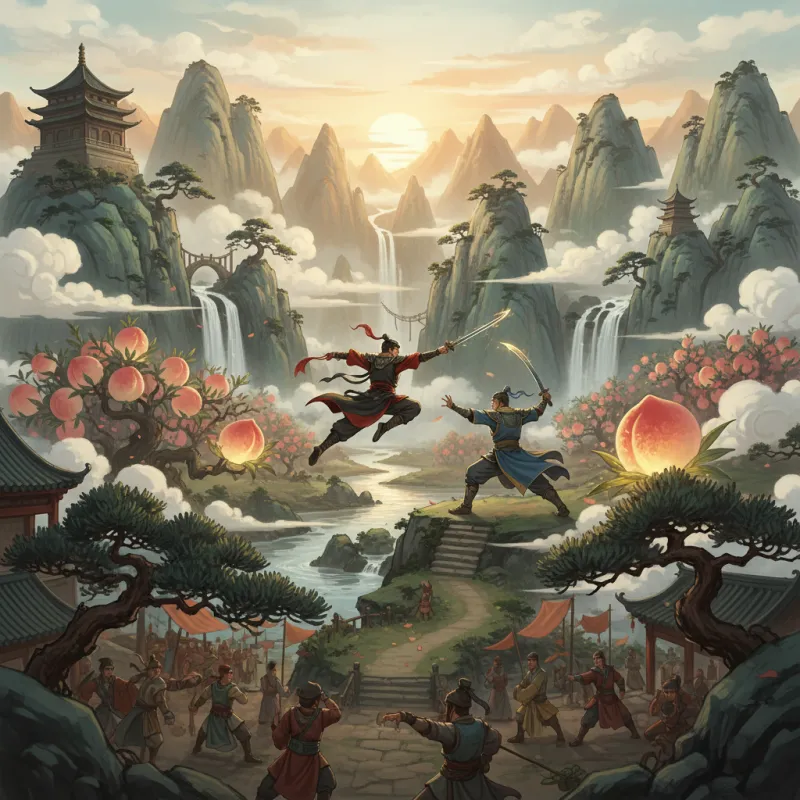
The Monkey King stood in the celestial orchard, juice dripping from his chin, surrounded by half-eaten peaches and the shattered remains of immortality itself. Sun Wukong (孙悟空 Sūn Wùkōng) had just committed the most audacious theft in Chinese mythology — not stealing one Peach of Immortality (蟠桃 pántáo), but devouring entire trees worth of them in a single afternoon. The Queen Mother of the West's (西王母 Xīwángmǔ) three-thousand-year harvest, gone. Heaven's carefully maintained hierarchy of immortality, demolished by a monkey with an appetite.
This is the fruit that makes ginseng look like a vitamin supplement and renders the Lingzhi mushroom a mere appetizer in the quest for eternal life.
The Three-Tiered System of Cosmic Agriculture
The Peach Garden atop Kunlun Mountain (昆仑山 Kūnlún Shān) operates on a timeline that makes human agriculture look frantic. This isn't a garden — it's a carefully calibrated system of immortality distribution, and the Queen Mother guards it more jealously than any emperor ever guarded his throne.
The front grove contains 1,200 trees that bloom once every three thousand years. Eat one of these peaches and you gain spiritual awareness, a lightness in your bones, and the ability to live for several centuries beyond your natural span. These are the "entry-level" immortality fruits, if such a term can apply to something that takes three millennia to ripen.
The middle section holds another 1,200 trees on a six-thousand-year cycle. These peaches grant true immortality — not just extended life, but the cessation of aging itself. Your hair stops graying. Your joints stop aching. Time becomes something that happens to other people.
The back rows, the inner sanctum of 1,200 trees, fruit once every nine thousand years. Eating these peaches makes you equal to Heaven and Earth in longevity. You become, in essence, a cosmic constant. The Daoist immortals (仙人 xiānrén) who attend the Queen Mother's legendary Peach Banquet (蟠桃会 Pántáo Huì) spend millennia positioning themselves for an invitation to taste these.
The Banquet That Launched a Rebellion
Every time the back-row peaches ripen — once every nine thousand years — the Queen Mother hosts the Peach Banquet, and the guest list reads like a who's-who of Chinese celestial bureaucracy. The Jade Emperor (玉皇大帝 Yùhuáng Dàdì) attends. The Eight Immortals show up. Every deity with sufficient rank receives a golden invitation.
Sun Wukong did not receive an invitation.
This oversight — whether deliberate snub or bureaucratic error — triggered the havoc in Heaven that defines the early chapters of Journey to the West. The Monkey King, appointed as the nominal "Guardian of the Peach Garden" (a title meant to keep him busy and out of trouble), discovered he wasn't invited to the very banquet he was supposedly protecting. His response was characteristically direct: he ate the peaches himself, drank the immortality wine, consumed Laozi's (老子 Lǎozǐ) pills of immortality for good measure, and became so thoroughly immortal that Heaven's executioners couldn't kill him even when they tried.
The text specifies he ate peaches from all three groves. This wasn't gluttony — it was a systematic dismantling of Heaven's power structure, one bite at a time.
The Botanical Impossibility
Real peaches (Prunus persica) originated in China, cultivated for over four thousand years in the Yellow River valley. They're delicious, nutritious, and rot within a week of picking. The mythological pántáo inverts every characteristic of its earthly cousin.
Where normal peaches are soft, the immortality peaches are described in some texts as having jade-like flesh. Where normal peaches spoil quickly, these preserve their potency across millennia. The trees themselves are said to have bark like dragon scales and leaves that shimmer with an inner light. Some versions claim the blossoms smell like sandalwood and cinnamon mixed with something indefinable — the scent of time itself, perhaps.
The Ming Dynasty novel Investiture of the Gods (封神演义 Fēngshén Yǎnyì) mentions that even the fallen leaves from these trees can extend life if brewed into tea, though this is considered wasteful when the actual fruit exists.
The Queen Mother's Monopoly
The Queen Mother of the West controls the only source of these peaches, which makes her arguably more powerful than the Jade Emperor himself. He may rule Heaven's bureaucracy, but she controls the mechanism that keeps that bureaucracy immortal. It's a monopoly that would make any earthly emperor envious.
Her garden sits atop Kunlun Mountain, the axis mundi of Chinese cosmology, surrounded by walls of flame and guarded by creatures that make dragons look domesticated. The location isn't arbitrary — Kunlun is where Heaven touches Earth, where the cosmic qi (气 qì) flows most purely. Only in such a place could fruits of immortality grow.
Historical texts like the Classic of Mountains and Seas (山海经 Shānhǎi Jīng), compiled during the Warring States period, describe the Queen Mother as a fearsome figure with tiger teeth and a leopard's tail, presiding over disasters and punishments. By the Han Dynasty, she'd transformed into the elegant hostess of the Peach Banquet, but her control over life and death remained absolute.
Immortality's Hierarchy
Not all immortals are created equal, and the peaches reflect this. The three-tier system isn't just about potency — it's about Heaven's social structure made edible.
Lower-ranking immortals might wait eighteen thousand years for a chance at a front-grove peach. Mid-tier deities could expect a middle-grove fruit every twelve thousand years or so. Only the highest echelon — the Jade Emperor, Laozi, the Buddha himself when he attends — receive the nine-thousand-year peaches.
Sun Wukong's crime wasn't just theft. It was the complete disruption of this hierarchy. By eating peaches from all three groves, he'd consumed immortality meant for dozens of deities across multiple cosmic cycles. He'd eaten the equivalent of Heaven's entire social security system.
The Peach in Popular Culture
The pántáo appears everywhere in Chinese culture, from birthday celebrations (where peach-shaped buns symbolize longevity) to the decorative arts. The character for longevity (寿 shòu) is often depicted emerging from a peach. Elderly relatives receive peach-themed gifts on their birthdays — a wish that they might taste, metaphorically, what the immortals taste literally.
In wuxia fiction, the peach becomes a plot device of infinite flexibility. A martial artist might discover a single peach tree descended from the Queen Mother's garden, its fruit granting decades of internal cultivation in a single night. Or a villain might seek the legendary garden itself, believing immortality will make them invincible (it never ends well).
The 1986 television adaptation of Journey to the West cemented the visual image of the peaches for modern audiences: luminous pink fruits the size of a child's head, glowing with an inner light. Every subsequent adaptation has borrowed this imagery.
The Paradox of Immortal Fruit
Here's what the myths rarely address: if the peaches grant immortality, why do the immortals need to keep eating them? The texts suggest that immortality, once gained, is permanent — Sun Wukong certainly never needs another peach after his rampage. Yet the Peach Banquet continues every nine thousand years, suggesting that even immortals need periodic renewal.
Perhaps immortality comes in degrees. Perhaps the peaches don't grant eternal life so much as push death so far into the future that it becomes irrelevant. Or perhaps the banquet serves a different purpose entirely — not sustenance, but social cohesion, a reminder that even in Heaven, some beings control resources others desperately need.
The Monkey King's solution was characteristically direct: become so immortal through so many methods that the question becomes moot. Five or six layers of immortality, he figured, ought to be enough. He ate the peaches, drank the wine, consumed the pills, achieved enlightenment through Buddhist practice, and had his name erased from the Register of Death for good measure.
Overkill? Perhaps. But he's still around, and the peaches ripen on their nine-thousand-year schedule, waiting for the next banquet, the next slight, the next monkey with an appetite for the impossible.
Related Reading
- Lingzhi: The Mushroom of Immortality from Myth to Medicine
- The Bizarre Plants of the Shanhaijing: Trees That Cure Death and Fruits That Grant Flight
- Magical Plants of the Shanhai Jing: Trees That Grant Immortality
- Mythical Plants of the Shanhaijing: Trees That Grant Immortality and Flowers That Kill
- Unraveling the Mystique of Wuxia: A Dive into Jianghu Culture and Kung Fu Novels
- The Best Chinese Horror Films: A Genre Guide
- Wuxia Training Montages: How Heroes Are Made
- Pangu and the Cosmic Egg: The Chinese Creation Myth
Explore Chinese Culture
- Explore Jin Yong's martial arts novels
- Explore cultivation fiction and immortal heroes
- Explore the real history behind wuxia