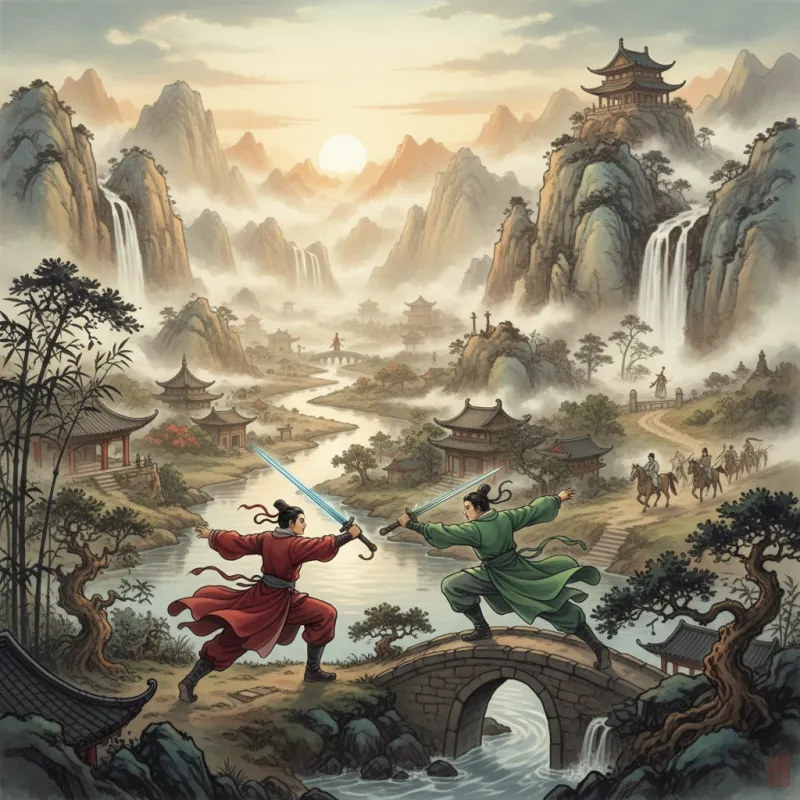
A swordsman stands at the edge of a cliff, his white robes whipping in the mountain wind. Below him, the jianghu (江湖, jiānghú) — that lawless realm of rivers and lakes where martial artists settle scores beyond the reach of imperial authority — stretches endlessly. He leaps, and for a moment, gravity itself seems negotiable. This is wuxia, and if you've never experienced it, you're missing one of humanity's most enduring fantasies about what it means to be free, skilled, and morally uncompromising in a corrupt world.
What Makes Wuxia Different From Every Other Martial Arts Genre
Let's be clear: wuxia isn't just "Chinese martial arts stories." That's like calling jazz "music with trumpets." The genre operates on a specific set of assumptions that separate it from everything else. First, martial artists in wuxia possess qinggong (轻功, qīnggōng) — the ability to move with supernatural lightness, running across water or leaping onto rooftops. Second, they cultivate neigong (内功, nèigōng), internal energy that can heal wounds, extend life, or kill with a touch. Third, and most importantly, they exist in the jianghu, a parallel society with its own codes, hierarchies, and justice system that operates completely outside Confucian bureaucracy.
This isn't historical fiction. Jin Yong's The Legend of the Condor Heroes (1957) takes place during the Song Dynasty, but Guo Jing can jump over buildings and Yang Kang's mother practices techniques that let her stay young for decades. Gu Long's The Eleventh Son (1975) features a protagonist who can draw his sword faster than the eye can follow. These aren't exaggerations for effect — they're the baseline reality of the genre. If you're looking for realistic martial arts, you want historical drama, not wuxia.
The Four Pillars That Hold Up Every Great Wuxia Novel
After reading dozens of these novels, I've noticed they all rest on four essential elements. First: the martial arts manual. Whether it's the Nine Yang Manual in Jin Yong's work or the Sunflower Manual that requires self-castration to master, these texts represent forbidden knowledge that everyone wants and no one should have. They're MacGuffins, sure, but they're also metaphors for the dangerous allure of power itself.
Second: the shifu-tudi relationship (师父-徒弟, shīfù-túdì), the bond between master and disciple. This isn't like Western mentorship — it's closer to parent-child, with similar obligations of loyalty and filial piety. When Linghu Chong in The Smiling, Proud Wanderer (1967) gets expelled by his master Yue Buqun, it's not just losing a teacher; it's being orphaned. The emotional weight of these relationships drives half the plot twists in the genre.
Third: the wulin (武林, wǔlín), the martial arts community itself, with its sects, alliances, and blood feuds that span generations. The major martial arts sects function like nations within nations, each with distinct philosophies and techniques. Shaolin emphasizes Buddhist compassion and external hard styles. Wudang follows Daoist principles and internal soft styles. The Beggars' Sect, despite its name, is often the most righteous organization in the jianghu.
Fourth: the concept of xia (侠, xiá) — the chivalrous ideal that defines what a martial hero should be. It's not enough to be skilled; you must use that skill to protect the weak, right wrongs, and maintain yi (义, yì), righteousness or loyalty. This is why the greatest wuxia protagonists often start as underdogs or outcasts. Their journey isn't just about gaining power; it's about learning when and how to use it morally.
How Jin Yong Changed Everything (And Why Gu Long Matters Too)
Before Jin Yong (Louis Cha), wuxia existed. After Jin Yong, wuxia meant something different. His fifteen novels, written between 1955 and 1972, established the modern template. He took the genre's pulp roots — serialized newspaper stories with cliffhanger chapters — and infused them with literary sophistication, historical detail, and psychological depth. His characters debate philosophy, struggle with moral ambiguity, and grow over decades of narrative time.
Take Demi-Gods and Semi-Devils (1963). It's set during the Song Dynasty's conflict with the Liao and Western Xia kingdoms, but Jin Yong uses this historical backdrop to explore questions about identity, fate, and whether violence can ever truly solve problems. The protagonist Xiao Feng discovers he's ethnically Khitan, not Han Chinese, and spends the novel torn between two peoples who both claim him and both reject him. That's not typical pulp fiction.
But Jin Yong isn't the whole story. Gu Long, writing in the 1960s and 70s, took wuxia in a completely different direction — more noir, more psychological, more interested in loneliness and existential dread. His prose is sparse where Jin Yong's is elaborate. His fights are quick and brutal, not the extended choreographed sequences Jin Yong loved. Li Xunhuan in Sentimental Swordsman, Ruthless Sword (1969) is an alcoholic who gave up the woman he loved to his sworn brother and now wanders the jianghu throwing his Little Li Flying Dagger with perfect accuracy while dying inside. That's a different kind of hero entirely.
The Jianghu's Unwritten Rules (And Why Breaking Them Matters)
The jianghu operates on codes that everyone understands but no one wrote down. If someone saves your life, you owe them a debt that might take years to repay. If you kill someone's master, their disciples will hunt you forever. If you challenge someone to a duel and they accept, backing out means losing face so completely you might as well leave the martial arts world entirely.
These rules create the genre's dramatic tension. In The Heaven Sword and Dragon Saber (1961), Zhang Wuji becomes leader of the Ming Cult but refuses to take revenge on the six major sects who killed his parents, because he understands that the cycle of vengeance will never end otherwise. His choice to break with jianghu tradition — to forgive rather than retaliate — is more shocking than any fight scene.
The concept of mianzi (面子, miànzi), face or reputation, governs everything. A martial artist's reputation is their currency in the jianghu. This is why so many plots revolve around false accusations, mistaken identities, and the desperate need to clear one's name. It's also why the greatest villains are often those who've mastered the art of manipulation — they destroy reputations, turn allies against each other, and win without drawing their swords.
Why Wuxia's Internal Energy System Is Secretly Brilliant
Western fantasy has magic systems. Wuxia has neigong, and it's more interesting because it's theoretically achievable. The idea that you could sit in meditation, circulate qi (气, qì) through your meridians, and gradually develop superhuman abilities — that's based on actual Daoist and Buddhist practices, just taken to fantastical extremes.
This creates a different relationship between reader and text. When Gandalf casts a spell, you know you'll never do that. When Guo Jing spends years practicing the Eighteen Dragon-Subduing Palms, there's a tiny part of you that thinks, "Maybe if I trained hard enough..." The internal energy cultivation methods in wuxia blur the line between fantasy and aspiration in a way Western magic rarely does.
The best wuxia novels use internal energy as character development. In The Book and the Sword (1955), Chen Jialuo's martial arts progress mirrors his moral and emotional growth. When he finally masters the highest levels of his sect's techniques, it's not just because he practiced hard — it's because he's resolved his internal conflicts and achieved a kind of spiritual clarity. Power and wisdom become inseparable.
Where Wuxia Lives Today (And Why It Still Matters)
The golden age of wuxia novels was the 1950s through 1980s, but the genre never died — it evolved. Modern web novels like Coiling Dragon and I Shall Seal the Heavens take wuxia's cultivation systems and push them to cosmic scales, creating the xianxia (仙侠, xiānxiá) subgenre where martial artists can eventually become immortals or gods. These stories trade some of wuxia's grounded humanity for pure power fantasy, but they're still asking the same questions about what you'd do with ultimate strength.
Meanwhile, wuxia's influence spread globally. The Matrix's wire-fu action sequences? That's wuxia filtered through Hong Kong cinema. Star Wars' Jedi training? That's the shifu-tudi relationship in space. Every time a Western story features a chosen one who must master ancient techniques to defeat evil, that's wuxia's DNA expressing itself.
But the core appeal remains unchanged: wuxia offers a world where skill matters more than birth, where loyalty and righteousness can triumph over corruption, and where individuals can achieve something approaching transcendence through discipline and moral clarity. In an age of systemic problems and institutional failures, the fantasy of the wandering hero who can actually make a difference — one sword stroke, one act of righteousness at a time — still resonates.
The jianghu is always there, waiting at the edge of the ordinary world. All you have to do is step into it, and suddenly gravity becomes optional, justice becomes possible, and your life becomes a story worth telling. That's the promise wuxia makes, and after centuries, readers still believe it.
Related Reading
- Acupoint Striking (Dianxue): The Deadly Art of Pressure Points
- Wudang vs Shaolin: Two Philosophies of Combat
- External vs. Internal Martial Arts: The Great Divide in Wuxia
- The Greatest Palm Techniques in Wuxia Fiction, Ranked
- Martial Arts Systems in Wuxia: Internal vs External, Orthodox vs Unorthodox
- Celestial Masters and Heavenly Generals: Daoism's Divine Warriors
- The Tang Clan: Masters of Hidden Weapons and Poison
- Sects and Clans in Wuxia: The Organizations That Rule the Martial World
Explore Chinese Culture
- Explore Jin Yong's martial arts novels
- Explore cultivation fiction and immortal heroes
- Explore the real history behind wuxia