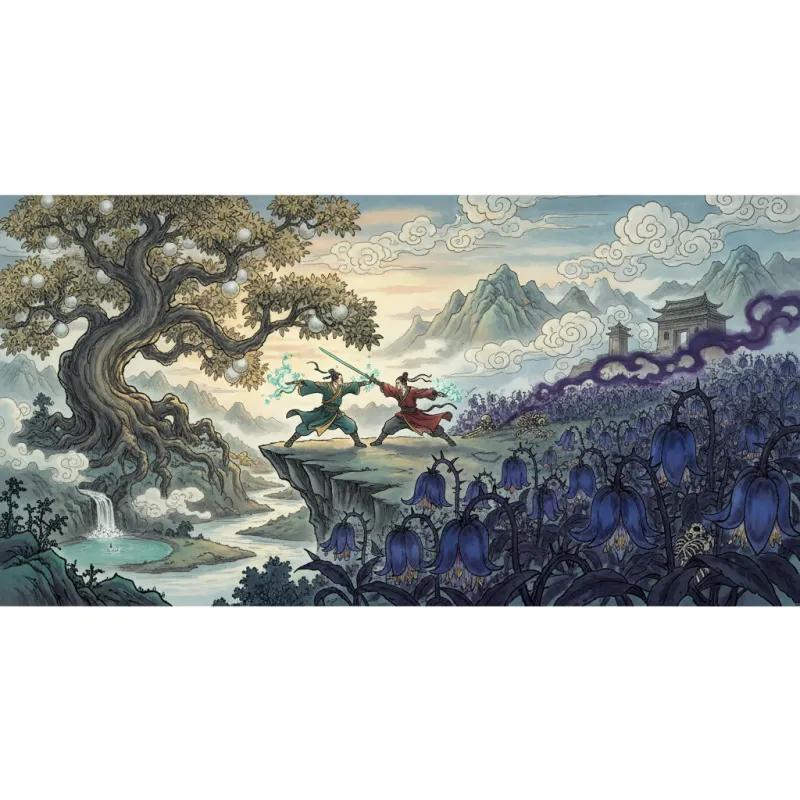
The scholar who first translated the Shanhaijing into English in 1892 wrote in his notes that he suspected the botanical sections were "fever dreams or deliberate fabrications." He was half right. The plants described in this ancient text — trees bearing fruits that grant ten thousand years of life, flowers whose scent kills at fifty paces — sound impossible. But they weren't meant to be botanical fact. They were a catalog of power itself, rendered in leaves and roots and blossoms. And in the world of Chinese mythology, power always comes in pairs: creation and destruction, healing and harm, life and death growing from the same soil.
The Geography of Impossible Botany
The Shanhaijing (山海经 Shānhǎi Jīng, "Classic of Mountains and Seas") organizes its mythical flora by mountain range and region, as if you could actually travel to these places with a good map and a sturdy pair of boots. Mount Kunlun (昆仑山 Kūnlún Shān) hosts the greatest concentration of life-extending plants — hardly surprising, since it's also the home of the Queen Mother of the West (西王母 Xī Wángmǔ) and her famous peach garden. But the text scatters its botanical wonders across dozens of peaks, each with specific coordinates and neighboring landmarks.
This geographical precision is deliberate. The Shanhaijing doesn't present its plants as abstract symbols. It describes them as real things in real places that you simply haven't reached yet. The xiāo tree (囂樹) grows on Mount Yiwang, exactly 320 li north of a river whose water runs backwards. The zhūyú plant (朱萸) appears on Mount Nüji, where the rocks are red and the birds have human faces. The text dares you to prove it wrong.
Modern scholars date the Shanhaijing's composition to somewhere between the 4th century BCE and the early Han Dynasty, though it claims to record knowledge from much earlier. What matters is that by the time wuxia fiction emerged as a genre, these plants had already spent two thousand years in the Chinese imagination, their properties and locations memorized by anyone with a classical education.
Trees That Cheat Death
The most famous immortality-granting plant in Chinese mythology is the peach tree (蟠桃 pántáo) of the Queen Mother of the West, which blooms once every three thousand years and produces fruit that grants eternal life. But the Shanhaijing describes at least seven other trees with similar properties, and their effects are more specific and stranger.
The mílì tree (迷黎樹) grows on Mount Kunwu and bears fruit that looks like a peach but tastes like dates. Eat one and you'll never feel hunger again — not metaphorically, but literally. Your body stops requiring food. The text doesn't specify whether this is pleasant or horrifying, which is typical of its clinical tone.
The jiànmù tree (建木樹, "Establishing Wood") is even more remarkable. It grows at the exact center of the world, and its branches reach into heaven while its roots penetrate the underworld. Climbing it allows you to travel between realms. The tree itself is immortal and makes immortal anything that rests in its shade for a full day and night. Several wuxia novels have borrowed this concept — Jin Yong's Demi-Gods and Semi-Devils features a similar world-tree in Dali, though he wisely avoids making it quite so powerful.
The text describes the shārén tree (沙人樹) with unusual detail: its leaves are red, its bark is black, and its sap is white as milk. Drinking the sap extends your life by one year for every drop. But the tree only grows in deserts where nothing else survives, and its roots extend three hundred feet down to reach water. The implication is clear: immortality requires you to go where life itself barely exists.
Flowers That End Everything
The Shanhaijing's deadly plants are described with the same matter-of-fact precision as its healing ones. The text rarely moralizes. It simply states: this flower kills, this is how, this is where you'll find it.
The dúcǎo (毒草, "poison grass") grows in thick carpets on Mount Guye. Its flowers are yellow and smell sweet, but the scent causes immediate respiratory failure in humans and animals. Birds avoid the mountain entirely. The text notes that the grass itself is immune to fire — you cannot burn it away. This detail appears in several wuxia novels as a plot device: the hero must cross a field of dúcǎo to reach a treasure or rescue someone, and fire won't help.
The gūshé flower (蠱蛇花, "venomous snake flower") is more insidious. It produces a pollen that causes no immediate symptoms but accumulates in the body over time. After sufficient exposure — the text doesn't specify how much — the victim's blood turns black and they die within three days. There is no cure mentioned. The flower grows on Mount Zhongshan, which the text describes as "a place where physicians go to gather ingredients," suggesting that even deadly plants have their uses in the right hands.
The most disturbing entry is the rénmiàn flower (人面花, "human-face flower"). It grows on Mount Qingqiu and its blossoms literally resemble human faces — eyes, nose, mouth, all present and disturbingly expressive. The text says the faces "weep at night." Touching the flower causes madness that progresses through specific stages: first paranoia, then violent rage, then catatonia, then death. The progression takes exactly nine days.
This flower appears in Gu Long's The Eleventh Son, where the protagonist encounters a garden of them and barely escapes. Gu Long adds a detail not in the original text: the faces resemble people you've killed. Whether this is artistic license or drawn from a variant version of the Shanhaijing is unclear.
The Principle of Balance
What makes the Shanhaijing's botanical catalog philosophically coherent is its implicit argument about power and knowledge. The text never suggests that deadly plants are evil or that healing plants are good. They simply are. The moral dimension enters only through human choice and understanding.
This reflects the concept of qì (氣), the vital energy that flows through all things in Chinese cosmology. Qì itself is neutral — it can heal or harm depending on how it's directed and concentrated. The plants of the Shanhaijing are simply qì made visible and tangible. A flower that kills is not malevolent; it's concentrated qì in a form that human bodies cannot tolerate. A fruit that grants immortality is qì so perfectly balanced that it arrests decay.
The text makes this explicit in its description of the língzhī mushroom (靈芝), which grows on Mount Wushan. The mushroom can cure any disease, but only if harvested at the exact moment of dawn on the summer solstice. Harvest it one hour earlier or later and it becomes violently poisonous. Same plant, same location, different timing — opposite effects. The mushroom hasn't changed its nature. Your relationship to it has changed.
This principle pervades wuxia fiction's treatment of medicinal herbs and spiritual plants. The Tianshan snow lotus in Jin Yong's novels can heal or kill depending on preparation. The same is true of the ice silkworm in Demi-Gods and Semi-Devils — it grants immunity to poison but will kill you if your internal energy isn't strong enough to withstand it.
The Problem of Verification
Here's what makes the Shanhaijing endlessly fascinating: it presents itself as a reference work, not mythology. It uses the language of geography and natural history. It provides measurements, directions, and identifying characteristics. It invites verification while describing things that cannot be verified.
This creates a peculiar epistemological space. You cannot prove the xiāo tree doesn't exist on Mount Yiwang because you cannot find Mount Yiwang. But the text describes Mount Yiwang's location relative to other landmarks with such precision that it feels like you simply haven't looked hard enough. The plants exist in a realm of permanent possibility — not real, but not definitively unreal either.
Wuxia authors have exploited this space brilliantly. When Jin Yong places a rare healing herb on an unmapped mountain peak, he's not just creating a plot device. He's invoking the Shanhaijing's tradition of plants that exist just beyond the edge of the known world. The hero's quest to find the herb becomes a quest to verify what the ancient texts claimed — to prove that the impossible botany is real after all.
Liang Yusheng does something similar in Seven Swordsmen from Mountain Tian, where the protagonist searches for the "Thousand-Year Snow Lotus" based on fragmentary references in old texts. The novel never confirms whether the plant actually has magical properties or whether its reputation is exaggerated. This ambiguity is itself a nod to the Shanhaijing's peculiar status as a text that might be describing real things or might be describing metaphors or might be describing something in between.
The Immortality Problem
The Shanhaijing's life-extending plants raise an uncomfortable question that wuxia fiction has grappled with for decades: if immortality is achievable through botanical means, why isn't everyone immortal? The text itself doesn't address this. It simply catalogs the plants and their properties, leaving the reader to wonder why the knowledge hasn't been more widely applied.
Wuxia novels have proposed various answers. Some suggest the plants are too rare or too difficult to obtain — they grow in places protected by monsters or require cultivation methods that have been lost. Others argue that immortality itself is undesirable, that living forever means watching everyone you love die, that it violates the natural order.
But the most interesting answer comes from the Shanhaijing itself, if you read between the lines. The text describes plants that grant immortality, but it also describes the places where these plants grow: remote mountains, deadly deserts, forests filled with poisonous creatures. The implication is that immortality is available to anyone willing to leave civilization behind entirely. The price of eternal life is eternal isolation.
This theme appears repeatedly in wuxia fiction. The immortal masters who live on remote mountain peaks, the hermits who've achieved longevity through consuming rare herbs — they're all alone. They've traded human connection for extended existence. The Shanhaijing's botanical catalog is not just a list of plants. It's a map of choices, each one requiring you to give up something fundamental about human life in exchange for power over death.
Living With Impossible Knowledge
The Shanhaijing has survived for over two thousand years not because anyone believes its botanical descriptions are literally true, but because it articulates something true about how humans relate to nature and power. We want to believe that somewhere, just beyond where we've already looked, there are plants that can heal any wound and grant any wish. We want to believe that knowledge itself — knowing where to look, when to harvest, how to prepare — is the key to transcending human limitations.
Wuxia fiction inherits this desire and makes it narrative. The hero's journey often involves seeking rare plants with miraculous properties, and the quest itself becomes a test of worthiness. You cannot simply buy immortality or stumble across it. You must prove through courage, wisdom, and sacrifice that you deserve access to the impossible botany.
The Shanhaijing understood this two millennia ago. Its plants are not just botanical specimens. They're thresholds between the ordinary and the extraordinary, between the mortal and the eternal. They grow in places you cannot easily reach, require knowledge you do not yet possess, and offer powers that will fundamentally change who you are. The text catalogs them with clinical precision, but the subtext is clear: these plants exist to be sought, not found. The seeking is the point.
Related Reading
- Lingzhi: The Mushroom of Immortality from Myth to Medicine
- Magical Plants of the Shanhai Jing: Trees That Grant Immortality
- Unraveling the Mystique of Wuxia: A Dive into Jianghu Culture and Kung Fu Novels
- The Bizarre Plants of the Shanhaijing: Trees That Cure Death and Fruits That Grant Flight
- The Peaches of Immortality: The Most Famous Fruit in Chinese Mythology
- Sun Wukong: The Great Sage Who Challenged Heaven
- Hua Mulan and Beyond: Real Women Warriors of China
- Martial Arts Systems in Wuxia: Internal vs External, Orthodox vs Unorthodox
Explore Chinese Culture
- Explore Jin Yong's martial arts novels
- Explore cultivation fiction and immortal heroes
- Explore the real history behind wuxia