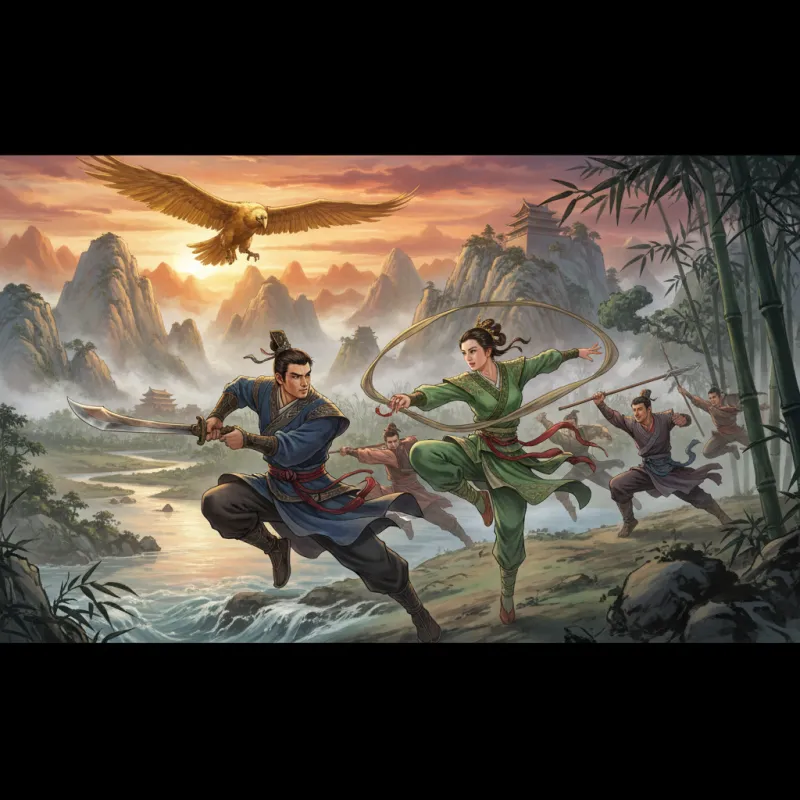
When Guo Jing stumbles into the Jiangnan Seven Freaks' ambush meant for someone else, he has no idea this accident will reshape the martial arts world for generations. Jin Yong's Legend of the Condor Heroes (射雕英雄传, Shè Diāo Yīngxióng Zhuàn) doesn't just tell a story—it establishes the blueprint that virtually every wuxia novel since 1957 has followed, borrowed from, or deliberately subverted.
Why This Novel Matters More Than You Think
Most readers approach Legend of the Condor Heroes as entertainment, but you're actually reading the text that codified modern wuxia conventions. Before Jin Yong serialized this novel from 1957 to 1959, martial arts fiction existed in fragmented forms—Republican-era pulp novels, opera adaptations, oral storytelling traditions. Jin Yong synthesized these elements and added something revolutionary: he grounded fantastical martial arts in meticulously researched Song Dynasty (1127-1279) history, creating a template where kung fu techniques feel plausible within their historical context.
The novel's influence extends beyond literature. Every Chinese period drama featuring martial arts, every video game with qi cultivation systems, every anime with training arcs—they're all downstream from innovations Jin Yong introduced here. The "stupid hero with a heart of gold" archetype? That's Guo Jing. The "brilliant but morally ambiguous rival"? Yang Kang established that template. Even the structure of having multiple martial arts schools with distinct philosophies traces directly to this novel's Quanzhen Sect (全真教, Quánzhēn Jiào), Peach Blossom Island (桃花岛, Táohuā Dǎo), and Beggar's Sect (丐帮, Gàibāng).
Reading Order and Translation Considerations
Here's where things get complicated. Legend of the Condor Heroes is the first book in Jin Yong's Condor Trilogy, followed by The Return of the Condor Heroes and The Heaven Sword and Dragon Saber. You absolutely must read them in order—the emotional payoff of seeing Guo Jing's descendants grapple with his legacy only works if you've invested in his journey first.
For English readers, Anna Holmwood's translation (published by St. Martin's Press, 2018-2019) represents the first complete official English version. Previous fan translations varied wildly in quality, often translating technique names inconsistently or flattening Jin Yong's deliberately archaic dialogue into modern English. Holmwood preserves the novel's tonal shifts—the comedic banter between the Jiangnan Seven Freaks, the formal court language, the poetic descriptions of martial arts techniques.
One warning: the novel spans four volumes in English, roughly 1,800 pages total. Jin Yong wrote for serialization, meaning some sections feel episodic while others rush toward climactic confrontations. The pacing reflects 1950s newspaper serial conventions—each installment needed a hook to bring readers back tomorrow. Modern readers sometimes find the middle sections of Volume 2 slow, but push through. The Peach Blossom Island arc and the final confrontation at Jiaxing justify every page.
Character Dynamics That Define the Genre
Guo Jing's defining trait isn't his eventual martial prowess—it's his stubborn integrity in a world that rewards cunning. He's deliberately written as slow-witted, requiring years to master techniques that geniuses learn in months. This frustrated 1950s readers accustomed to clever protagonists, but Jin Yong was making a point: moral character matters more than intellectual brilliance. Guo Jing becomes the greatest hero of his generation not despite his limitations, but because his simplicity prevents the moral compromises that corrupt more talented martial artists.
Huang Rong, his eventual partner, provides the perfect counterbalance—brilliant, manipulative when necessary, but ultimately guided by genuine affection rather than pure self-interest. Their relationship established the wuxia romance template: the earnest hero civilized by the clever woman who sees his potential before anyone else does. What makes their dynamic work is that Huang Rong never becomes merely supportive—she solves problems Guo Jing can't, manipulates situations he doesn't understand, and frequently saves him through intelligence rather than martial skill.
Yang Kang, Guo Jing's sworn brother and narrative foil, represents the novel's most psychologically complex character. Raised as Jin Dynasty royalty after his father's death, Yang Kang faces an impossible choice when he discovers his true Han Chinese heritage: embrace his blood family and lose everything he's known, or maintain his privileged position by denying his identity. Jin Yong refuses easy answers—Yang Kang's eventual villainy stems from understandable self-preservation instincts, making him tragic rather than simply evil. His arc directly influences how later wuxia novels handle questions of loyalty and identity.
The Martial Arts System Explained
Jin Yong's genius lies in creating martial arts that feel systematized without becoming mechanical. The novel introduces the concept of neigong (内功, nèigōng)—internal energy cultivation—as the foundation underlying all advanced techniques. Guo Jing's training arc demonstrates this principle: he learns the Eighteen Dragon-Subduing Palms (降龙十八掌, Jiàng Lóng Shíbā Zhǎng) relatively quickly, but spends years developing the internal power to use them effectively.
The novel's most influential martial arts concept is the Nine Yin Manual (九阴真经, Jiǔ Yīn Zhēnjīng), a legendary text containing the ultimate martial arts secrets. This established the "forbidden manual" trope that appears in virtually every subsequent wuxia work—the dangerous knowledge that grants immense power but corrupts those who pursue it obsessively. Jin Yong uses the Manual to explore how the same knowledge produces different results depending on the practitioner's character: Guo Jing uses it to enhance his defensive abilities and protect others, while villains who obtain fragments become increasingly unstable.
The novel also introduces the concept of martial arts "styles" reflecting philosophical worldviews. Quanzhen Sect techniques emphasize Taoist principles of balance and natural flow. Peach Blossom Island's martial arts incorporate mathematical precision and strategic thinking, reflecting founder Huang Yaoshi's scholarly background. The Beggar's Sect's Dog-Beating Staff Technique (打狗棒法, Dǎ Gǒu Bàng Fǎ) emphasizes adaptability and improvisation, matching the sect's pragmatic street-level perspective.
Historical Context and Political Subtext
Setting the novel during the Southern Song Dynasty wasn't arbitrary. Jin Yong wrote during the 1950s, when China was redefining its national identity after decades of foreign invasion and civil war. The Song Dynasty faced similar pressures—the Jin Dynasty (founded by Jurchen invaders) controlled northern China, forcing the Song court south. This historical parallel allowed Jin Yong to explore questions of collaboration versus resistance, national identity, and the cost of maintaining cultural integrity under foreign pressure.
Guo Jing's ultimate decision to defend Xiangyang against Mongol invasion (detailed more fully in the sequel) reflects these concerns. He chooses certain death defending a corrupt Song government because the alternative—allowing foreign conquest—violates his understanding of duty. Modern readers sometimes find this nationalism uncomfortable, but Jin Yong deliberately complicates it: many of Guo Jing's closest allies are Mongols, and the novel repeatedly shows Song officials as incompetent or corrupt. The point isn't blind patriotism but rather the tragedy of individuals caught between competing loyalties.
Reading Strategies for Maximum Enjoyment
First-time readers should resist the urge to skip training sequences. Jin Yong uses these sections to develop character relationships and philosophical themes, not just to power up protagonists. Guo Jing's time with the Seven Freaks establishes his loyalty to flawed mentors. His training with Hong Qigong teaches him that martial arts mastery requires joy and spontaneity, not just discipline. Each training arc reveals something essential about both student and teacher.
Pay attention to poetry and classical allusions. Jin Yong assumes readers recognize references to Tang Dynasty poetry, Confucian classics, and Taoist philosophy. Modern translations usually include footnotes, but understanding the cultural weight of these references deepens appreciation. When characters quote poetry during fights, they're not showing off—they're invoking shared cultural knowledge to communicate complex ideas efficiently.
Finally, read actively for the novel's humor. Jin Yong's comedy often gets lost in translation or overlooked by readers expecting pure action. The Jiangnan Seven Freaks' bickering, Hong Qigong's food obsession, Huang Rong's elaborate pranks—these moments provide essential tonal balance and reveal character depths that pure action scenes can't convey.
Legacy and Where to Go Next
After finishing Legend of the Condor Heroes, you'll understand references that permeate Chinese popular culture. The phrase "shooting eagles" (射雕, shè diāo) became shorthand for a certain type of heroic ideal. Peach Blossom Island inspired countless fictional martial arts sanctuaries. The Eighteen Dragon-Subduing Palms appears in everything from video games to modern wuxia novels as the archetypal "righteous hero" technique.
The immediate next step is The Return of the Condor Heroes, which deliberately subverts everything this novel establishes. Where Guo Jing represents conventional heroism, Yang Guo (Yang Kang's son) embodies the rebellious antihero who achieves greatness by breaking every rule his father's generation held sacred. The tonal shift is jarring but intentional—Jin Yong spent the sequel questioning the values he'd celebrated in this novel.
For readers who want to explore Jin Yong's evolution as a writer, Demi-Gods and Semi-Devils represents his mature style—more psychologically complex, more morally ambiguous, less concerned with clear heroes and villains. But start here, with Legend of the Condor Heroes. You're not just reading a novel; you're accessing the foundational text of modern Chinese popular culture.
Related Reading
- 12 Best Wuxia Novels for Beginners: Where to Start Reading
- The Smiling Proud Wanderer: A Story About Freedom
- Wuxia Web Novels: The Online Revolution in Martial Arts Fiction
- The Best Wuxia Novels for English Readers
- Classic vs. New Wuxia: How the Genre Evolved
- The Jade Palace of Kunlun: Home of the Queen Mother of the West
- Real Chinese Martial Arts Schools That Inspired Wuxia Fiction
- The Poison Arts: Wuxia Fiction's Most Feared Discipline
Explore Chinese Culture
- Explore Jin Yong's martial arts novels
- Explore cultivation fiction and immortal heroes
- Explore the real history behind wuxia