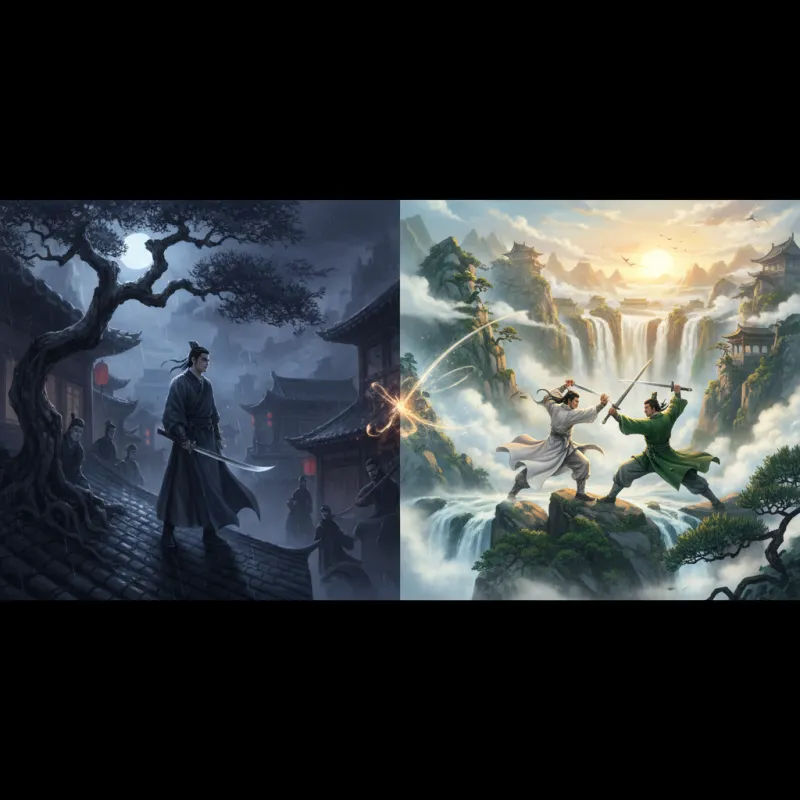
Ask any serious wuxia reader whether they prefer Jin Yong (金庸 Jīn Yōng) or Gu Long (古龙 Gǔ Lóng), and you'll witness something remarkable: they won't just answer — they'll defend their choice like a martial artist protecting their school's honor. This isn't literary criticism. It's identity. Because these two masters didn't just write different novels; they wrote different philosophies about what it means to be human in a world of swords.
The Fundamental Split
Jin Yong constructs universes. Gu Long captures moments.
When Jin Yong writes about the Beggar Sect (丐帮 Gàibāng) in The Legend of the Condor Heroes (射雕英雄传 Shèdiāo Yīngxióng Zhuàn), you get the sect's complete hierarchy, its history dating back to the Song Dynasty, the eighteen palm techniques passed down through generations, and the moral code that governs every member. When Gu Long writes about a beggar in The Sentimental Swordsman (多情剑客无情剑 Duōqíng Jiànkè Wúqíng Jiàn), you get three sentences about a man who drinks because remembering hurts too much.
Both approaches work. But they work on different parts of your soul.
Jin Yong's novels average 800,000 to 1,200,000 characters. Gu Long's rarely exceed 300,000. This isn't just about length — it's about philosophy. Jin Yong believes the world makes sense if you study it long enough. Gu Long believes the world is fundamentally unknowable, so why pretend otherwise?
The Hero Problem
Jin Yong's heroes earn their greatness through a clear progression system that would make any RPG designer jealous. Guo Jing (郭靖 Guō Jìng) starts as a slow-witted boy and becomes a legendary defender of Xiangyang through years of dedicated training under multiple masters. Yang Guo (杨过 Yáng Guò) transforms his grief into the Dismal Ecstasy Palm (黯然销魂掌 Ànrán Xiāohún Zhǎng). Zhang Wuji (张无忌 Zhāng Wújì) masters the Nine Yang Manual (九阳真经 Jiǔyáng Zhēnjīng) through systematic study.
Gu Long's heroes just are.
Li Xunhuan (李寻欢 Lǐ Xúnhuān) has his Little Li Flying Dagger (小李飞刀 Xiǎo Lǐ Fēidāo) — we never see him practice it, never learn where he got it, never watch him improve. He's already perfect, and that perfection is his tragedy. Chu Liuxiang (楚留香 Chǔ Liúxiāng) moves through the world with effortless grace, but we're never told how he acquired his skills. The mystery is the point.
This reflects a deeper divide: Jin Yong writes Confucian wuxia, where self-cultivation leads to mastery. Gu Long writes Daoist wuxia, where true skill transcends technique entirely. One is about becoming; the other is about being.
The Women Question
Here's where it gets uncomfortable for Jin Yong fans: his female characters, despite being numerous and often skilled, exist primarily in relation to male protagonists. Huang Rong (黄蓉 Huáng Róng) is brilliant, but her story revolves around Guo Jing. Xiao Longnu (小龙女 Xiǎo Lóngnǚ) is powerful, but defined by her relationship with Yang Guo. Even Zhao Min (赵敏 Zhào Mǐn), arguably his most independent female character, ultimately abandons her political ambitions for Zhang Wuji.
Gu Long's women are different — and not always in comfortable ways. They're more autonomous, more dangerous, more likely to have their own agendas that have nothing to do with romance. Sun Xiuqing (孙秀青 Sūn Xiùqīng) in The Eleventh Son (萧十一郎 Xiāo Shíyī Láng) makes choices that serve her own survival, not her heart. Lin Xian'er (林仙儿 Lín Xiān'ér) in Juedai Shuangjiao (绝代双骄 Juédài Shuāngjiāo) is manipulative, cruel, and utterly compelling — a character who would be impossible in Jin Yong's moral universe.
But Gu Long also writes more male gaze, more objectification, more casual sexism in his prose. His women have agency, but they're often viewed through a lens that modern readers find troubling. Jin Yong's women are idealized; Gu Long's are sexualized. Pick your poison.
The Prose Itself
Jin Yong writes in elegant, classical Chinese that flows like a river — measured, clear, building momentum through accumulation. His fight scenes are choreographed ballets where you can visualize every move. When Qiao Feng (乔峰 Qiáo Fēng) fights at Juxian Manor in Demi-Gods and Semi-Devils (天龙八部 Tiānlóng Bābù), Jin Yong gives you a blow-by-blow account spanning pages, each technique named and described.
Gu Long writes like he's being charged by the word and can't afford to waste any. His sentences are short. Brutal. Impressionistic. A fight scene might be: "The blade moved. Blood appeared. Someone fell." That's it. That's the whole fight. And somehow it's more visceral than Jin Yong's elaborate choreography because your imagination fills in the violence.
This stylistic difference mirrors their view of combat itself. Jin Yong sees martial arts as a discipline with rules, forms, and beauty. Gu Long sees it as murder dressed up in fancy clothes. In Jin Yong's world, the Eighteen Dragon-Subduing Palms is a noble technique with a proud lineage. In Gu Long's world, a knife in the back is just as effective and far more honest.
The Morality Question
Jin Yong's universe has a moral center, even when characters struggle to find it. There are righteous sects (正派 zhèngpài) and evil sects (邪派 xiépài), and while individuals might blur the lines, the categories themselves remain stable. The Wudang Sect (武当派 Wǔdāng Pài) represents Daoist virtue; the Ming Cult (明教 Míngjiào) might be misunderstood but ultimately fights for justice.
Gu Long burns down the entire moral framework and dances in the ashes.
In his world, the "righteous" martial artists are often the most hypocritical, hiding cruelty behind noble rhetoric. The "villains" might be the only honest people in the room. Li Xunhuan's greatest enemy isn't some evil overlord — it's his own loyalty to a friend who betrayed him. Chu Liuxiang's adventures reveal that the respectable members of the jianghu (江湖 jiānghú) are often worse than the thieves and assassins.
This isn't moral relativism; it's moral realism. Gu Long suggests that the real evil isn't in breaking the rules — it's in pretending the rules mean anything when power is what actually matters.
The Ending Problem
Jin Yong gives you closure. His novels end with weddings, reunions, the restoration of order. Even when there's tragedy — and there often is — it feels meaningful, part of a larger pattern. The Return of the Condor Heroes (神雕侠侣 Shéndiāo Xiálǚ) ends with Yang Guo and Xiao Longnu reunited after sixteen years. Demi-Gods and Semi-Devils ends with Duan Yu (段誉 Duàn Yù) becoming emperor and Xu Zhu (虚竹 Xūzhú) finding unexpected happiness.
Gu Long gives you ambiguity. His novels often end mid-scene, with the hero walking away into uncertainty. Li Xunhuan rides off alone. Chu Liuxiang disappears into the night. The problems aren't solved; they're just... over. Because that's how life works. You don't get resolution; you get the next morning.
Some readers find this unsatisfying. Others find it the only honest way to end a story about violence and loss.
Why This Matters
The Jin Yong vs. Gu Long debate isn't about which writer is "better" — it's about what you need from fiction. Do you want to believe that effort is rewarded, that good people can triumph through persistence and virtue, that the world has an underlying order? Read Jin Yong. His novels are comfort food for the soul, epic and satisfying and ultimately hopeful.
Do you want to be told the truth, even when it hurts? Do you want prose that cuts like a blade, characters who fail despite their best efforts, a world that doesn't care about your moral categories? Read Gu Long. His novels are whiskey at midnight — harsh, intoxicating, and impossible to forget.
The greatest readers of wuxia fiction read both. Because Jin Yong teaches you how the world should be, and Gu Long teaches you how it is. You need both visions to understand the genre, just as you need both hope and realism to navigate life.
The real question isn't which master you prefer. It's which one you need right now.
Related Reading
- 12 Best Wuxia Novels for Beginners: Where to Start Reading
- Legend of the Condor Heroes: A Complete Reading Guide
- The Best Wuxia Novels for English Readers
- The Smiling Proud Wanderer: A Story About Freedom
- The Allure of Wuxia: Exploring Chinese Martial Arts Fiction and Jianghu Culture
- Chinese Mythology in Hollywood: From Mulan to Shang-Chi
- The Hetu and Luoshu: Magical Diagrams from the Rivers
- The Real History Behind Wuxia: Knight-Errants of Ancient China
Explore Chinese Culture
- Explore Jin Yong's martial arts novels
- Explore cultivation fiction and immortal heroes
- Explore the real history behind wuxia