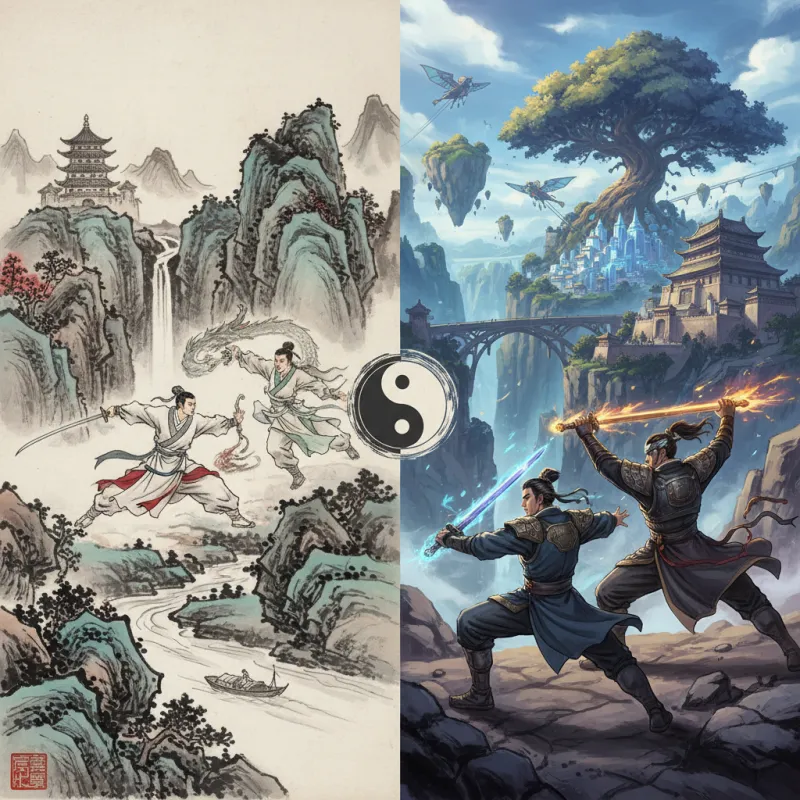
The first time I read The Legend of the Condor Heroes (射雕英雄传 Shèdiāo Yīngxióng Zhuàn), I thought I understood wuxia. Then I picked up Grandmaster of Demonic Cultivation (魔道祖师 Mó Dào Zǔ Shī), and realized the genre had shape-shifted while I wasn't looking. Same martial arts, same jianghu (江湖 jiānghú, the martial world), but the DNA had been rewritten. The question isn't whether wuxia evolved — it's whether what we're reading now is still the same species.
The Classical Foundation: 1954-1985
When people talk about "real" wuxia, they usually mean the trinity: Jin Yong (金庸 Jīn Yōng), Gu Long (古龙 Gǔ Lóng), and Liang Yusheng (梁羽生 Liáng Yǔshēng). These three authors, writing primarily between the 1950s and 1980s, established the conventions that still define the genre.
Jin Yong's The Condor Trilogy gave us the template: a young nobody discovers hidden martial arts manuals, trains under eccentric masters, gets entangled in sect politics, and eventually becomes powerful enough to reshape the jianghu. His protagonists were moral paragons — Guo Jing (郭靖 Guō Jìng) was almost painfully righteous, Yang Guo (杨过 Yáng Guò) rebelled but ultimately chose the heroic path. The martial arts were grounded in real Chinese martial traditions, even when they became fantastical. The sects and factions had clear hierarchies, ancient histories, and recognizable philosophies drawn from Buddhism, Daoism, and Confucianism.
Gu Long took a different approach. His heroes were cynical, his plots were noir mysteries dressed in silk robes, and his martial arts were impressionistic rather than technical. When Li Xunhuan (李寻欢 Lǐ Xúnhuān) threw his flying dagger in Sentimental Swordsman, Ruthless Sword (多情剑客无情剑 Duōqíng Jiànkè Wúqíng Jiàn), Gu Long didn't describe the mechanics — he described the inevitability. The dagger never missed. That was all you needed to know.
Classical wuxia had rules. Power levels were relatively consistent. A master was a master because of decades of training, not because they absorbed some ancient spirit. Magic existed, but it was called qigong (气功 qìgōng) and had pseudo-scientific explanations involving meridians and internal energy. Death was permanent. The jianghu was dangerous, but it made sense.
The Web Novel Revolution: 2000s Onward
Then the internet happened, and everything went sideways.
Chinese web novels (网络小说 wǎngluò xiǎoshuō) didn't just change wuxia — they detonated it and rebuilt it from fragments. The new model was xianxia (仙侠 xiānxiá, immortal heroes), xuanhuan (玄幻 xuánhuàn, mysterious fantasy), and a dozen other subgenres that borrowed wuxia's aesthetics while abandoning its constraints.
Coiling Dragon (盘龙 Pánlóng) by I Eat Tomatoes, published starting in 2008, exemplifies the shift. The protagonist Linley starts as a talented youth, but by the end of the series, he's literally a god who can destroy universes. The power scaling is exponential. The martial arts become cosmic forces. The jianghu expands to include multiple dimensions, divine realms, and reincarnation mechanics borrowed from cultivation novels.
This is where purists start screaming. "That's not wuxia!" they say. "That's power fantasy with Chinese characteristics!"
They're not entirely wrong. Web novels operate on different economics than newspaper serials. Jin Yong wrote The Condor Heroes in installments over several years, but he knew roughly where he was going. Web novelists often write daily chapters, responding to reader feedback in real-time, stretching stories to millions of characters because that's what the platform rewards. The result is scope creep on a cosmic scale.
But here's the thing: the core appeal remains. A protagonist who starts weak and becomes strong through training and adversity. A complex world with its own rules and hierarchies. Martial techniques with poetic names. Loyalty, betrayal, revenge, and honor. The weapons might now be divine artifacts instead of well-forged swords, but they still have names and histories.
What Changed, What Stayed
The most obvious difference is power scaling. Classical wuxia heroes could defeat dozens of opponents, maybe hundreds if they were truly exceptional. Modern protagonists count their defeated enemies in thousands, then millions, then lose track entirely when they ascend to higher realms.
The romance dynamics shifted too. Jin Yong's heroes usually ended up with one woman after much angst and misunderstanding. Modern web novels often feature harems, or at least multiple romantic interests who stick around for hundreds of chapters. The gender politics are... complicated. Some modern works like Grandmaster of Demonic Cultivation subvert expectations entirely with queer relationships. Others double down on regressive tropes.
The relationship with history changed. Classical wuxia was often set in specific dynasties — Song, Ming, Qing — with real historical figures making cameo appearances. Modern works either create entirely fictional worlds or set stories in vague "ancient China" that borrows aesthetics without historical specificity. The jianghu became less about the actual rivers and lakes of China and more about a fantasy realm that happens to use Chinese cultural signifiers.
But the emotional core? That stayed. The moment when a master passes their ultimate technique to a worthy student. The betrayal that shatters a sect. The duel at dawn between rivals who respect each other. The sacrifice that saves the jianghu from destruction. These beats still land, whether they're happening in a Song Dynasty teahouse or on a floating immortal mountain.
The Adaptation Feedback Loop
Here's where it gets interesting: the evolution wasn't linear. Film and television adaptations kept pulling the genre back toward its classical roots even as web novels pushed toward cosmic power fantasy.
The 2017 adaptation of The King's Avatar (全职高手 Quánzhí Gāoshǒu) — technically not wuxia but using all its tropes in an esports setting — showed that audiences still responded to classical narrative structures. The 2019 live-action version of Grandmaster of Demonic Cultivation toned down the power levels and emphasized character relationships over cosmic battles.
Meanwhile, classical works kept getting adapted with modern sensibilities. The 2017 Legend of the Condor Heroes remake gave Huang Rong (黄蓉 Huáng Róng) more agency and made the romance less one-sided. The 2021 Word of Honor (山河令 Shānhé Lìng) adaptation leaned into the queer subtext that classical wuxia only hinted at.
The genre is in constant conversation with itself. Modern authors reference Jin Yong the way Western fantasy authors reference Tolkien — sometimes to honor, sometimes to subvert. Classical works get reinterpreted through modern lenses. The boundary between "classical" and "new" becomes increasingly porous.
The International Factor
Wuxia's global spread through translation platforms like Wuxiaworld and Webnovel introduced another variable: international readers who came to the genre without cultural context or nostalgia for the classics.
For these readers, Coiling Dragon or Martial God Asura (修罗武神 Xiūluó Wǔshén) might be their first exposure to Chinese martial arts fiction. They don't know that power levels used to be more restrained, that the jianghu used to be geographically specific, that cultivation to immortality wasn't always the end goal. They accept the genre as they find it.
This created a feedback loop. Chinese authors, seeing international success, started incorporating elements that worked for global audiences. More explicit power systems. Clearer progression mechanics. Less reliance on cultural knowledge that doesn't translate. The genre evolved to be more accessible, which some see as dilution and others see as natural adaptation.
What We Lost, What We Gained
I won't pretend nothing was lost in the evolution. Classical wuxia had a groundedness that modern works often lack. When Jin Yong described the Eighteen Dragon-Subduing Palms (降龙十八掌 Jiàng Lóng Shíbā Zhǎng), you could almost believe a real martial artist might perform something like it with enough training. When a modern protagonist learns the "Heaven-Destroying Earth-Shattering Chaos Annihilation Fist," you know we've left realism behind.
The pacing changed too. Classical wuxia took time to develop characters, relationships, and themes. Modern web novels, optimized for daily chapter releases and reader retention, often prioritize constant action and progression over depth. The quiet moments — a conversation over tea, a description of landscape, a meditation on honor — get compressed or eliminated.
But we gained scope and ambition. Modern wuxia isn't afraid to ask "what comes after mastery?" Classical heroes reached the peak of martial arts and the story ended. Modern protagonists reach that peak and discover it's just the beginning. There are always higher realms, stronger opponents, deeper mysteries. Whether this is profound or exhausting depends on your tolerance for escalation.
We gained diversity too. Classical wuxia was dominated by heterosexual male protagonists. Modern works include female leads, queer relationships, and protagonists from different social classes and backgrounds. The jianghu expanded to include voices that were marginalized in the classical canon.
Still the Same River
Here's my conclusion after reading both classical masterpieces and modern web novels that stretch to millions of words: wuxia didn't evolve into something else. It did what it's always done — adapted to new media, new audiences, new cultural moments while keeping its essential spirit.
The genre has always been about transformation. Weak becoming strong. Commoners becoming heroes. Outcasts finding belonging. The specific mechanics change — whether you're learning the Nine Yang Divine Skill (九阳神功 Jiǔ Yáng Shénggōng) or cultivating through nine heavenly tribulations — but the emotional journey remains.
Classical wuxia and modern wuxia aren't opposing forces. They're points on a continuum that stretches back to Tang Dynasty martial arts tales and forward to whatever form the genre takes next. The jianghu is still the jianghu, even when it includes immortal realms and parallel dimensions. The code of xia (侠 xiá, martial heroism) still matters, even when the heroes can split mountains with their swords.
The genre that refuses to die keeps refusing. And every time it transforms, it carries something essential forward while leaving room for something new. That's not evolution away from wuxia's roots — that's the most wuxia thing possible.
Related Reading
- Wuxia Web Novels: The Online Revolution in Martial Arts Fiction
- 12 Best Wuxia Novels for Beginners: Where to Start Reading
- Legend of the Condor Heroes: A Complete Reading Guide
- The Allure of Wuxia: Exploring Chinese Martial Arts Fiction and Jianghu Culture
- Demi-Gods and Semi-Devils: Themes of Identity and Fate
- Qinggong: The Art of Lightness in Wuxia Fiction
- The Jianghu Code: Unwritten Rules That Govern the Martial World
- The Heavenly Sword and Dragon Saber: Twin Weapons of Destiny
Explore Chinese Culture
- Explore Jin Yong's martial arts novels
- Explore cultivation fiction and immortal heroes
- Explore the real history behind wuxia