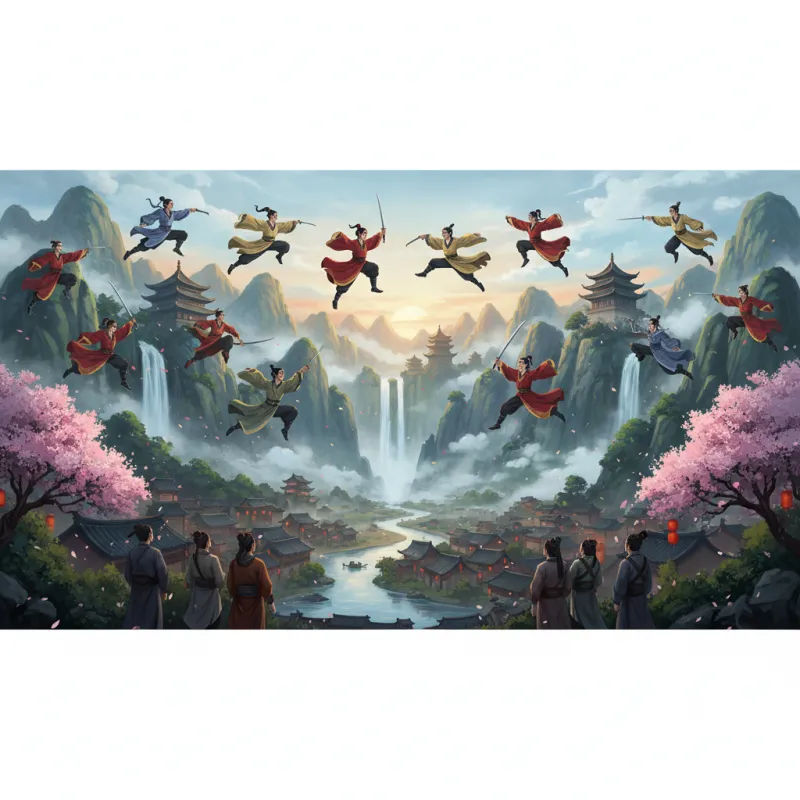
You've just discovered wuxia novels, and someone tells you to start with The Smiling, Proud Wanderer. Three hundred pages later, you're drowning in sect politics, wondering who's betraying whom, and why everyone keeps talking about "orthodox" versus "unorthodox" martial arts. Here's the truth: not all wuxia classics make good entry points. The best novels for beginners balance accessibility with the genre's essential elements—martial arts philosophy, jianghu (江湖, jiānghú) culture, and that addictive blend of action and romance that's kept readers hooked since the 1950s.
What Makes a Good Beginner Wuxia Novel?
Before diving into specific recommendations, let's establish criteria. A beginner-friendly wuxia novel should have a clear protagonist arc—you need someone to root for from page one. It should introduce core concepts like internal energy (内力, nèilì) and martial arts sects without assuming prior knowledge. Most importantly, it needs a strong English translation. I've seen readers bounce off brilliant novels simply because the translation was clunky or incomplete.
The ideal starter novel also avoids excessive political intrigue. Works like Demi-Gods and Semi-Devils are masterpieces, but they juggle dozens of characters across multiple kingdoms. Save those for when you've got your bearings.
The Absolute Best: Legend of the Condor Heroes
Jin Yong's Legend of the Condor Heroes (射雕英雄传, Shèdiāo Yīngxióng Zhuàn, 1957) is the definitive starting point, and I'll die on this hill. The protagonist, Guo Jing, begins as a simple-minded boy on the Mongolian steppes—no special bloodline, no hidden genius. He succeeds through sheer determination and moral integrity, which makes his journey deeply satisfying.
The novel's structure is perfect for newcomers. Each section introduces new martial arts styles and philosophies organically. When Guo Jing learns the Eighteen Dragon-Subduing Palms (降龙十八掌, jiàng lóng shíbā zhǎng), you learn alongside him. The romance with Huang Rong, a clever beggar-princess, adds emotional depth without overwhelming the martial arts core.
Anna Holmwood's English translation captures Jin Yong's accessible prose style. At roughly 1,200 pages, it's substantial but never drags. The historical backdrop—the Mongol conquest of China in the 13th century—provides context without requiring a history degree. This is the novel that launched Jin Yong's career and defined modern wuxia. Start here.
For Readers Who Want Faster Pacing: Crouching Tiger, Hidden Dragon
Wang Dulu's Crouching Tiger, Hidden Dragon (卧虎藏龙, Wòhǔ Cáng Lóng, 1941) offers a leaner introduction to wuxia. At under 400 pages, it moves quickly while hitting all the genre's key notes: forbidden romance, stolen swords, rooftop duels, and the tension between personal desire and martial code.
The film adaptation made this story famous in the West, but the novel provides richer character psychology. Li Mubai's internal conflict—between his love for Yu Xiulian and his duty to the jianghu—feels genuinely tragic. Jen Yu, the rebellious aristocrat who steals the Green Destiny sword, embodies the genre's fascination with characters who reject societal expectations.
This novel works brilliantly as a gateway because it's essentially a character study wrapped in martial arts action. If you're coming from literary fiction and worry wuxia might be too pulpy, start here. The prose is elegant, the themes are mature, and you'll finish it in a weekend.
The Dark Horse: Heaven Sword and Dragon Saber
Here's a controversial take: Heaven Sword and Dragon Saber (倚天屠龙记, Yǐtiān Túlóng Jì, 1961) might be a better starting point than its predecessor, Legend of the Condor Heroes. Yes, it's technically the third book in Jin Yong's Condor trilogy, but it stands alone beautifully.
Zhang Wuji, the protagonist, grows up poisoned and powerless—a stark contrast to typical wuxia heroes. His journey from victim to leader of the Ming Cult feels earned. The novel also features Jin Yong's most complex female characters. Zhou Zhiruo's transformation from innocent girl to ruthless sect leader remains one of the genre's most compelling character arcs.
What makes this particularly beginner-friendly is its structure around the two legendary weapons: the Heaven-Relying Sword and Dragon-Slaying Saber. This central mystery provides a clear narrative thread even when the plot branches into sect politics. The English translation by Minford and Chang is excellent, though be warned—at 1,800+ pages across four volumes, this is a commitment.
For Readers Who Love Antiheroes: The Book and the Sword
Jin Yong's debut novel, The Book and the Sword (书剑恩仇录, Shūjiàn Ēnchóu Lù, 1955), takes a different approach. The Red Flower Society, a band of martial artists fighting Manchu rule in 18th-century China, operates more like a revolutionary cell than a traditional sect. The protagonist, Chen Jialuo, must choose between his brotherhood and his blood—the Qianlong Emperor is secretly his brother.
This novel works for beginners because the stakes are immediately clear: overthrow the Qing dynasty. No need to understand complex sect hierarchies or ancient grudges. The martial arts are grounded and tactical rather than supernatural. When characters fight, they use terrain, weapons, and strategy—not just overwhelming internal energy.
The political intrigue might seem dense, but it's actually more accessible than pure jianghu politics. Everyone understands rebellion against tyranny. The romance between Chen Jialuo and the Kazakh princess Huo Qingtong adds cross-cultural dimension that feels fresh even today.
Gu Long's Alternative: The Eleventh Son
If Jin Yong's detailed world-building doesn't grab you, try Gu Long's The Eleventh Son (萧十一郎, Xiāo Shíyī Láng, 1970). Gu Long writes wuxia like hardboiled detective fiction—terse prose, moral ambiguity, and protagonists who drink too much.
Xiao Shiyilang is a bandit who steals the割鹿刀 (Gēlù Dāo, Deer-Carving Saber), triggering a jianghu-wide manhunt. Unlike Jin Yong's heroes, Xiao doesn't grow through training montages. He survives through cunning and luck. The novel's cynical view of martial arts sects—as corrupt institutions protecting their power—offers a refreshing counterpoint to Jin Yong's more romantic vision.
At roughly 300 pages, this is the quickest entry point on this list. Gu Long's style influenced modern Chinese crime fiction and web novels. If you're interested in how wuxia evolved into xianxia, understanding Gu Long's innovations is essential.
The Modern Gateway: Legends of the Condor Heroes (Manga Adaptation)
Not ready to commit to a thousand-page novel? The manga adaptation of Legend of the Condor Heroes by Wee Tian Beng and Jin Yong provides a visual introduction to wuxia's core concepts. The artwork captures the kinetic energy of martial arts combat while preserving Jin Yong's character development.
This isn't a substitute for the novel, but it's an excellent preview. The visual medium makes complex fight choreography easier to follow. When Huang Rong uses the Dog-Beating Staff technique (打狗棒法, dǎgǒu bàng fǎ), you see exactly how the moves flow together. The manga also condenses the story to about 800 pages across multiple volumes—still substantial, but more manageable.
For readers who struggle with prose descriptions of martial arts, this format bridges the gap. Read the manga first, then tackle the novel. You'll have visual references for characters and locations, making the prose version easier to navigate.
What to Read After Your First Wuxia Novel
Once you've finished your starter novel, the genre opens up. If you loved Legend of the Condor Heroes, continue with Return of the Condor Heroes (神雕侠侣, Shéndiāo Xiálǚ)—though be prepared for a darker, more controversial romance. If Gu Long's style clicked, try The Legend of Lu Xiaofeng (陆小凤传奇, Lù Xiǎofèng Chuánqí), which reads like wuxia meets Sherlock Holmes.
For readers ready to explore the philosophical depths of martial arts, Jin Yong's The Smiling, Proud Wanderer (笑傲江湖, Xiào'ào Jiānghú) examines power, orthodoxy, and freedom through the story of Linghu Chong, a swordsman who refuses to play by sect rules.
The key is matching your second novel to what you loved about your first. Loved the romance? Try The Romance of the Fox Volant (雪山飞狐, Xuěshān Fēihú). Preferred the historical setting? The Duke of Mount Deer (鹿鼎记, Lùdǐng Jì) blends wuxia with Qing dynasty court intrigue. Wanted more female protagonists? Liang Yusheng's The Bride with White Hair (白发魔女传, Báifà Mónǚ Zhuàn) centers on Lian Nishang, one of wuxia's most iconic heroines.
Why These Novels Still Matter
Wuxia novels from the 1950s-1970s might seem dated, but they established narrative patterns that dominate Chinese popular fiction today. The cultivation novels flooding webnovel platforms? They're wuxia's descendants, replacing martial arts with immortal cultivation. The "leveling up" structure in progression fantasy? Jin Yong was doing that in 1957.
These classics also preserve a vision of jianghu culture that's increasingly distant from modern China. The code of honor, the emphasis on loyalty over law, the belief that martial arts mastery reflects moral cultivation—these ideas shaped Chinese cultural identity for generations. Reading wuxia isn't just entertainment; it's understanding a worldview.
Start with Legend of the Condor Heroes. Give it a hundred pages. If Guo Jing's earnest determination doesn't win you over, try Gu Long's cynical bandits or Wang Dulu's tragic romance. There's a wuxia novel for every reader. The genre's survived for over a century because it offers something prose fiction rarely delivers: the visceral thrill of physical mastery combined with genuine emotional depth. Once you find your entry point, you'll understand why millions of readers have spent decades in the jianghu, and why they never really leave.
Related Reading
- Classic vs. New Wuxia: How the Genre Evolved
- Gu Long vs. Jin Yong: Two Masters, Two Visions of Wuxia
- The Smiling Proud Wanderer: A Story About Freedom
- Wuxia Web Novels: The Online Revolution in Martial Arts Fiction
- Demi-Gods and Semi-Devils: Themes of Identity and Fate
- Confucianism and Daoism in Wuxia: The Philosophical Heart of Martial Fiction
- Sects and Clans in Wuxia: The Organizations That Rule the Martial World
- Exploring the Evolution of Wuxia: Modern Influences on Chinese Martial Arts Fiction
Explore Chinese Culture
- Explore Jin Yong's martial arts novels
- Explore cultivation fiction and immortal heroes
- Explore the real history behind wuxia