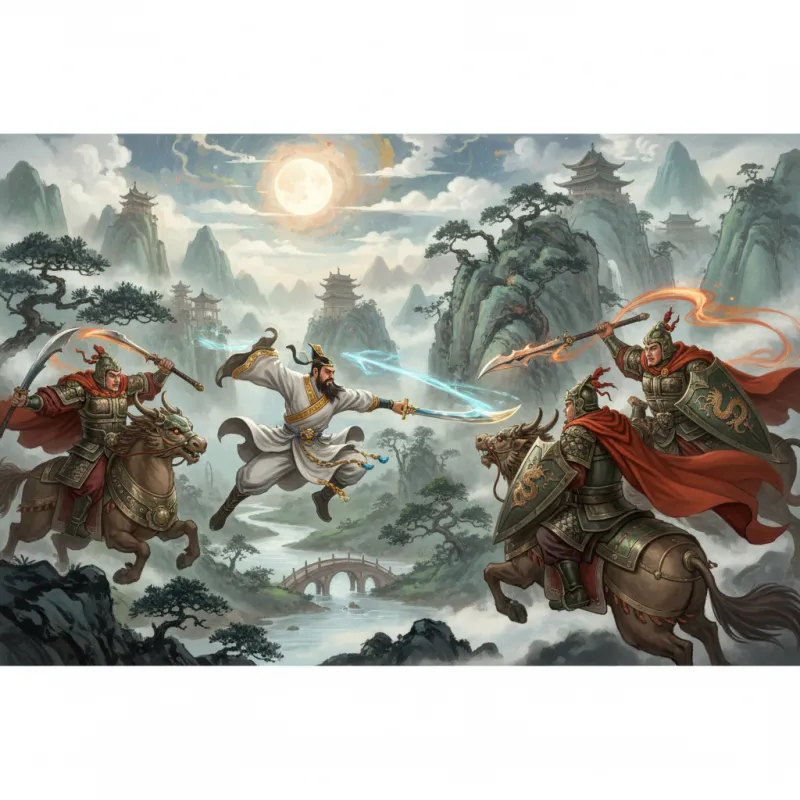
When lightning splits the sky above a corrupt magistrate's mansion, it's not random chance — it's a bureaucratic decision. Somewhere in the celestial hierarchy, a form was filed, a warrant was issued, and a divine warrior was dispatched with orders to execute judgment. The Daoist pantheon doesn't just govern through moral persuasion; it maintains order through an elaborate military apparatus that would make any earthly empire jealous. These aren't the serene immortals of meditation halls. These are heaven's enforcers, and they carry weapons.
The Thunder Ministry: Heaven's Executioners
The Ministry of Thunder (雷部 Léi Bù) operates as heaven's most direct instrument of violence. While other celestial departments handle administrative matters — recording lifespans, managing reincarnation queues, auditing merit — the Thunder Ministry specializes in one thing: punishment that cannot be ignored. When a mortal's crimes exceed what earthly justice can address, when demons grow too bold, when the cosmic order itself faces disruption, the Thunder Ministry deploys.
Lei Gong (雷公 Léi Gōng), the Thunder Duke himself, commands this operation. Classical texts depict him as a creature of primal force — blue-skinned, winged, wielding a hammer and chisel that generate thunderbolts. He's not a refined scholar-official. He's the divine equivalent of a special forces commander, and his jurisdiction covers everything from striking down oath-breakers to demolishing demon strongholds. The Fengshen Yanyi (封神演義 Fēngshén Yǎnyì), that sprawling Ming dynasty epic of divine warfare, shows Lei Gong in action during the cosmic conflict that established the current celestial order. He doesn't negotiate.
Working under Lei Gong is Dian Mu (電母 Diàn Mǔ), the Lightning Mother, who illuminates targets with her mirrors before Lei Gong strikes. It's a two-stage weapons system: she marks, he destroys. Then there's Feng Bo (風伯 Fēng Bó), the Wind Earl, and Yu Shi (雨師 Yǔ Shī), the Rain Master, who control the atmospheric conditions necessary for the Thunder Ministry's operations. This isn't mythology — it's military doctrine translated into divine bureaucracy.
The Celestial Masters: Exorcists with Authority
The Celestial Masters (天師 Tiānshī) tradition, founded by Zhang Daoling (張道陵 Zhāng Dàolíng) in 142 CE, established something revolutionary: a religious hierarchy that could command celestial forces through proper ritual authority. Zhang Daoling didn't just meditate his way to enlightenment. According to tradition, he received direct military commissions from Laozi himself, including registers of divine generals, talismans that functioned as command seals, and the authority to deploy heavenly troops against demonic forces.
This wasn't symbolic. The early Celestial Masters operated as a theocratic state in Sichuan, complete with administrative districts, tax collection, and military organization. When they performed exorcisms, they weren't begging spirits to leave — they were issuing eviction notices backed by celestial military force. The talismans they created functioned as requisition forms, summoning specific divine warriors for specific tasks. A Celestial Master conducting a ritual was essentially a field officer calling in air support.
The 63rd generation Celestial Master still holds this title today, maintaining an unbroken lineage that spans nearly two millennia. The position carries real authority within Daoist communities, and the rituals preserve that original military framework. When a contemporary Celestial Master performs a jiao (醮 jiào) ritual, they're not just praying — they're activating command structures that predate most world religions.
The Four Heavenly Kings: Border Guards of Reality
The Four Heavenly Kings (四大天王 Sì Dà Tiānwáng) guard the cardinal directions, but their role extends beyond simple border patrol. These figures, borrowed from Buddhist cosmology and thoroughly integrated into Daoist practice, represent the principle that cosmic order requires constant military vigilance. Each king commands legions of divine soldiers and specializes in different aspects of supernatural warfare.
Virudhaka (增長天王 Zēngzhǎng Tiānwáng), Guardian of the South, wields a sword and oversees spiritual growth — but "growth" here means expansion of righteous territory, not personal development seminars. Dhrtarastra (持國天王 Chíguó Tiānwáng), Guardian of the East, plays a pipa that can shatter demonic formations. Virupaksa (廣目天王 Guǎngmù Tiānwáng), Guardian of the West, sees through illusions with his thousand eyes and carries a serpent or pearl. Vaisravana (多聞天王 Duōwén Tiānwáng), Guardian of the North, commands wealth and fortune but also leads armies against yaksha demons.
These aren't passive sentinels. In Journey to the West (西遊記 Xīyóu Jì), they actively participate in military operations against Sun Wukong and later assist in protecting Tang Sanzang. They represent the Daoist understanding that maintaining cosmic order requires both defensive fortifications and offensive capabilities. The boundaries they guard aren't just geographical — they're ontological barriers between different realms of existence.
Marshal Ma and the Celestial Cavalry
Marshal Ma (馬元帥 Mǎ Yuánshuài), also known as Ma Lingguan, commands heaven's cavalry forces with three eyes that see past, present, and future simultaneously. His third eye isn't decorative — it's a tactical advantage that allows him to anticipate demonic movements and coordinate complex military operations across multiple dimensions. He carries a golden brick that can expand to crush demons and a demon-binding rope that functions as both weapon and restraint system.
What makes Marshal Ma particularly interesting is his origin story. Unlike many celestial warriors who were born divine or achieved immortality through cultivation, Ma was a human general who proved so effective at demon suppression that heaven recruited him directly. His promotion demonstrates the Daoist principle that the celestial bureaucracy operates as a meritocracy — competence matters more than origin. If you can get results, heaven will give you command authority.
Marshal Ma frequently appears in Daoist exorcism rituals, particularly those dealing with possession or haunting. Priests invoke him not as a distant deity but as a commanding officer who can deploy troops to secure a location. The ritual texts specify his rank, his jurisdiction, and the types of forces he can mobilize. This precision reflects the underlying logic: you don't just ask for help, you file a proper request through military channels.
The Generals of the Five Directions
The Five Direction Generals (五方將軍 Wǔfāng Jiāngjūn) represent a more specialized force structure, with each general commanding troops aligned with one of the five phases (wuxing): wood, fire, earth, metal, and water. This isn't just elemental magic — it's a sophisticated understanding of how different types of spiritual threats require different tactical responses.
The Eastern General commands wood-phase forces, effective against demons that feed on anger and aggression. The Southern General leads fire-phase troops, specializing in purification and the destruction of pollution-based entities. The Central General coordinates earth-phase operations, dealing with hauntings tied to specific locations. The Western General deploys metal-phase warriors against shape-shifters and illusion-casters. The Northern General commands water-phase forces that excel at pursuing fleeing demons and conducting operations in aquatic environments.
This system appears throughout Daoist ritual texts, where priests must correctly identify the nature of a spiritual threat before invoking the appropriate general. Calling in the wrong specialist wastes resources and might prove ineffective. It's military doctrine applied to supernatural warfare, and it reveals how seriously Daoism takes the practical mechanics of cosmic order maintenance.
Divine Warriors in Wuxia Fiction
Modern wuxia fiction has thoroughly absorbed these celestial military concepts, though often with creative reinterpretation. In Fengshen Yanyi, the entire narrative revolves around a massive recruitment drive to staff heaven's military positions — the封神 (fēngshén, "Investiture of the Gods") that gives the novel its name. Characters who die in the mortal conflict get promoted to celestial military ranks based on their abilities and achievements. It's simultaneously a war story and a divine HR process.
Contemporary wuxia novels frequently feature protagonists who discover they're reincarnations of celestial warriors or who gain access to heavenly military techniques. The Daoist cultivation systems in these stories often include methods for summoning divine generals or channeling their martial techniques. Some novels explore what happens when celestial warriors go rogue or when the heavenly bureaucracy becomes corrupt — scenarios that resonate precisely because the original mythology established such clear hierarchies and rules.
The appeal is obvious: these aren't vague spiritual forces but specific individuals with defined capabilities, ranks, and jurisdictions. A writer can deploy Marshal Ma in a scene with the same tactical precision that the character himself uses in battle. The celestial military provides a framework that's both mythologically rich and narratively functional.
The Logic of Divine Violence
What makes the Daoist celestial military fascinating is its underlying assumption: the universe requires active enforcement. Unlike religious systems that emphasize divine mercy or karmic inevitability, Daoism's heavenly warriors represent the principle that cosmic order doesn't maintain itself. Demons must be suppressed. Violations must be punished. Boundaries must be defended.
This isn't cruelty — it's cosmic hygiene. The Thunder Ministry doesn't strike randomly; it executes warrants issued through proper bureaucratic channels. The Celestial Masters don't command divine troops for personal gain; they operate under strict ritual protocols that limit their authority. Even the most violent divine warriors function within a legal framework that, in theory, prevents abuse.
The system reflects a deeply pragmatic worldview: heaven governs through the same mechanisms that earthly empires use — administration, hierarchy, and when necessary, military force. The difference is that heaven's military operates with perfect intelligence, incorruptible officers, and weapons that can strike across dimensional boundaries. It's the empire that Confucian scholars dreamed about, projected onto the cosmos and staffed with immortals.
When lightning strikes a corrupt official's mansion, it's not divine wrath in the abstract. It's Lei Gong executing a specific order, issued by a specific celestial department, for specific violations of cosmic law. The system has paperwork. It has chain of command. It has rules of engagement. And that, perhaps, is the most distinctly Chinese thing about it — the conviction that even heaven needs a well-organized military to function properly.
Related Reading
- The Three Pure Ones: Supreme Deities of Daoism
- The Mountain Gods: Nature Deities in the Daoist Pantheon
- The Best Wuxia Novels for English Readers
- Tragic Heroes of Wuxia: When Honor Leads to Destruction
- Hua Mulan and the Wuxia Tradition of Women Warriors
Explore Chinese Culture
- Explore Jin Yong's martial arts novels
- Explore cultivation fiction and immortal heroes
- Explore the real history behind wuxia